Home > Press > Routes towards defect-free graphene
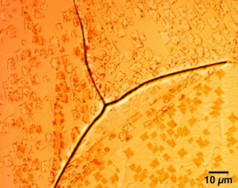 |
| Optical micrograph showing graphene domains formed across grain boundaries. |
Abstract:
A new way of growing graphene without the defects that weaken it and prevent electrons from flowing freely within it could open the way to large-scale manufacturing of graphene-based devices with applications in fields such as electronics, energy, and healthcare.
Routes towards defect-free graphene
Oxford, UK | Posted on February 1st, 2013A team led by Oxford University scientists has overcome a key problem of growing graphene - a one atom-thick layer of carbon - when using an established technique called chemical vapour deposition, that the tiny flakes of graphene form with random orientations, leaving defects or 'seams' between flakes that grow together.
The discovery, reported in a paper to be published in ACS Nano, reveals how these graphene flakes, known as 'domains', can be lined up by manipulating the alignment of carbon atoms on a relatively cheap copper foil - the atomic structure of the copper surface acts as a 'guide' that controls the orientation of the carbon atoms growing on top of them.
A combination of control of this copper guide and the pressure applied during growth makes it possible to control the thickness of these domains, the geometry of their edges and the grain boundaries where they meet - 'seams' that act as obstacles to the smooth progress of electrons necessary to create efficient graphene-based electrical and electronic devices.
'Current methods of growing flakes of graphene often suffer from graphene domains not lining up,' said Professor Nicole Grobert of Oxford University's Department of Materials who led the work. 'Our discovery shows that it is possible to produce large sheets of graphene where these flakes, called 'domains', are well-aligned, which will create a neater, stronger, and more 'electron-friendly' material.'
In principle the size of the sheet of graphene that can be created is only limited by the size of the copper base sheet.
The Oxford-led team, which includes researchers from Forschungszentrum Juelich Germany, the University of Ioannina Greece, and Renishaw plc, has shown that it is also possible using the new technique to selectively grow bilayer domains of graphene - a double layer of closely packed carbon atoms - which are of particular interest for their unusual electrical properties.
'People have used copper as a base material before, but this is the first time anyone has shown that the many different types of copper surfaces can indeed strongly control the structure of graphene,' said Professor Grobert. 'It's an important step towards finding a way of manufacturing graphene in a controlled fashion at an industrial scale, something that is essential if we are to bridge the gap between fundamental research and building useful graphene-based technologies.'
####
For more information, please click here
Contacts:
University of Oxford Press Office
44-018-652-83877
Copyright © University of Oxford
If you have a comment, please Contact us.Issuers of news releases, not 7th Wave, Inc. or Nanotechnology Now, are solely responsible for the accuracy of the content.
Bookmark:


| Related News Press |
News and information
 Quantum computer improves AI predictions April 17th, 2026
Flexible sensor gains sensitivity under pressure April 17th, 2026
A reusable chip for particulate matter sensing April 17th, 2026
Detecting vibrational quantum beating in the predissociation dynamics of SF6 using time-resolved photoelectron spectroscopy April 17th, 2026
Graphene/ Graphite
Electrifying results shed light on graphene foam as a potential material for lab grown cartilage June 6th, 2025
Breakthrough in proton barrier films using pore-free graphene oxide: Kumamoto University researchers achieve new milestone in advanced coating technologies September 13th, 2024
Possible Futures
A fundamentally new therapeutic approach to cystic fibrosis: Nanobody repairs cellular defect April 17th, 2026
UC Irvine physicists discover method to reverse ‘quantum scrambling’ : The work addresses the problem of information loss in quantum computing system April 17th, 2026
Chip Technology
A reusable chip for particulate matter sensing April 17th, 2026
Metasurfaces smooth light to boost magnetic sensing precision January 30th, 2026
Nanomedicine
A fundamentally new therapeutic approach to cystic fibrosis: Nanobody repairs cellular defect April 17th, 2026
New molecular technology targets tumors and simultaneously silences two ‘undruggable’ cancer genes August 8th, 2025
New imaging approach transforms study of bacterial biofilms August 8th, 2025
Electrifying results shed light on graphene foam as a potential material for lab grown cartilage June 6th, 2025
Discoveries
Quantum computer improves AI predictions April 17th, 2026
Flexible sensor gains sensitivity under pressure April 17th, 2026
A reusable chip for particulate matter sensing April 17th, 2026
Detecting vibrational quantum beating in the predissociation dynamics of SF6 using time-resolved photoelectron spectroscopy April 17th, 2026
Announcements
A fundamentally new therapeutic approach to cystic fibrosis: Nanobody repairs cellular defect April 17th, 2026
UC Irvine physicists discover method to reverse ‘quantum scrambling’ : The work addresses the problem of information loss in quantum computing system April 17th, 2026
Energy
Sensors innovations for smart lithium-based batteries: advancements, opportunities, and potential challenges August 8th, 2025
Simple algorithm paired with standard imaging tool could predict failure in lithium metal batteries August 8th, 2025
Industrial
Tiny nanosheets, big leap: A new sensor detects ethanol at ultra-low levels January 30th, 2026
Quantum interference in molecule-surface collisions February 28th, 2025
Boron nitride nanotube fibers get real: Rice lab creates first heat-tolerant, stable fibers from wet-spinning process June 24th, 2022
 |
||
 |
||
| The latest news from around the world, FREE | ||
 |
||
|
|
||
| Premium Products | ||
 |
||
|
Only the news you want to read!
Learn More |
||
 |
||
|
Full-service, expert consulting
Learn More |
||
|
|
||