Home > Press > Soft Lego built in the computer
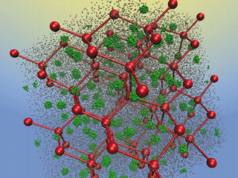 |
| Simulation snapshot of a diamond crystal built of soft patchy diblock star polymers (Copyright: American Physical Society) |
Abstract:
Barbara Capone of the Computational Physics Group of the University of Vienna has developed a new method for the construction of building blocks at the nanoscale. The researcher in Soft Matter Physics, who works at the group of Christos Likos, Professor for Multiscale Computational Physics, is specialized on topics of self-assembly of materials at the nanoscale and she has published, together with her colleagues, a paper at the prestigious Journal "Physical Review Letters" on "soft Lego".
Soft Lego built in the computer
Vienna, Austria | Posted on January 17th, 2013In developing these novel self-assembling materials, postdoc Barbara Capone has focused on the design of organic and inorganic building blocks, which are robust and can be produced at large scale. Capone has put forward, together with her colleagues at the Universities of Vienna and Mainz, a completely new pathway for the construction of building blocks at the nanoscale.
"Soft Lego" orders in crystal structures
The team of researchers has shown that so-called block copolymer stars - that means polymers that consist of two different blocks and they are chemically anchored on a common point - have a robust and flexible architecture and they possess the ability to self-assemble at different levels. At the single-molecule level, they first order as soft patchy colloids which serve then as "soft Lego" for the emergence of larger structures. At the next level of self-assembly, the colloids form complex crystal structures, such as diamond or cubic phases.
The spatial ordering in the crystals can be steered through the architecture of the "soft Lego" and opens up the possibility for the construction of new materials at the macroscopic scale with desired structure. In this way, crystals can be built that have applications in, e.g., photonics, acting as filters for light of certain frequencies or as light guides.
####
For more information, please click here
Contacts:
Scientific contacts
Dr. Barbara Capone
Computational Physics
University of Vienna
1090 Wien, Sensengasse 8
T +43-1-4277-732 36
homepage.univie.ac.at/barbara.capone/
Univ.-Prof. Dipl.-Ing. Dr. Christos N. Likos
Computational Physics
University of Vienna
1090 Wien, Sensengasse 8
T +43-1-4277-732 30 (oder: -73231)
Press Contact
Mag. Veronika Schallhart
Press Office of the University of Vienna
Research and teaching
1010 Wien, Universitätsring 1
T +43-1-4277-175 30
Copyright © University of Vienna
If you have a comment, please Contact us.Issuers of news releases, not 7th Wave, Inc. or Nanotechnology Now, are solely responsible for the accuracy of the content.
Bookmark:


| Related Links |
| Related News Press |
News and information
 Simulating magnetization in a Heisenberg quantum spin chain April 5th, 2024
NRL charters Navy’s quantum inertial navigation path to reduce drift April 5th, 2024
Discovery points path to flash-like memory for storing qubits: Rice find could hasten development of nonvolatile quantum memory April 5th, 2024
Self Assembly
Liquid crystal templated chiral nanomaterials October 14th, 2022
Nanoclusters self-organize into centimeter-scale hierarchical assemblies April 22nd, 2022
Atom by atom: building precise smaller nanoparticles with templates March 4th, 2022
Nanostructures get complex with electron equivalents: Nanoparticles of two different sizes break away from symmetrical designs January 14th, 2022
Discoveries
Chemical reactions can scramble quantum information as well as black holes April 5th, 2024
New micromaterial releases nanoparticles that selectively destroy cancer cells April 5th, 2024
Utilizing palladium for addressing contact issues of buried oxide thin film transistors April 5th, 2024
Announcements
NRL charters Navy’s quantum inertial navigation path to reduce drift April 5th, 2024
Discovery points path to flash-like memory for storing qubits: Rice find could hasten development of nonvolatile quantum memory April 5th, 2024
Interviews/Book Reviews/Essays/Reports/Podcasts/Journals/White papers/Posters
Simulating magnetization in a Heisenberg quantum spin chain April 5th, 2024
Discovery points path to flash-like memory for storing qubits: Rice find could hasten development of nonvolatile quantum memory April 5th, 2024
Photonics/Optics/Lasers
With VECSELs towards the quantum internet Fraunhofer: IAF achieves record output power with VECSEL for quantum frequency converters April 5th, 2024
Nanoscale CL thermometry with lanthanide-doped heavy-metal oxide in TEM March 8th, 2024
Optically trapped quantum droplets of light can bind together to form macroscopic complexes March 8th, 2024
HKUST researchers develop new integration technique for efficient coupling of III-V and silicon February 16th, 2024
 |
||
 |
||
| The latest news from around the world, FREE | ||
 |
||
|
|
||
| Premium Products | ||
 |
||
|
Only the news you want to read!
Learn More |
||
 |
||
|
Full-service, expert consulting
Learn More |
||
|
|
||