Home > Press > Sieve holds nanoparticles and acts as solar absorber: Scientists of the “Helmholtz-University Young Investigators Group” from Kiel and Geestacht in Germany publish their research results
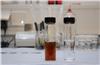 |
| The Nanofluid with particles of gold (left) and the solution filtered (right). All metal paticles are filtered out. Copyright: CAU, Photo: Claudia Eulitz |
Abstract:
A membrane consisting of polymer fibres and proteins makes a novel filter for tiny, nano-scaled particles in aqueous solutions. The result of such a research, which was done by Professor Mady Elbahri and his team from the Institute of Material Science at Kiel University (KU) and the Institute of Polymer Research at Helmholtz-Zentrum Geesthacht (HZG), has recently been published as the cover article in the current issue (21.11.2012) of Advanced Functional Materials.
Sieve holds nanoparticles and acts as solar absorber: Scientists of the “Helmholtz-University Young Investigators Group” from Kiel and Geestacht in Germany publish their research results
Kiel, Germany | Posted on November 27th, 2012A Nanofluid, which means a colloidal suspension of e.g. metal nanoparticles in water, passes easily through commonly used macroporous polymeric membranes. The particles are too small to be held using hole diameters between three and four micrometers. In addition, the particles would block smaller sieve openings rapidly. Hence, pressure would be necessary to filter out the fluid.
In order to solve these problems, Elbahri and his team biofunctionalized their membrane and added a commercially available protein to the fibres. "We found out that the protein undergoes a conformational change under water, and its ability to capture all the metal nanoparticles during the filtration process is activated", explains Elbahri. "This is a breakthrough", adds Co-author Dr. Shahin Homaeigohar. "The same principle will hopefully enable us, to filter biomolecules and organisms out of waste water."
From Filtration to solar thermal energy
When the nano sieve captures metal particles such as gold, another application is at hand, because, no other method has succeeded in dispersing the particles that well. "This result was unexpected", says Elbahri. "Under dry conditions, the membrane shows the color of the metal, in this case the red of the gold nanoparticles". When the membrane gets wet, it becomes black. "Then, it acts as an omnidirectional perfect black absorber, which can be used as a solar absorber." Elbahri adds: "Indeed we bridge the gaps between several disciplines, chemistry, physics, bioscience and materials science that is, and the Nanochemistry and Nanoengineering group has now initiated the first step toward intradisciplinarity of Nanoscience."
Application as a virus and bio-filter
The nano sieve will allow filtering very small particles or biomolecules and organisms such as viruses out of water. The scientists involved have already patented their innovation, a bio-nano-composite, in Europe. Another patent for the USA is . Besides its application in water filtration, the nano sieve shows great potentials as solar absorber and as a catalyser. "All in all, the result is a breakthrough towards the design of an operative filtration process, as a new route for the fabrication of functional materials, and offers commercially attractive efficiencies at a low cost", says Elbahri.
Full bibliographic information
"Smart Metal-Polymer Bionanocomposites as Omnidirectional Plasmonic Black Absorber by Nanofluid Filtration"; Mady Elbahri, Shahin Homaeigohar, Ramzy Abdelaziz, Tianhe Dai, Rania Khalil, Ahnaf Usman Zillohu. DOI: 10.1002/adfm.201200768, Advanced Functional Materials, 22, 4771, 2012
####
For more information, please click here
Contacts:
Boris Pawlowski
Prof. Dr. Mady Elbahri
Phone: +49 431 880-6230
or
Copyright © AlphaGalileo
If you have a comment, please Contact us.Issuers of news releases, not 7th Wave, Inc. or Nanotechnology Now, are solely responsible for the accuracy of the content.
Bookmark:


| Related News Press |
News and information
 Simulating magnetization in a Heisenberg quantum spin chain April 5th, 2024
NRL charters Navy’s quantum inertial navigation path to reduce drift April 5th, 2024
Discovery points path to flash-like memory for storing qubits: Rice find could hasten development of nonvolatile quantum memory April 5th, 2024
Nanomedicine
New micromaterial releases nanoparticles that selectively destroy cancer cells April 5th, 2024
Good as gold - improving infectious disease testing with gold nanoparticles April 5th, 2024
Researchers develop artificial building blocks of life March 8th, 2024
Discoveries
Chemical reactions can scramble quantum information as well as black holes April 5th, 2024
New micromaterial releases nanoparticles that selectively destroy cancer cells April 5th, 2024
Utilizing palladium for addressing contact issues of buried oxide thin film transistors April 5th, 2024
Announcements
NRL charters Navy’s quantum inertial navigation path to reduce drift April 5th, 2024
Discovery points path to flash-like memory for storing qubits: Rice find could hasten development of nonvolatile quantum memory April 5th, 2024
Energy
Development of zinc oxide nanopagoda array photoelectrode: photoelectrochemical water-splitting hydrogen production January 12th, 2024
Shedding light on unique conduction mechanisms in a new type of perovskite oxide November 17th, 2023
Inverted perovskite solar cell breaks 25% efficiency record: Researchers improve cell efficiency using a combination of molecules to address different November 17th, 2023
The efficient perovskite cells with a structured anti-reflective layer – another step towards commercialization on a wider scale October 6th, 2023
Research partnerships
Discovery points path to flash-like memory for storing qubits: Rice find could hasten development of nonvolatile quantum memory April 5th, 2024
Researchers’ approach may protect quantum computers from attacks March 8th, 2024
'Sudden death' of quantum fluctuations defies current theories of superconductivity: Study challenges the conventional wisdom of superconducting quantum transitions January 12th, 2024
 |
||
 |
||
| The latest news from around the world, FREE | ||
 |
||
|
|
||
| Premium Products | ||
 |
||
|
Only the news you want to read!
Learn More |
||
 |
||
|
Full-service, expert consulting
Learn More |
||
|
|
||