Home > Press > UT Arlington physics team demonstrates new power generation technique
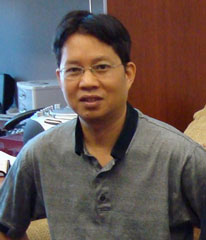 |
| Wei Chen |
Abstract:
A University of Texas at Arlington physics professor has helped create a hybrid nanomaterial that can be used to convert light and thermal energy into electrical current, surpassing earlier methods that used either light or thermal energy, but not both.
UT Arlington physics team demonstrates new power generation technique
Arlington, TX | Posted on November 12th, 2012Working with Louisiana Tech University assistant professor Long Que, UT Arlington associate physics professor Wei Chen and graduate students Santana Bala Lakshmanan and Chang Yang synthesized a combination of copper sulfide nanoparticles and single-walled carbon nanotubes.
The team used the nanomaterial to build a prototype thermoelectric generator that they hope can eventually produce milliwatts of power. Paired with microchips, the technology could be used in devices such as self-powering sensors, low-power electronic devices and implantable biomedical micro-devices, Chen said.
"If we can convert both light and heat to electricity, the potential is huge for energy production," Chen said. "By increasing the number of the micro-devices on a chip, this technology might offer a new and efficient platform to complement or even replace current solar cell technology."
In lab tests, the new thin-film structure showed increases by as much at 80 percent in light absorption when compared to single-walled nanotube thin-film devices alone, making it a more efficient generator.
Copper sulfide is also less expensive and more environment-friendly than the noble metals used in similar hybrids.
In October, the journal Nanotechnology published a paper on the work called "Optical thermal response of single-walled carbon nanotube-copper sulfide nanoparticle hybrid nanomaterials." In it, researchers also say also found that they could enhance the thermal and optical switching effects of the hybrid nanomaterial as much as ten times by using asymmetric illumination, rather than symmetric illumination.
Coauthors on the Nanotechnology paper from Louisiana Tech include Yi-Hsuan Tseng, Yuan He and Que, all of the school's Institute for Micromanufacturing.
"Dr. Chen's research with nanomaterials is an important advancement with the potential for far-reaching applications," said Pamela Jansma, dean of the UT Arlington College of Science. "This is the kind of work that demonstrates the value of a research university in North Texas and beyond."
Chen is currently receiving funding from the U.S. Department of Defense to develop nanoparticle self-lighting photodynamic therapy for use against breast and prostate cancers. In 2010, he was the first to publish results in the journal Nanomedicine demonstrating that near infrared light could be used to heat copper sulfide nanoparticles for photothermal therapy in cancer treatment, which destroys cancer cells with heat between 41 and 45 degrees Celsius.
Next month, the Journal of Biomedical Nanotechnology will publish Chen's work successfully coupling gold nanoparticles with the copper sulfide nanoparticles for the photothermal therapy. Such a material would be less costly and potentially more effective than using gold particles alone, Chen said. The new paper is called "Local field enhanced Au/CuS nanocomposites as efficient photothermal transducer agents for cancer treatment."
Chen is also leading a UT Arlington team exploring ways to develop various nanoparticles for radiation detection. That work is funded by a $1.3 million grant from the National Science Foundation and the U.S. Department of Homeland Security.
####
About University of Texas at Arlington
The study of nanoparticles and their potential beyond the lab is an important part of the work going on at UT Arlington, a comprehensive research institution of more than 33,200 students and more than 2,200 faculty members in the heart of North Texas. Visit www.uta.edu to learn more.
The University of Texas at Arlington is an Equal Opportunity and Affirmative Action employer.
For more information, please click here
Contacts:
Traci Peterson
817-272-9208
Cell:817-521-5494
Copyright © University of Texas at Arlington
If you have a comment, please Contact us.Issuers of news releases, not 7th Wave, Inc. or Nanotechnology Now, are solely responsible for the accuracy of the content.
Bookmark:


| Related News Press |
News and information
 Quantum computer improves AI predictions April 17th, 2026
Flexible sensor gains sensitivity under pressure April 17th, 2026
A reusable chip for particulate matter sensing April 17th, 2026
Detecting vibrational quantum beating in the predissociation dynamics of SF6 using time-resolved photoelectron spectroscopy April 17th, 2026
Govt.-Legislation/Regulation/Funding/Policy
Quantum computer improves AI predictions April 17th, 2026
Metasurfaces smooth light to boost magnetic sensing precision January 30th, 2026
New imaging approach transforms study of bacterial biofilms August 8th, 2025
Nanotubes/Buckyballs/Fullerenes/Nanorods/Nanostrings/Nanosheets
Tiny nanosheets, big leap: A new sensor detects ethanol at ultra-low levels January 30th, 2026
Enhancing power factor of p- and n-type single-walled carbon nanotubes April 25th, 2025
Chainmail-like material could be the future of armor: First 2D mechanically interlocked polymer exhibits exceptional flexibility and strength January 17th, 2025
Innovative biomimetic superhydrophobic coating combines repair and buffering properties for superior anti-erosion December 13th, 2024
Nanomedicine
A fundamentally new therapeutic approach to cystic fibrosis: Nanobody repairs cellular defect April 17th, 2026
New molecular technology targets tumors and simultaneously silences two ‘undruggable’ cancer genes August 8th, 2025
New imaging approach transforms study of bacterial biofilms August 8th, 2025
Electrifying results shed light on graphene foam as a potential material for lab grown cartilage June 6th, 2025
Discoveries
Quantum computer improves AI predictions April 17th, 2026
Flexible sensor gains sensitivity under pressure April 17th, 2026
A reusable chip for particulate matter sensing April 17th, 2026
Detecting vibrational quantum beating in the predissociation dynamics of SF6 using time-resolved photoelectron spectroscopy April 17th, 2026
Materials/Metamaterials/Magnetoresistance
First real-time observation of two-dimensional melting process: Researchers at Mainz University unveil new insights into magnetic vortex structures August 8th, 2025
Researchers unveil a groundbreaking clay-based solution to capture carbon dioxide and combat climate change June 6th, 2025
A 1960s idea inspires NBI researchers to study hitherto inaccessible quantum states June 6th, 2025
Institute for Nanoscience hosts annual proposal planning meeting May 16th, 2025
Announcements
A fundamentally new therapeutic approach to cystic fibrosis: Nanobody repairs cellular defect April 17th, 2026
UC Irvine physicists discover method to reverse ‘quantum scrambling’ : The work addresses the problem of information loss in quantum computing system April 17th, 2026
Military
Quantum engineers ‘squeeze’ laser frequency combs to make more sensitive gas sensors January 17th, 2025
Chainmail-like material could be the future of armor: First 2D mechanically interlocked polymer exhibits exceptional flexibility and strength January 17th, 2025
Single atoms show their true color July 5th, 2024
NRL charters Navy’s quantum inertial navigation path to reduce drift April 5th, 2024
Battery Technology/Capacitors/Generators/Piezoelectrics/Thermoelectrics/Energy storage
Decoding hydrogen‑bond network of electrolyte for cryogenic durable aqueous zinc‑ion batteries January 30th, 2026
COF scaffold membrane with gate‑lane nanostructure for efficient Li+/Mg2+ separation January 30th, 2026
MXene nanomaterials enter a new dimension Multilayer nanomaterial: MXene flakes created at Drexel University show new promise as 1D scrolls January 30th, 2026
 |
||
 |
||
| The latest news from around the world, FREE | ||
 |
||
|
|
||
| Premium Products | ||
 |
||
|
Only the news you want to read!
Learn More |
||
 |
||
|
Full-service, expert consulting
Learn More |
||
|
|
||