Home > Press > Immunomodulatory effect of nanoparticles
 |
Abstract:
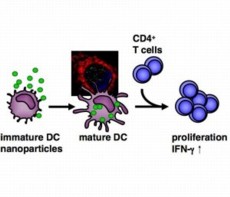
Polymeric nanoparticles for immunotherapy represent a dynamic research field. The possibility to control their size, charge, and other surface properties provides the opportunity to affect both uptake by immune cells and induction of immunity. Dendritic cells (DC), which represent the most potent antigen-presenting cells of the immune system, are one of the main targets of current NP-based immunotherapeutic approaches against tumors.
Immunomodulatory effect of nanoparticles
Mainz, Germany | Posted on October 25th, 2012Researcher from the Max Planck Institute for Polymer Research in Mainz, Germany, now study the uptake of unfunctionalized, sulfonate- and phosphonate-functionalized polystyrene NP by immature DC (iDC) and mature DC (mDC). iDC display a higher time- and dose-dependent uptake of functionalized polystyrene NP mDC. Notably, NP induce an enhanced maturation of iDC resulting in a significantly enhanced T cell stimulatory capacity.
Considering the increasing use of nanomaterials in clinical studies, investigations on the effect of nanomaterials on cell morphology and functionality are critical for screening materials that can potentially be used in clinical settings. The results are important for the research on immunomodulatory properties of NP and their potential applications in immunotherapy.
####
For more information, please click here
Copyright © Wiley-VCH Materials Science Journals
If you have a comment, please Contact us.Issuers of news releases, not 7th Wave, Inc. or Nanotechnology Now, are solely responsible for the accuracy of the content.
Bookmark:


| Related Links |
 Link to the original paper on Wiley Online Library:
| Related News Press |
News and information
Simulating magnetization in a Heisenberg quantum spin chain April 5th, 2024
NRL charters Navy’s quantum inertial navigation path to reduce drift April 5th, 2024
Discovery points path to flash-like memory for storing qubits: Rice find could hasten development of nonvolatile quantum memory April 5th, 2024
Nanomedicine
New micromaterial releases nanoparticles that selectively destroy cancer cells April 5th, 2024
Good as gold - improving infectious disease testing with gold nanoparticles April 5th, 2024
Researchers develop artificial building blocks of life March 8th, 2024
Discoveries
Chemical reactions can scramble quantum information as well as black holes April 5th, 2024
New micromaterial releases nanoparticles that selectively destroy cancer cells April 5th, 2024
Utilizing palladium for addressing contact issues of buried oxide thin film transistors April 5th, 2024
Announcements
NRL charters Navy’s quantum inertial navigation path to reduce drift April 5th, 2024
Discovery points path to flash-like memory for storing qubits: Rice find could hasten development of nonvolatile quantum memory April 5th, 2024
 |
||
 |
||
| The latest news from around the world, FREE | ||
 |
||
|
|
||
| Premium Products | ||
 |
||
|
Only the news you want to read!
Learn More |
||
 |
||
|
Full-service, expert consulting
Learn More |
||
|
|
||