Home > Press > Penn Researchers Make First All-optical Nanowire Switch
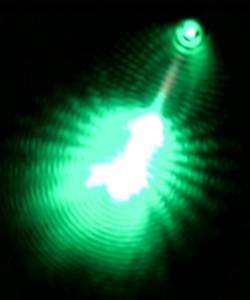 |
| Laser light is emitted from the end of a cadmium sulfide nanowire. |
Abstract:
Computers may be getting faster every year, but those advances in computer speed could be dwarfed if their 1's and 0's were represented by bursts of light, instead of electricity.
Penn Researchers Make First All-optical Nanowire Switch
Philadelphia, PA | Posted on September 10th, 2012Researchers at the University of Pennsylvania have made an important advance in this frontier of photonics, fashioning the first all-optical photonic switch out of cadmium sulfide nanowires. Moreover, they combined these photonic switches into a logic gate, a fundamental component of computer chips that process information.
The research was conducted by associate professor Ritesh Agarwal and graduate student Brian Piccione of the Department of Materials Science and Engineering in Penn's School of Engineering and Applied Science. Post-doctoral fellows Chang-Hee Cho and Lambert van Vugt, also of the Materials Science Department, contributed to the study.
It was published in the journal Nature Nanotechnology.
The research team's innovation built upon their earlier research, which showed that their cadmium sulfide nanowires exhibited extremely strong light-matter coupling, making them especially efficient at manipulating light. This quality is crucial for the development of nanoscale photonic circuits, as existing mechanisms for controlling the flow of light are bulkier and require more energy than their electronic analogs.
"The biggest challenge for photonic structures on the nanoscale is getting the light in, manipulating it once it's there and then getting it out," Agarwal said. "Our major innovation was how we solved the first problem, in that it allowed us to use the nanowires themselves for an on-chip light source."
The research team began by precisely cutting a gap into a nanowire. They then pumped enough energy into the first nanowire segment that it began to emit laser light from its end and through the gap. Because the researchers started with a single nanowire, the two segment ends were perfectly matched, allowing the second segment to efficiently absorb and transmit the light down its length.
"Once we have the light in the second segment, we shine another light through the structure and turn off what is being transported through that wire," Agarwal said. "That's what makes it a switch."
The researchers were able to measure the intensity of the light coming out of the end of the second nanowire and to show that the switch could effectively represent the binary states used in logic devices.
"Putting switches together lets you make logic gates, and assembling logic gates allows you to do computation," Piccione said. "We used these optical switches to construct a NAND gate, which is a fundamental building block of modern computer processing."
A NAND gate, which stands for "not and," returns a "0" output when all its inputs are "1." It was constructed by the researchers by combining two nanowire switches into a Y-shaped configuration. NAND gates are important for computation because they are "functionally complete," which means that, when put in the right sequence, they can do any kind of logical operation and thus form the basis for general-purpose computer processors.
"We see a future where ‘consumer electronics' become ‘consumer photonics'," Agarwal said. "And this study shows that is possible."
The research was supported by the U.S. Army Research Office and the National Institutes of Health's New Innovator Award Program.
####
For more information, please click here
Contacts:
Evan Lerner
215-573-6604
Copyright © University of Pennsylvania
If you have a comment, please Contact us.Issuers of news releases, not 7th Wave, Inc. or Nanotechnology Now, are solely responsible for the accuracy of the content.
Bookmark:


| Related News Press |
News and information
 Simulating magnetization in a Heisenberg quantum spin chain April 5th, 2024
NRL charters Navy’s quantum inertial navigation path to reduce drift April 5th, 2024
Discovery points path to flash-like memory for storing qubits: Rice find could hasten development of nonvolatile quantum memory April 5th, 2024
Govt.-Legislation/Regulation/Funding/Policy
NRL charters Navy’s quantum inertial navigation path to reduce drift April 5th, 2024
Discovery points path to flash-like memory for storing qubits: Rice find could hasten development of nonvolatile quantum memory April 5th, 2024
Chemical reactions can scramble quantum information as well as black holes April 5th, 2024
Chip Technology
Discovery points path to flash-like memory for storing qubits: Rice find could hasten development of nonvolatile quantum memory April 5th, 2024
Utilizing palladium for addressing contact issues of buried oxide thin film transistors April 5th, 2024
HKUST researchers develop new integration technique for efficient coupling of III-V and silicon February 16th, 2024
Optical computing/Photonic computing
With VECSELs towards the quantum internet Fraunhofer: IAF achieves record output power with VECSEL for quantum frequency converters April 5th, 2024
Chemical reactions can scramble quantum information as well as black holes April 5th, 2024
Optically trapped quantum droplets of light can bind together to form macroscopic complexes March 8th, 2024
HKUST researchers develop new integration technique for efficient coupling of III-V and silicon February 16th, 2024
Discoveries
Chemical reactions can scramble quantum information as well as black holes April 5th, 2024
New micromaterial releases nanoparticles that selectively destroy cancer cells April 5th, 2024
Utilizing palladium for addressing contact issues of buried oxide thin film transistors April 5th, 2024
Announcements
NRL charters Navy’s quantum inertial navigation path to reduce drift April 5th, 2024
Discovery points path to flash-like memory for storing qubits: Rice find could hasten development of nonvolatile quantum memory April 5th, 2024
Military
NRL charters Navy’s quantum inertial navigation path to reduce drift April 5th, 2024
What heat can tell us about battery chemistry: using the Peltier effect to study lithium-ion cells March 8th, 2024
New chip opens door to AI computing at light speed February 16th, 2024
Photonics/Optics/Lasers
With VECSELs towards the quantum internet Fraunhofer: IAF achieves record output power with VECSEL for quantum frequency converters April 5th, 2024
Nanoscale CL thermometry with lanthanide-doped heavy-metal oxide in TEM March 8th, 2024
Optically trapped quantum droplets of light can bind together to form macroscopic complexes March 8th, 2024
HKUST researchers develop new integration technique for efficient coupling of III-V and silicon February 16th, 2024
 |
||
 |
||
| The latest news from around the world, FREE | ||
 |
||
|
|
||
| Premium Products | ||
 |
||
|
Only the news you want to read!
Learn More |
||
 |
||
|
Full-service, expert consulting
Learn More |
||
|
|
||