Home > Press > Sensor technology helps standardize food industry
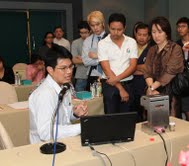 |
| Rungroj Maolanon (seated) giving a talk on NanoNose technology to private sector groups. |
Abstract:
Researchers at NANOTEC, King Mongkut's Institute of Technology Ladkrabang (KMITL)(College of Nanotechnology), and Mahidol University have collaborated to develop an electronic nose (NanoNose) to help local food industry in areas related to standardizing smell, which is one of the key sensory perceptions for the food industry.
Sensor technology helps standardize food industry
Pathumthani, Thailand | Posted on July 10th, 2012The Thai food industry is a multi billion dollar industry and account for 3% of the total world food export. The drawback of this industry is that it is prone to various sensitive aspects such as safety and quality. "We utilized knowledge in areas related to surface analysis and nanaocoating to existing sensor technology to developed an electronic nose (NanoNose) which is a bio-mimetic device based on series of gas sensors to provide a quasi-quantitative measure of the signature of smell" said Rungroj Maolanon, a researcher at Nanomolecular Sensor Lab at NANOTEC and team member. "In a way similar to human nose, NanoNose allow analysis of the headspace (volatile compounds) generated by liquid, gaseous or solid samples".
NanoNose provides a qualitative measure of smell and identifies samples through a learning process. It compares each fingerprint to known chemical substance patterns in a data library and either matches the fingerprint, or records the sample as a new pattern. The data analysis employed the Principal Component Analysis (PCA), which classify the data according the recognition pattern of sensor array. The electrical response of each sensor is generated by the replacement of absorbed oxygen molecules by exposed chemical vapors to induce free charge on metal oxide sensor surface.
From this research collaboration, different variation of NanoNose applications can be applied to agriculture, food science, health and environmental monitoring. The capability of the device to distinguish different types of smell has been demonstrated on fine scents such as perfume, alcoholic beverages, and coffee aroma. In the medical industry, breath analyses using NanoNose can be use to detect infections, gastrointestinal disorders and liver disease.
####
For more information, please click here
Contacts:
Ramjitti Indaraprasirt
Manager
Public Relations Section
NANOTEC
02-564-7100 ext: 6617
Copyright © NANOTEC
If you have a comment, please Contact us.Issuers of news releases, not 7th Wave, Inc. or Nanotechnology Now, are solely responsible for the accuracy of the content.
Bookmark:


| Related News Press |
News and information
 Simulating magnetization in a Heisenberg quantum spin chain April 5th, 2024
NRL charters Navy’s quantum inertial navigation path to reduce drift April 5th, 2024
Discovery points path to flash-like memory for storing qubits: Rice find could hasten development of nonvolatile quantum memory April 5th, 2024
Sensors
Discoveries
Chemical reactions can scramble quantum information as well as black holes April 5th, 2024
New micromaterial releases nanoparticles that selectively destroy cancer cells April 5th, 2024
Utilizing palladium for addressing contact issues of buried oxide thin film transistors April 5th, 2024
Announcements
NRL charters Navy’s quantum inertial navigation path to reduce drift April 5th, 2024
Discovery points path to flash-like memory for storing qubits: Rice find could hasten development of nonvolatile quantum memory April 5th, 2024
Food/Agriculture/Supplements
Silver nanoparticles: guaranteeing antimicrobial safe-tea November 17th, 2023
Night-time radiative warming using the atmosphere November 17th, 2023
DGIST and New Life Group launched a research project on "Functional beauty and health products using the latest nanotechnology" May 12th, 2023
Research partnerships
Discovery points path to flash-like memory for storing qubits: Rice find could hasten development of nonvolatile quantum memory April 5th, 2024
Researchers’ approach may protect quantum computers from attacks March 8th, 2024
'Sudden death' of quantum fluctuations defies current theories of superconductivity: Study challenges the conventional wisdom of superconducting quantum transitions January 12th, 2024
 |
||
 |
||
| The latest news from around the world, FREE | ||
 |
||
|
|
||
| Premium Products | ||
 |
||
|
Only the news you want to read!
Learn More |
||
 |
||
|
Full-service, expert consulting
Learn More |
||
|
|
||