Home > Press > Perfectly spherical gold nanodroplets produced with the smallest-ever nanojets
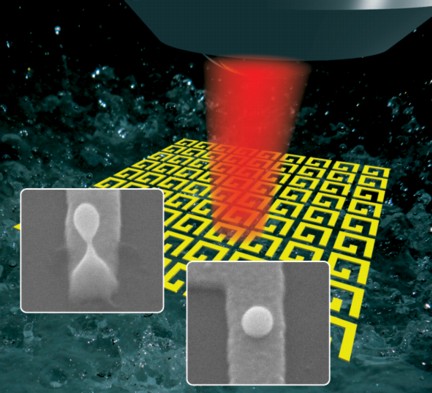 |
| Similar to the way water backjets eject droplets of water on the surface of a pond, powerful laser pulses can locally melt gold nanostructures and produce gold nanojets, ejecting perfectly spherical gold nanodroplets. |
Abstract:
KU Leuven researcher Ventsislav Valev and an international team of scientists have developed a new method for optical manipulation of matter at the nanoscale. Using ‘plasmonic hotspots' - regions with electric current that heat up very locally - gold nanostructures can be melted and made to produce the smallest nanojets ever observed. The tiny gold nanodroplets formed in the nanojets, are perfectly spherical, which makes them interesting for applications in medicine.
Perfectly spherical gold nanodroplets produced with the smallest-ever nanojets
Leuven, Belgium | Posted on January 14th, 2012The ‘backjet' phenomenon on which the method turns can be compared to a pebble being dropped into water. Tightly focused ultrafast laser pulses carry sufficient energy to locally melt the surface of a gold film. When a laser pulse of light hits the film, a nanoscale backjet - a nanojet - of molten gold surges upward.
As the name suggests, nanojets on the surface of a homogeneous gold film are incredibly small, their size being determined by the distribution of energy in the light pulse. This distribution of energy is in turn dependent on the wavelength of light. Initially, scientists anticipated that nanojets could not be significantly smaller than the wavelength of light. In this study however, Ventsislav Valev and his colleagues show that nanojets can in fact be made much smaller with the help of ‘plasmonic hotspots'.
Plasmonic hotspots are regions on the surface of metal nanostructures where light causes very strong oscillation of the electrons. Because electron oscillations constitute an electric current and because electric currents heat up the material the same way an electric stove heats up in the kitchen, the plasmonic hotspots are extremely hot. So hot that they can melt the gold in a spot much smaller than the wavelength of light. Dr. Valev and his colleagues were successfully able to demonstrate that this tiny little pool of molten gold can give rise to the smallest nanojets ever observed.
The gold nanodroplets propelled upward by the nanojets solidify in flight, producing perfectly spherical nanoparticles. These gold nanodroplets can be collected and used for medical applications including cancer treatment. The nanoparticles can be attached to molecules and injected in the blood. Once the molecules attach to cancer cells, light can be used to heat up the gold nanodroplets and destroy the cancer cells. Currently, the gold nanoparticles used in medications are chemically synthesised. These chemically synthesised gold nanoparticles have an unavoidably granular aspect. Conversely, gold nanodroplets created by the plasmonic nanojet method detailed by Dr. Valev and his colleagues are perfectly spherical, ensuring a better efficiency.
The study was conducted in collaboration with scientists from Germany, the United Kingdom, Bulgaria, Russia and Singapore and is published in the latest edition of the journal Advanced Materials.
####
For more information, please click here
Contacts:
Dr. Ventsislav Valev
Molecular Imaging and Photonics
Faculty of Science
University of Leuven
Griet Van der Perre
+32 16 32 40 08
Copyright © AlphaGalileo
If you have a comment, please Contact us.Issuers of news releases, not 7th Wave, Inc. or Nanotechnology Now, are solely responsible for the accuracy of the content.
Bookmark:


| Related Links |
| Related News Press |
News and information
 Simulating magnetization in a Heisenberg quantum spin chain April 5th, 2024
NRL charters Navy’s quantum inertial navigation path to reduce drift April 5th, 2024
Discovery points path to flash-like memory for storing qubits: Rice find could hasten development of nonvolatile quantum memory April 5th, 2024
Nanomedicine
New micromaterial releases nanoparticles that selectively destroy cancer cells April 5th, 2024
Good as gold - improving infectious disease testing with gold nanoparticles April 5th, 2024
Researchers develop artificial building blocks of life March 8th, 2024
Discoveries
Chemical reactions can scramble quantum information as well as black holes April 5th, 2024
New micromaterial releases nanoparticles that selectively destroy cancer cells April 5th, 2024
Utilizing palladium for addressing contact issues of buried oxide thin film transistors April 5th, 2024
Announcements
NRL charters Navy’s quantum inertial navigation path to reduce drift April 5th, 2024
Discovery points path to flash-like memory for storing qubits: Rice find could hasten development of nonvolatile quantum memory April 5th, 2024
Photonics/Optics/Lasers
With VECSELs towards the quantum internet Fraunhofer: IAF achieves record output power with VECSEL for quantum frequency converters April 5th, 2024
Nanoscale CL thermometry with lanthanide-doped heavy-metal oxide in TEM March 8th, 2024
Optically trapped quantum droplets of light can bind together to form macroscopic complexes March 8th, 2024
HKUST researchers develop new integration technique for efficient coupling of III-V and silicon February 16th, 2024
Research partnerships
Discovery points path to flash-like memory for storing qubits: Rice find could hasten development of nonvolatile quantum memory April 5th, 2024
Researchers’ approach may protect quantum computers from attacks March 8th, 2024
'Sudden death' of quantum fluctuations defies current theories of superconductivity: Study challenges the conventional wisdom of superconducting quantum transitions January 12th, 2024
 |
||
 |
||
| The latest news from around the world, FREE | ||
 |
||
|
|
||
| Premium Products | ||
 |
||
|
Only the news you want to read!
Learn More |
||
 |
||
|
Full-service, expert consulting
Learn More |
||
|
|
||