Home > Press > Nature Materials Study: Quick-Cooking Nanomaterials in a $40 Microwave Oven To Make Tomorrow’s Solid-State Air Conditioners and Refrigerators: Engineers at Rensselaer Polytechnic Institute Develop New Method for Creating Better Thermoelectric Materials in Large Batches
 |
Abstract:
Engineering researchers at Rensselaer Polytechnic Institute have developed a new method for creating advanced nanomaterials that could lead to highly efficient refrigerators and cooling systems requiring no refrigerants and no moving parts. The key ingredients for this innovation are a dash of nanoscale sulfur and a normal, everyday microwave oven.
Nature Materials Study: Quick-Cooking Nanomaterials in a $40 Microwave Oven To Make Tomorrow’s Solid-State Air Conditioners and Refrigerators: Engineers at Rensselaer Polytechnic Institute Develop New Method for Creating Better Thermoelectric Materials in Large Batches
Troy, NY | Posted on January 11th, 2012At the heart of these solid-state cooling systems are thermoelectric materials, which can convert electricity into a range of different temperatures—from hot to cold. Thermoelectric refrigerators employing these principles have been available for more than 20 years, but they are still small and highly inefficient. This is largely because the materials used in current thermoelectric cooling devices are expensive and difficult to make in large quantities, and do not have the necessary combination of thermal and electrical properties. A new study, published today in the journal Nature Materials, overcomes these challenges and opens the door to a new generation of high-performance, cost-effective solid state refrigeration and air conditioning.
Rensselaer Professor Ganpati Ramanath led the study, in collaboration with colleagues Theodorian Borca-Tasciuc and Richard W. Siegel.
See a video of Ramanath explaining the study at: http://www.youtube.com/user/rpirensselaer?feature=mhee#p/u/12/hgmBwg3FeS4
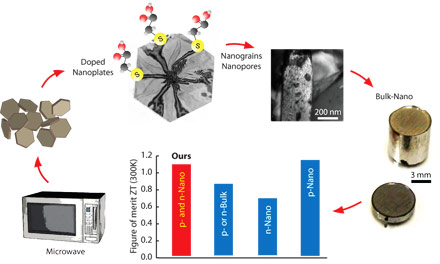
Driving this research breakthrough is the idea of intentionally contaminating, or doping, nanostructured thermoelectric materials with barely-there amounts of sulfur. The doped materials are obtained by cooking the material and the dopant together for few minutes in a store-bought $40 microwave oven. The resulting powder is formed into pea-sized pellets by applying heat and pressure in a way that preserves the properties endowed by the nanostructuring and the doping. These pellets exhibit properties better than the hard-to-make thermoelectric materials currently available in the marketplace. Additionally, this new method for creating the doped pellets is much faster, easier, and cheaper than conventional methods of making thermoelectric materials.
"This is not a one-off discovery. Rather, we have developed and demonstrated a new way to create a whole new class of doped thermoelectric materials with superior properties," said Ramanath, a faculty member in the Department of Materials Science and Engineering at Rensselaer. "Our findings truly hold the potential to transform the technology landscape of refrigeration and make a real impact on our lives."
Results of the study are detailed in the Nature Materials paper "A new class of doped nanobulk high figure of merit thermoelectrics by scalable bottom-up assembly." See the paper online at: http://dx.doi.org/10.1038/NMAT3213
Trying to engineer thermoelectric materials is somewhat like playing a game of "tug of war," Ramanath said. Researchers endeavor to control three separate properties of the material: electrical conductivity, thermal conductivity, and Seebeck coefficient. Manipulating one of these properties, however, necessarily affects the other two. This new study demonstrates a new way to minimize the interdependence of these three properties by combining doping and nanostructuring in well-known thermoelectric materials such as tellurides and selenides based on bismuth and antimony.
The goal of tweaking these three properties is to create a thermoelectric material with a high figure of merit, or ZT, which is a measure of how efficient the material is at converting heat to electricity. The new pea-sized pellets of nanomaterials developed by the Rensselaer team demonstrated a ZT of 1 to 1.1 at room temperature. Since such high values are obtained even without optimizing the process, the researchers are confident that higher ZT can be obtained with some smart engineering.
"It's really amazing as to how nanostructures seasoned with just a few atoms of sulfur can lead to such superior thermoelectric properties of the bulk material made from the nanostructures, and allows us to reap the benefits of nanostructuring on a macroscale," Ramanath said.
An important facet of the discovery is the ability to make both p-type (positive charge) and n-type (negative charge) thermoelectric nanomaterials with a high ZT. Up until now, researchers around the world have only been able to make large quantities of p-type materials with high ZT.
Additionally, the new study shows the Rensselaer research team can make batches of 10 to 15 grams (enough to make several pea-sized pellets) of the doped nanomaterial in two to three minutes with a microwave oven. Larger quantities can be produced using industrial-sized microwaves ovens.
"Our ability to scalably and inexpensively produce both p- and n-type materials with a high ZT paves the way to the fabrication of high-efficiency cooling devices, as well as solid-state thermoelectric devices for harvesting waste heat or solar heat into electricity," said Borca-Tasciuc, professor in the Department of Mechanical, Aerospace, and Nuclear Engineering at Rensselaer.
"This is a very exciting discovery because it combines the realization of novel and useful thermoelectric properties with a demonstrated processing route forward to industrial applications," said Siegel, the Robert W. Hunt Professor of Materials Science and Engineering at Rensselaer.
Rensselaer graduate student Rutvik J. Mehta carried out this work for his doctoral thesis. Mehta, Ramanath, and Borca-Tasciuc have filed a patent and formed a new company, ThermoAura Inc., to further develop and market the new thermoelectric materials technology. Mehta has since graduated and is now a post-doctoral associate at Rensselaer. He also serves as president of ThermoAura.
Beyond refrigerators and air conditioning, the researchers envision this technology could one day be used to cool computer chips.
Along with Ramanath,Borca-Tasciuc, Siegel, and Mehta, co-authors of the paper are Rensselaer graduate students Yanliang Zhang, Chinnathambi Karthik, and Binay Singh.
This research is funded by support from the National Science Foundation (NSF); IBM through the Rensselaer Nanotechnology Center; and the U.S. Department of Energy through the S3TEC Energy Frontiers Research Center at the Massachusetts Institute of Technology (MIT).
####
For more information, please click here
Contacts:
Michael Mullaney
Phone: (518) 276-6161
Copyright © Rensselaer Polytechnic Institute (RPI)
If you have a comment, please Contact us.Issuers of news releases, not 7th Wave, Inc. or Nanotechnology Now, are solely responsible for the accuracy of the content.
Bookmark:


| Related Links |
 Faculty Home Page – Borca-Tasciuc:
“Nanosculpture” Could Enable New Types of Heat Pumps and Energy Converters:
Inexpensive “Nanoglue” Can Bond Nearly Anything Together:
Water Could Hold Answer to Graphene Nanoelectronics:
Professor-Turned-Producer Learns the Movie Biz:
| Related News Press |
News and information
Simulating magnetization in a Heisenberg quantum spin chain April 5th, 2024
NRL charters Navy’s quantum inertial navigation path to reduce drift April 5th, 2024
Discovery points path to flash-like memory for storing qubits: Rice find could hasten development of nonvolatile quantum memory April 5th, 2024
Chip Technology
Discovery points path to flash-like memory for storing qubits: Rice find could hasten development of nonvolatile quantum memory April 5th, 2024
Utilizing palladium for addressing contact issues of buried oxide thin film transistors April 5th, 2024
HKUST researchers develop new integration technique for efficient coupling of III-V and silicon February 16th, 2024
Discoveries
Chemical reactions can scramble quantum information as well as black holes April 5th, 2024
New micromaterial releases nanoparticles that selectively destroy cancer cells April 5th, 2024
Utilizing palladium for addressing contact issues of buried oxide thin film transistors April 5th, 2024
Announcements
NRL charters Navy’s quantum inertial navigation path to reduce drift April 5th, 2024
Discovery points path to flash-like memory for storing qubits: Rice find could hasten development of nonvolatile quantum memory April 5th, 2024
Home
Nanomaterials enable dual-mode heating and cooling device: Device could cut HVAC energy use by nearly 20% in the US December 2nd, 2020
Bosch Sensortec launches ideation community to foster and accelerate innovative IoT applications : Creativity hub for customers, partners, developers and makers February 18th, 2019
Iran Develops Water-Repellent Nano-Paint December 5th, 2018
 |
||
 |
||
| The latest news from around the world, FREE | ||
 |
||
|
|
||
| Premium Products | ||
 |
||
|
Only the news you want to read!
Learn More |
||
 |
||
|
Full-service, expert consulting
Learn More |
||
|
|
||