Home > Press > Nanomechanics as a Corner Stone of Nanotechnology
 |
Abstract:
The new still emerging field of nanomechanics is, probably, one of the simplest parts in the conceptual foundation of nanoscale sciences and
nanotechnology.
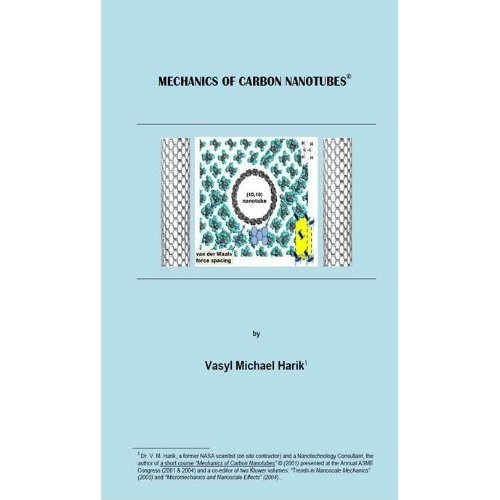
A first nationally distributed short course "Mechanics of Carbon Nanotubes" has been presented at the Annual ASME Congress in 2001 by Dr. Vasyl Michael Harik, then a Senior Staff Scientist at the ICASE Institute at the NASA Langley Research Center, Hampton, VA. In 2011, exactly ten years after the first presentation of that short course, a new book with the same title "Mechanics of Carbon Nanotubes"
jhu.md/tWET33 has been published by a 2004 NASA spin-off, Nanodesigns Consulting of Newark, DE.
Nanomechanics as a Corner Stone of Nanotechnology
Newark, DE | Posted on January 10th, 2012Since Galileo Galilei in the 17-th century, mechanics has become the basis of modern physical sciences. A statement that a science only then becomes a science, when it starts using mathematics belongs to Galileo, who advocated a rigor and specificity in the description, if not the analysis, of scientific experiments. After the discovery of carbon nanotubes in 1991 and 1993 by Iijima and his lab, the analysis of mechanical behavior of the multi wall and the single wall carbon nanotubes has laid the new foundation for the precise description of various nanoscale experiments and the nanoscale analysis of new materials, nanostructures and nanoparticles of only 1 nm in diameter, for example, the so called Buckminster ball or the "bucky" ball, i.e., the spherical C60 carbon particles. It so happens that the "bucky" ball is the smallest material particle that satisfies a rigorous nanoscale (homogenization) criterion for the averaging of material properties [1].
In 2001, a classification of carbon nanotubes have been done according to their sizes: diameters, length, their aspect ratio and other key ratios [1].
The aspect ratio of carbon nanotubes is the key parameter in the design of new atomic force microscope (AFM) probes. It is widely known that carbon nanotubes are the strongest material, yet they may fall apart when their radius is about one carbon ring in size. These structurally unstable nanotubes belong to the class of carbon nanocrystals, in addition to other three classes of carbon nanotubes (i.e., the thin and thick nanotube shells and the long or the high aspect ratio carbon nanotubes [1]).
A first nationally distributed short course "Mechanics of Carbon Nanotubes" has been presented at the Annual ASME Congress in 2001 by Dr. Vasyl Michael Harik, then a Senior Staff Scientist at the ICASE Institute at the NASA Langley Research Center, Hampton, VA. In 2011, exactly ten years after the first presentation of that short course, a new book with the same title has been published by a 2004 NASA spin-off, Nanodesigns Consulting of Newark, DE. The new still emerging field of nanomechanics is, probably, one of the simplest parts in the conceptual foundation of new nanoscale sciences and the nanotechnology. It is an essential part of the new nanotech education.
[1] V. M. Harik, Mechanics of Carbon Nanotubes, 2011. Nanodesigns Press, Nanodesigns Consulting (P.O. Box 9090, Newark, DE 19714-9090) Newark, Delaware.
####
For more information, please click here
Contacts:
Dr. Vasyl Michael Harik
Copyright © Nanodesigns Consulting
If you have a comment, please Contact us.Issuers of news releases, not 7th Wave, Inc. or Nanotechnology Now, are solely responsible for the accuracy of the content.
Bookmark:


| Related News Press |
News and information
 Simulating magnetization in a Heisenberg quantum spin chain April 5th, 2024
NRL charters Navy’s quantum inertial navigation path to reduce drift April 5th, 2024
Discovery points path to flash-like memory for storing qubits: Rice find could hasten development of nonvolatile quantum memory April 5th, 2024
Nanotubes/Buckyballs/Fullerenes/Nanorods/Nanostrings
Tests find no free-standing nanotubes released from tire tread wear September 8th, 2023
Detection of bacteria and viruses with fluorescent nanotubes July 21st, 2023
Announcements
NRL charters Navy’s quantum inertial navigation path to reduce drift April 5th, 2024
Discovery points path to flash-like memory for storing qubits: Rice find could hasten development of nonvolatile quantum memory April 5th, 2024
Interviews/Book Reviews/Essays/Reports/Podcasts/Journals/White papers/Posters
Simulating magnetization in a Heisenberg quantum spin chain April 5th, 2024
Discovery points path to flash-like memory for storing qubits: Rice find could hasten development of nonvolatile quantum memory April 5th, 2024
 |
||
 |
||
| The latest news from around the world, FREE | ||
 |
||
|
|
||
| Premium Products | ||
 |
||
|
Only the news you want to read!
Learn More |
||
 |
||
|
Full-service, expert consulting
Learn More |
||
|
|
||