Home > Press > N.E. Chemcat Corporation Licenses Brookhaven Lab's Electrocatalyst Technology for Fuel Cells in Electric Vehicles
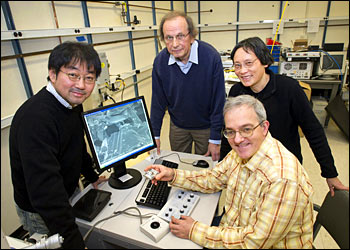 |
| (From left) Brookhaven National Laboratory chemists Kotaro Sasaki, Radoslav Adzic, Jia Wang, and Miomir Vukmirovic work on the recently licensed electrocatalysts using a new electron microscope in their laboratory. |
Abstract:
N.E. Chemcat Corporation, Japan's leading catalyst and precious metal compound manufacturer, has licensed electrocatalysts developed by scientists at the U.S. Department of Energy's Brookhaven National Laboratory that can reduce the use of costly platinum and increase the effectiveness of fuel cells for use in electric vehicles. In addition, the license includes innovative methods for making the catalysts and an apparatus design used in manufacturing them.
N.E. Chemcat Corporation Licenses Brookhaven Lab's Electrocatalyst Technology for Fuel Cells in Electric Vehicles
Upton, NY | Posted on January 3rd, 2012Platinum is the most efficient electrocatalyst for fuel cells, but platinum-based catalysts are expensive, unstable, and have low durability. The newly licensed electrocatalysts have high activity, stability, and durability, while containing only about one tenth the platinum of conventional catalysts used in fuel cells, reducing overall costs.
The electrocatalysts consist of a palladium or a palladium alloy nanoparticle core covered with a monolayer - one-atom thick - platinum shell. This palladium-platinum combination notably improves oxygen reduction at the cathode of a hydrogen/oxygen fuel cell. This type of fuel cell produces electricity using hydrogen as fuel, and forms water as the only byproduct.
Radoslav Adzic, the Brookhaven Lab senior chemist who led the team that developed the catalysts, said, "We are delighted that N.E. Chemcat Corporation has licensed our platinum monolayer electrocatalyst technology. We hope that it will facilitate the development of affordable and reliable fuel cell electric vehicles, which would be very beneficial for the environment since they produce no harmful emissions. Also, the use of nonrenewable fossil fuels for transportation that contribute to global warming would be greatly reduced, prolonging their availability for other uses in the future."
The U.S. Department of Energy's Office of Science and its Office of Energy Efficiency and Renewable Energy funded research that contributed to these licensed technologies. Besides Adzic, those who contributed to the research include Brookhaven chemists Jia Wang, Kotaro Sasaki, and Miomir Vukmirovic, and postdoctoral fellows Junliang Zhang and Yibo Mo.
####
About Brookhaven National Laboratory
One of ten national laboratories overseen and primarily funded by the Office of Science of the U.S. Department of Energy (DOE), Brookhaven National Laboratory conducts research in the physical, biomedical, and environmental sciences, as well as in energy technologies and national security. Brookhaven Lab also builds and operates major scientific facilities available to university, industry and government researchers. Brookhaven is operated and managed for DOE's Office of Science by Brookhaven Science Associates, a limited-liability company founded by the Research Foundation of State University of New York on behalf of Stony Brook University, the largest academic user of Laboratory facilities, and Battelle, a nonprofit, applied science and technology organization.
For more information, please click here
Contacts:
Diane Greenberg
631) 344-2347
or
Peter Genzer
(631) 344-3174
Copyright © Brookhaven National Laboratory
If you have a comment, please Contact us.Issuers of news releases, not 7th Wave, Inc. or Nanotechnology Now, are solely responsible for the accuracy of the content.
Bookmark:


| Related News Press |
News and information
 Quantum computer improves AI predictions April 17th, 2026
Flexible sensor gains sensitivity under pressure April 17th, 2026
A reusable chip for particulate matter sensing April 17th, 2026
Detecting vibrational quantum beating in the predissociation dynamics of SF6 using time-resolved photoelectron spectroscopy April 17th, 2026
Chemistry
Projecting light to dispense liquids: A new route to ultra-precise microdroplets January 30th, 2026
From sensors to smart systems: the rise of AI-driven photonic noses January 30th, 2026
"Nanoreactor" cage uses visible light for catalytic and ultra-selective cross-cycloadditions October 3rd, 2025
Cambridge chemists discover simple way to build bigger molecules – one carbon at a time June 6th, 2025
Single-atom catalysts change spin state when boosted by a magnetic field June 4th, 2025
Laboratories
Researchers develop molecular qubits that communicate at telecom frequencies October 3rd, 2025
Govt.-Legislation/Regulation/Funding/Policy
Quantum computer improves AI predictions April 17th, 2026
Metasurfaces smooth light to boost magnetic sensing precision January 30th, 2026
New imaging approach transforms study of bacterial biofilms August 8th, 2025
Announcements
A fundamentally new therapeutic approach to cystic fibrosis: Nanobody repairs cellular defect April 17th, 2026
UC Irvine physicists discover method to reverse ‘quantum scrambling’ : The work addresses the problem of information loss in quantum computing system April 17th, 2026
Patents/IP/Tech Transfer/Licensing
Getting drugs across the blood-brain barrier using nanoparticles March 3rd, 2023
Metasurfaces control polarized light at will: New research unlocks the hidden potential of metasurfaces August 13th, 2021
Arrowhead Pharmaceuticals Announces Closing of Agreement with Takeda November 27th, 2020
Automotive/Transportation
Decoding hydrogen‑bond network of electrolyte for cryogenic durable aqueous zinc‑ion batteries January 30th, 2026
Sensors innovations for smart lithium-based batteries: advancements, opportunities, and potential challenges August 8th, 2025
Simple algorithm paired with standard imaging tool could predict failure in lithium metal batteries August 8th, 2025
Fuel Cells
Deciphering local microstrain-induced optimization of asymmetric Fe single atomic sites for efficient oxygen reduction August 8th, 2025
Current and Future Developments in Nanomaterials and Carbon Nanotubes: Applications of Nanomaterials in Energy Storage and Electronics October 28th, 2022
 |
||
 |
||
| The latest news from around the world, FREE | ||
 |
||
|
|
||
| Premium Products | ||
 |
||
|
Only the news you want to read!
Learn More |
||
 |
||
|
Full-service, expert consulting
Learn More |
||
|
|
||