Home > Press > Trojan Horse Causes Nanoparticle Allergy
 |
Abstract:
Workers with existing allergic conditions have worse reactions when exposed to nanoparticles in the workplace, suggest Chinese scientists. They believe that the response is caused by a Trojan horse known as an exosome, which is present in all of us.
Trojan Horse Causes Nanoparticle Allergy
Germany | Posted on December 18th, 2011Nanoparticles are becoming ubiquitous in industry and commercial applications, and there are rightly concerns about their safety, which is often still not as well understood as their physical properties. In particular, it is important for employers to understand the effects of nanoparticles on the immune system and allergic reactions to them in order to safeguard their workers against long-term and short-term effects of exposure.
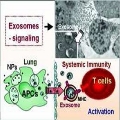
Now, a team of scientists at the Chinese Academy of Sciences, Beijing, led by Guangjun Nie and Yuliang Zhao, has studied these effects using magnetic iron oxide nanoparticles. They propose that, when inhaled, the nanoparticles induce formation of a vesiclelike intra- and intercellular vehicle called an exosome in the lungs. Inhalation is the most common way for nanoparticles to be introduced to the human body. Exosomes are known to act as Trojan horses to deliver sometimes unwanted particles such as viruses into cells, and in this case they quickly remove the nanoparticles from the lungs and convey signals throughout the body, including to the immune system. In those individuals that already have some kind of allergic respiratory condition (known as sensitized individuals), these signals can result in both direct and indirect activation of T cells, which cause familiar allergic responses such as inflammation. In unsensitized individuals the body's response is much lower, as the pathway to T-cell activation only takes the indirect pathway.
The scientists believe that their work should urgently inform policy guidelines and further research to protect both sensitized and unsensitized workers from allergic reactions caused by occupational exposure to nanoparticles.
####
For more information, please click here
Copyright © John Wiley & Sons, Inc.
If you have a comment, please Contact us.Issuers of news releases, not 7th Wave, Inc. or Nanotechnology Now, are solely responsible for the accuracy of the content.
Bookmark:


| Related Links |
 M. Zhu et al., Small ; DOI: 10.1002/smll.201101708
| Related News Press |
News and information
Simulating magnetization in a Heisenberg quantum spin chain April 5th, 2024
NRL charters Navy’s quantum inertial navigation path to reduce drift April 5th, 2024
Discovery points path to flash-like memory for storing qubits: Rice find could hasten development of nonvolatile quantum memory April 5th, 2024
Discoveries
Chemical reactions can scramble quantum information as well as black holes April 5th, 2024
New micromaterial releases nanoparticles that selectively destroy cancer cells April 5th, 2024
Utilizing palladium for addressing contact issues of buried oxide thin film transistors April 5th, 2024
Announcements
NRL charters Navy’s quantum inertial navigation path to reduce drift April 5th, 2024
Discovery points path to flash-like memory for storing qubits: Rice find could hasten development of nonvolatile quantum memory April 5th, 2024
Safety-Nanoparticles/Risk management
Tests find no free-standing nanotubes released from tire tread wear September 8th, 2023
Billions of nanoplastics released when microwaving baby food containers: Exposure to plastic particles kills up to 75% of cultured kidney cells July 21st, 2023
 |
||
 |
||
| The latest news from around the world, FREE | ||
 |
||
|
|
||
| Premium Products | ||
 |
||
|
Only the news you want to read!
Learn More |
||
 |
||
|
Full-service, expert consulting
Learn More |
||
|
|
||