Home > Press > Novel Gold-Nanoparticle-Based Assay for Understanding Alzheimer’s Disease
 |
Abstract:
Acetylcholinesterase (AChE) is an enzyme that can catalytically break down acetylcholine at cholinergic synapses, resulting in the termination of synaptic transmission. It had been shown that the level of AChE in the cerebrospinal fluid of individuals suffering from Alzheimer's disease is significantly reduced. Therefore, a low level of AChE may indicate a risk or a preclinical stage of Alzheimer's disease. This information could be useful for early prevention and treatment of the disease. However, to date there is no accurate method for identifying Alzheimer's disease in an early or asymptomatic stage of the disease.
Novel Gold-Nanoparticle-Based Assay for Understanding Alzheimer’s Disease
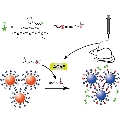
Germany | Posted on December 13th, 2011The clinical application of existing gold nanoparticle (AuNP)-based colorimetric assays is hampered by their moderate sensitivity and selectivity. Now, however, Xingyu Jiang and co-workers (National Center for Nanoscience and Technology, Beijing) have developed a novel AuNP-based assay highly sensitive to acetylcholinesterase (AChE). The fluorescence of Rhodamine B detached from Au surfaces is measured and simultaneously the color change of AuNPs solutions is known.
This new assay provides a detection limit (0.1 mU/mL) much lower than that of all existing probes for AChE. Such a high sensitivity allows the measurement of AChE in the cerebrospinal fluid even after being diluted more than a thousand times. In this manner, false positive results for other components like biothiols in real samples can be ruled out and relevant clinical tests are rendered possible. The study shows that the level of AChE in model mice that suffer from Alzheimer's disease (AD) is lower than that in healthy mice. The assay also allows the progression of the disease and the effect of drug treatments to be studied by monitoring the AChE level in the model mice treated with different drug dosages.
####
For more information, please click here
Copyright © Wiley-VCH Materials Science Journals
If you have a comment, please Contact us.Issuers of news releases, not 7th Wave, Inc. or Nanotechnology Now, are solely responsible for the accuracy of the content.
Bookmark:


| Related Links |
 Dingbin Liu et al., Adv. Healthcare Mat. ; DOI: 10.1002/adhm.201100002
| Related News Press |
News and information
Simulating magnetization in a Heisenberg quantum spin chain April 5th, 2024
NRL charters Navy’s quantum inertial navigation path to reduce drift April 5th, 2024
Discovery points path to flash-like memory for storing qubits: Rice find could hasten development of nonvolatile quantum memory April 5th, 2024
Nanomedicine
New micromaterial releases nanoparticles that selectively destroy cancer cells April 5th, 2024
Good as gold - improving infectious disease testing with gold nanoparticles April 5th, 2024
Researchers develop artificial building blocks of life March 8th, 2024
Discoveries
Chemical reactions can scramble quantum information as well as black holes April 5th, 2024
New micromaterial releases nanoparticles that selectively destroy cancer cells April 5th, 2024
Utilizing palladium for addressing contact issues of buried oxide thin film transistors April 5th, 2024
Announcements
NRL charters Navy’s quantum inertial navigation path to reduce drift April 5th, 2024
Discovery points path to flash-like memory for storing qubits: Rice find could hasten development of nonvolatile quantum memory April 5th, 2024
 |
||
 |
||
| The latest news from around the world, FREE | ||
 |
||
|
|
||
| Premium Products | ||
 |
||
|
Only the news you want to read!
Learn More |
||
 |
||
|
Full-service, expert consulting
Learn More |
||
|
|
||