Home > Press > NASA Develops Super-Black Material That Absorbs Light Across Multiple Wavelength Bands 11.08.11
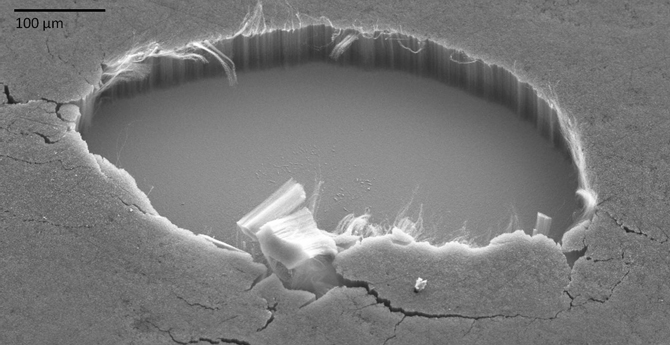 |
| This close-up view (only about 0.03 inches wide) shows the internal structure of a carbon-nanotube coating that absorbs about 99 percent of the ultraviolet, visible, infrared, and far-infrared light that strikes it. A section of the coating, which was grown on smooth silicon, was purposely removed to show the tubes' vertical alignment. (Credit: Stephanie Getty, NASA Goddard) |
Abstract:
NASA engineers have produced a material that absorbs on average more than 99 percent of the ultraviolet, visible, infrared, and far-infrared light that hits it -- a development that promises to open new frontiers in space technology.
NASA Develops Super-Black Material That Absorbs Light Across Multiple Wavelength Bands 11.08.11
Greenbelt, MD | Posted on November 9th, 2011The team of engineers at NASA's Goddard Space Flight Center in Greenbelt, Md., reported their findings recently at the SPIE Optics and Photonics conference, the largest interdisciplinary technical meeting in this discipline. The team has since reconfirmed the material's absorption capabilities in additional testing, said John Hagopian, who is leading the effort involving 10 Goddard technologists.
"The reflectance tests showed that our team had extended by 50 times the range of the material's absorption capabilities. Though other researchers are reporting near-perfect absorption levels mainly in the ultraviolet and visible, our material is darn near perfect across multiple wavelength bands, from the ultraviolet to the far infrared," Hagopian said. "No one else has achieved this milestone yet."
The nanotech-based coating is a thin layer of multi-walled carbon nanotubes, tiny hollow tubes made of pure carbon about 10,000 times thinner than a strand of human hair. They are positioned vertically on various substrate materials much like a shag rug. The team has grown the nanotubes on silicon, silicon nitride, titanium, and stainless steel, materials commonly used in space-based scientific instruments. (To grow carbon nanotubes, Goddard technologist Stephanie Getty applies a catalyst layer of iron to an underlayer on silicon, titanium, and other materials. She then heats the material in an oven to about 1,382 degrees Fahrenheit. While heating, the material is bathed in carbon-containing feedstock gas.)
The tests indicate that the nanotube material is especially useful for a variety of spaceflight applications where observing in multiple wavelength bands is important to scientific discovery. One such application is stray-light suppression. The tiny gaps between the tubes collect and trap background light to prevent it from reflecting off surfaces and interfering with the light that scientists actually want to measure. Because only a small fraction of light reflects off the coating, the human eye and sensitive detectors see the material as black.
In particular, the team found that the material absorbs 99.5 percent of the light in the ultraviolet and visible, dipping to 98 percent in the longer or far-infrared bands. "The advantage over other materials is that our material is from 10 to 100 times more absorbent, depending on the specific wavelength band," Hagopian said.
"We were a little surprised by the results," said Goddard engineer Manuel Quijada, who co-authored the SPIE paper and carried out the reflectance tests. "We knew it was absorbent. We just didn't think it would be this absorbent from the ultraviolet to the far infrared."
If used in detectors and other instrument components, the technology would allow scientists to gather hard-to-obtain measurements of objects so distant in the universe that astronomers no longer can see them in visible light or those in high-contrast areas, including planets in orbit around other stars, Hagopian said. Earth scientists studying the oceans and atmosphere also would benefit. More than 90 percent of the light Earth-monitoring instruments gather comes from the atmosphere, overwhelming the faint signal they are trying to retrieve.
Currently, instrument developers apply black paint to baffles and other components to help prevent stray light from ricocheting off surfaces. However, black paints absorb only 90 percent of the light that strikes it. The effect of multiple bounces makes the coating's overall advantage even larger, potentially resulting in hundreds of times less stray light.
In addition, black paints do not remain black when exposed to cryogenic temperatures. They take on a shiny, slightly silver quality, said Goddard scientist Ed Wollack, who is evaluating the carbon-nanotube material for use as a calibrator on far-infrared-sensing instruments that must operate in super-cold conditions to gather faint far-infrared signals emanating from objects in the very distant universe. If these instruments are not cold, thermal heat generated by the instrument and observatory, will swamp the faint infrared they are designed to collect.
Black materials also serve another important function on spacecraft instruments, particularly infrared-sensing instruments, added Goddard engineer Jim Tuttle. The blacker the material, the more heat it radiates away. In other words, super-black materials, like the carbon nanotube coating, can be used on devices that remove heat from instruments and radiate it away to deep space. This cools the instruments to lower temperatures, where they are more sensitive to faint signals.
To prevent the black paints from losing their absorption and radiative properties at long wavelengths, instrument developers currently use epoxies loaded with conductive metals to create a black coating. However, the mixture adds weight, always a concern for instrument developers. With the carbon-nanotube coating, however, the material is less dense and remains black without additives, and therefore is effective at absorbing light and removing heat. "This is a very promising material," Wollack said. "It's robust, lightweight, and extremely black. It is better than black paint by a long shot."
####
For more information, please click here
Contacts:
Lori Keesey
NASA's Goddard Space Flight Center, Greenbelt, Md.
301-258-0192
Ed Campion
NASA's Goddard Space Flight Center, Greenbelt, Md.
301-286-0697
Copyright © NASA
If you have a comment, please Contact us.Issuers of news releases, not 7th Wave, Inc. or Nanotechnology Now, are solely responsible for the accuracy of the content.
Bookmark:


| Related News Press |
News and information
 Quantum computer improves AI predictions April 17th, 2026
Flexible sensor gains sensitivity under pressure April 17th, 2026
A reusable chip for particulate matter sensing April 17th, 2026
Detecting vibrational quantum beating in the predissociation dynamics of SF6 using time-resolved photoelectron spectroscopy April 17th, 2026
Govt.-Legislation/Regulation/Funding/Policy
Quantum computer improves AI predictions April 17th, 2026
Metasurfaces smooth light to boost magnetic sensing precision January 30th, 2026
New imaging approach transforms study of bacterial biofilms August 8th, 2025
Nanotubes/Buckyballs/Fullerenes/Nanorods/Nanostrings/Nanosheets
Tiny nanosheets, big leap: A new sensor detects ethanol at ultra-low levels January 30th, 2026
Enhancing power factor of p- and n-type single-walled carbon nanotubes April 25th, 2025
Chainmail-like material could be the future of armor: First 2D mechanically interlocked polymer exhibits exceptional flexibility and strength January 17th, 2025
Innovative biomimetic superhydrophobic coating combines repair and buffering properties for superior anti-erosion December 13th, 2024
Discoveries
Quantum computer improves AI predictions April 17th, 2026
Flexible sensor gains sensitivity under pressure April 17th, 2026
A reusable chip for particulate matter sensing April 17th, 2026
Detecting vibrational quantum beating in the predissociation dynamics of SF6 using time-resolved photoelectron spectroscopy April 17th, 2026
Materials/Metamaterials/Magnetoresistance
First real-time observation of two-dimensional melting process: Researchers at Mainz University unveil new insights into magnetic vortex structures August 8th, 2025
Researchers unveil a groundbreaking clay-based solution to capture carbon dioxide and combat climate change June 6th, 2025
A 1960s idea inspires NBI researchers to study hitherto inaccessible quantum states June 6th, 2025
Institute for Nanoscience hosts annual proposal planning meeting May 16th, 2025
Announcements
A fundamentally new therapeutic approach to cystic fibrosis: Nanobody repairs cellular defect April 17th, 2026
UC Irvine physicists discover method to reverse ‘quantum scrambling’ : The work addresses the problem of information loss in quantum computing system April 17th, 2026
Tools
Metasurfaces smooth light to boost magnetic sensing precision January 30th, 2026
From sensors to smart systems: the rise of AI-driven photonic noses January 30th, 2026
Japan launches fully domestically produced quantum computer: Expo visitors to experience quantum computing firsthand August 8th, 2025
Aerospace/Space
Decoding hydrogen‑bond network of electrolyte for cryogenic durable aqueous zinc‑ion batteries January 30th, 2026
ICFO researchers overcome long-standing bottleneck in single photon detection with twisted 2D materials August 8th, 2025
Onion-like nanoparticles found in aircraft exhaust May 14th, 2025
 |
||
 |
||
| The latest news from around the world, FREE | ||
 |
||
|
|
||
| Premium Products | ||
 |
||
|
Only the news you want to read!
Learn More |
||
 |
||
|
Full-service, expert consulting
Learn More |
||
|
|
||