Home > Press > No Batteries Required: Automobile Instruments Harvest Energy from Road Vibration to Keep Sensors Running
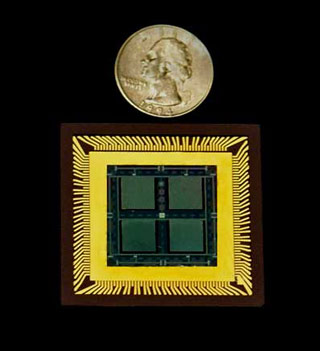 |
| Provided/MicroGen Systems Prototype chip from MicroGen Systems includes four piezoelectric power sources. The devices can shrink further as circuits require less power. |
Abstract:
Your little deuce coupe, hot rod Lincoln or pink Cadillac gets a small boost of energy, as tiny sensors in your automobile can now harvest constant power from road vibration instead of replacing batteries.
No Batteries Required: Automobile Instruments Harvest Energy from Road Vibration to Keep Sensors Running
Ithaca, NY | Posted on August 10th, 2011MicroGen Systems Inc., of Ithaca, and Cornell University's Cornell Nanoscale Facility, have collaborated to develop battery-free sensors that can operate in anything that spins, rolls, jiggles or shakes, like car tires and clothing dryers.
The battery device is a tiny sheet of a piezoelectric material that generates electricity when mounted on a shock-resistant base and it is flexed. Vibration like a spinning automobile wheel causes the tiny flap to swing back and forth, generating current that charges an adjacent thin-film battery. The prototype - about the size of a quarter - puts out up to 200 microwatts. As circuits become smaller and need less power, the device can shrink with them.
Several companies have already expressed interest in MicroGen's energy harvester technology.
Robert Andosca, president of MicroGen was first drawn to New York by research funding made available by Sen. Charles Schumer (D-N.Y.). Paul Mutolo, director of external partnerships for the university's Energy Materials Center (emc2), helped bring MicroGen to Ithaca, to be close to Cornell.
To refine the technology, Andosca needed the state-of-the-art facilities at the Cornell Nanoscale Facility. "There are 17 of these facilities in the country and Cornell's facility is one of the two best," says Andosca. Through the Energy Materials Center, MicroGen obtained startup funding from the New York State Foundation for Science, Technology and Innovation (NYSTAR) to support his work at the Cornell Nanoscale Facility. The funding comes from emc2's part in the NYS Center for Future Energy Systems and is targeted to assisting companies in the energy sector. The funding enabled him to build, test and redesign until he had a product that would meet the industry standard power level for wireless sensor units.
Now MicroGen is working with R. Bruce van Dover, professor of materials science and engineering, to refine the technology, particularly to develop a version that can withstand high temperatures, aiming for sensors in jet engines.
####
For more information, please click here
Contacts:
Blaine Friedlander
(607) 254-8093
Copyright © Newswise
If you have a comment, please Contact us.Issuers of news releases, not 7th Wave, Inc. or Nanotechnology Now, are solely responsible for the accuracy of the content.
Bookmark:


| Related News Press |
News and information
 Quantum computer improves AI predictions April 17th, 2026
Flexible sensor gains sensitivity under pressure April 17th, 2026
A reusable chip for particulate matter sensing April 17th, 2026
Detecting vibrational quantum beating in the predissociation dynamics of SF6 using time-resolved photoelectron spectroscopy April 17th, 2026
Govt.-Legislation/Regulation/Funding/Policy
Quantum computer improves AI predictions April 17th, 2026
Metasurfaces smooth light to boost magnetic sensing precision January 30th, 2026
New imaging approach transforms study of bacterial biofilms August 8th, 2025
Sensors
Flexible sensor gains sensitivity under pressure April 17th, 2026
Tiny nanosheets, big leap: A new sensor detects ethanol at ultra-low levels January 30th, 2026
From sensors to smart systems: the rise of AI-driven photonic noses January 30th, 2026
Sensors innovations for smart lithium-based batteries: advancements, opportunities, and potential challenges August 8th, 2025
Announcements
A fundamentally new therapeutic approach to cystic fibrosis: Nanobody repairs cellular defect April 17th, 2026
UC Irvine physicists discover method to reverse ‘quantum scrambling’ : The work addresses the problem of information loss in quantum computing system April 17th, 2026
Automotive/Transportation
Decoding hydrogen‑bond network of electrolyte for cryogenic durable aqueous zinc‑ion batteries January 30th, 2026
Sensors innovations for smart lithium-based batteries: advancements, opportunities, and potential challenges August 8th, 2025
Simple algorithm paired with standard imaging tool could predict failure in lithium metal batteries August 8th, 2025
Battery Technology/Capacitors/Generators/Piezoelectrics/Thermoelectrics/Energy storage
Decoding hydrogen‑bond network of electrolyte for cryogenic durable aqueous zinc‑ion batteries January 30th, 2026
COF scaffold membrane with gate‑lane nanostructure for efficient Li+/Mg2+ separation January 30th, 2026
MXene nanomaterials enter a new dimension Multilayer nanomaterial: MXene flakes created at Drexel University show new promise as 1D scrolls January 30th, 2026
 |
||
 |
||
| The latest news from around the world, FREE | ||
 |
||
|
|
||
| Premium Products | ||
 |
||
|
Only the news you want to read!
Learn More |
||
 |
||
|
Full-service, expert consulting
Learn More |
||
|
|
||