Home > Press > Photonic Crystals: Materials, Technologies and Global Markets
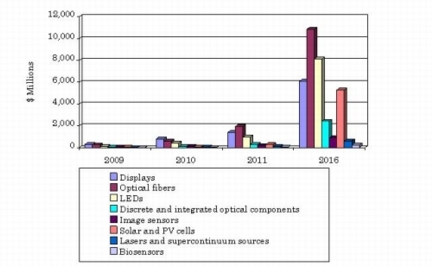 |
| SUMMARY FIGURE GLOBAL MARKET FOR COMPONENTS AND MODULES USING PHOTONIC CRYSTALS, 2009-2016 ($ MILLIONS) |
Abstract:
In a recent release, PHOTONIC CRYSTALS: MATERIALS, TECHNOLOGIES AND GLOBAL MARKETS (AVM059B) from BCC Research (www.bccresearch.com), the global market value for photonic crystal components and modules is estimated to be $5.2 billion in 2011. That value should reach $34.5 billion by 2016 as it increases at a five-year compound annual growth rate (CAGR) of 46.1%.
Photonic Crystals: Materials, Technologies and Global Markets
Wellesley, MA | Posted on July 18th, 2011The photonic crystal component and module market can be broken down into eight segments - displays, optical fibers, LEDs, discrete and integrated optical components, image sensors, solar and PV cells, lasers and supercontinuum sources, and biosensors.
The segment made up of displays is projected to be worth nearly $6.1 billion in 2016 after rising at a CAGR of $34.5 billion from its estimated 2011 value of nearly $1.4 billion.
The segment made up of optical fibers is estimated to be worth nearly $2 billion in 2011, and in 2016 should be worth more than $10.8 billion, yielding a CAGR of 41.2%.
The LEDs segment, estimated to be worth $983 million in 2011, should rise in 2016 to $8.1 billion at a CAGR of 52.5%.
The segment made up of discrete and integrated optical components is estimated to be worth $303 million in 2011, and in 2016 is expected to be worth $2.4 billion, a CAGR of 51.6%.
The segment made up of image sensors is estimated to be worth nearly $200 million in 2011, and in 2016 should be worth $888 million, a CAGR of 34.9%.
The segment made up of solar and PV cells is estimated to be worth $270 million in 2011, and in 2016 should be worth $5.3 billion, a CAGR 81.3%.
In 2011, the segment made up of lasers and supercontinuum sources is estimated to be worth $96 million, and in 2016 should be worth $621 million, a CAGR of 45.3%.
The segment made up of biosensors is estimated to be worth $27 million in 2011, and in 2016 should be worth $250 million, a CAGR of 56.1%.
Photonic crystals have been classic underachievers: full of promise, sound in theory, poor in implementation. Characterized by the presence of nanoscale patterns of segments with varied dielectric constants, photonic crystals rival electrons when it comes to versatility.
There are a number of reasons photonic crystals have struggled to find their place in various domains. These include rapid strides in other areas of electronic fabrication, difficulty in fabricating photonic crystal-enabled products, and shareholder unwillingness to alter their well-oiled supply chains.
The future is bright for photonic crystals, a yearly growth in excess of 46% a clear indicator. More importantly, this growth will not be vertical or confined to a single component, but will foray in a wide-ranging spread of intermediate components.
This report will be relevant to photonic crystal technology experts, developers who can assess the potential offerings and benefits of photonic crystals, and end application device vendors who can benefit from the superior material attributes of photonic crystals.
####
For more information, please click here
Contacts:
Steven Cumming
Tel: 866-285-7215
Fax: 781-489-7308
Copyright © BCC Research
If you have a comment, please Contact us.Issuers of news releases, not 7th Wave, Inc. or Nanotechnology Now, are solely responsible for the accuracy of the content.
Bookmark:


| Related News Press |
News and information
 Simulating magnetization in a Heisenberg quantum spin chain April 5th, 2024
NRL charters Navy’s quantum inertial navigation path to reduce drift April 5th, 2024
Discovery points path to flash-like memory for storing qubits: Rice find could hasten development of nonvolatile quantum memory April 5th, 2024
Possible Futures
Discovery points path to flash-like memory for storing qubits: Rice find could hasten development of nonvolatile quantum memory April 5th, 2024
With VECSELs towards the quantum internet Fraunhofer: IAF achieves record output power with VECSEL for quantum frequency converters April 5th, 2024
Announcements
NRL charters Navy’s quantum inertial navigation path to reduce drift April 5th, 2024
Discovery points path to flash-like memory for storing qubits: Rice find could hasten development of nonvolatile quantum memory April 5th, 2024
Interviews/Book Reviews/Essays/Reports/Podcasts/Journals/White papers/Posters
Simulating magnetization in a Heisenberg quantum spin chain April 5th, 2024
Discovery points path to flash-like memory for storing qubits: Rice find could hasten development of nonvolatile quantum memory April 5th, 2024
Photonics/Optics/Lasers
With VECSELs towards the quantum internet Fraunhofer: IAF achieves record output power with VECSEL for quantum frequency converters April 5th, 2024
Nanoscale CL thermometry with lanthanide-doped heavy-metal oxide in TEM March 8th, 2024
Optically trapped quantum droplets of light can bind together to form macroscopic complexes March 8th, 2024
HKUST researchers develop new integration technique for efficient coupling of III-V and silicon February 16th, 2024
 |
||
 |
||
| The latest news from around the world, FREE | ||
 |
||
|
|
||
| Premium Products | ||
 |
||
|
Only the news you want to read!
Learn More |
||
 |
||
|
Full-service, expert consulting
Learn More |
||
|
|
||