Home > Press > Using impurities in diamonds as a method of creating a node in a quantum network
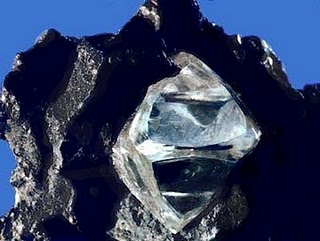 |
| Rough diamond |
Abstract:
When it comes to dreaming about diamonds, energy efficiency and powerful information processing aren't normally the thoughts that spring to mind. Unless, of course, you are a quantum physicist looking to create the most secure and powerful networks around.
Using impurities in diamonds as a method of creating a node in a quantum network
Calgary, Canada | Posted on May 7th, 2011Researchers at the University of Calgary and Hewlett Packard Labs in Palo Alto, California, have come up with a way to use impurities in diamonds as a method of creating a node in a quantum network. In addition to making powerful and secure networks, this discovery may also help sensitive measurements of magnetic fields and create new powerful platforms useful for applications in biology.
"Impurities in diamonds have recently been used to store information encoded onto their quantum state, which can be controlled and read out using light. But coming up with robust way to create connections needed to pass on signals between these impurities is difficult," says Dr. Paul Barclay, who recently moved to Calgary to start labs at the University of Calgary in the Institute for Quantum Information Science and at the National Institute for Nanotechnology in Edmonton.
"We have taken an important step towards achieving this," adds Barclay.
Barclay and colleagues Dr. Andrei Faraon, Dr. Kai-Mei Fu, Dr. Charles Santori and Dr. Ray Beausoleil from Hewlett Packard have published a paper on their research in the journal Nature Photonics.
Impurities in diamonds are responsible for slightly altering the material's colour, typically adding a slight red or yellow tint. The "NV center" impurity, which consists of a nitrogen atom and a vacancy in otherwise perfect diamond carbon lattice, has quantum properties that researchers are learning to exploit for useful applications.
In principle, individual particles of light, photons, can be used to transfer this quantum information between impurities, each of which could be a node in a quantum network used for energy efficient and powerful information processing. In practice, this is challenging to demonstrate because of the small size of the impurities (a few nanometers) and the experimental complexity that comes along with studying and controlling several nanoscale quantum systems at once.
Researchers at Hewlett Packard Labs and Barclay, who worked on this research at HP and is now a professor in the Department on Physics and Astronomy, have created photonic "microring resonators" on diamond chips. These microrings are designed to efficiently channel light between diamond impurities, and an on-chip photonic circuit connected to quantum impurities at other locations on the chip.
In future work, this microring will be connected to other components on the diamond chip, and light will be routed between impurities.
"This work demonstrates the important connection between fundamental physics, blue sky applications, and near-term problem solving. It involves many of the same concepts being pushed by companies such as HP, IBM, and Intel who are beginning to integrate photonics with computer hardware to increase performance and reduce the major problem of heat generation," says Barclay.
The article, Resonant enhancement of the zero-phonon emission from a colour centre in a diamond cavity, is written Andrei Faraon, Kai-Mei Fu, Charles Santori and Ray Beausoleil (Hewlett Packard) and Paul Barclay (Hewlett Packard and University of Calgary), and is published in the recent on-line edition of Nature Photonics.
####
For more information, please click here
Contacts:
Paul Barclay and Leanne Yohemas
403-540-6552
University of Calgary
2500 University Dr. NW.
Calgary, Alberta, Canada, T2N 1N4
Copyright © University of Calgary
If you have a comment, please Contact us.Issuers of news releases, not 7th Wave, Inc. or Nanotechnology Now, are solely responsible for the accuracy of the content.
Bookmark:


| Related News Press |
News and information
 Quantum computer improves AI predictions April 17th, 2026
Flexible sensor gains sensitivity under pressure April 17th, 2026
A reusable chip for particulate matter sensing April 17th, 2026
Detecting vibrational quantum beating in the predissociation dynamics of SF6 using time-resolved photoelectron spectroscopy April 17th, 2026
Physics
UC Irvine physicists discover method to reverse ‘quantum scrambling’ : The work addresses the problem of information loss in quantum computing system April 17th, 2026
Quantum computers simulate fundamental physics: shedding light on the building blocks of nature June 6th, 2025
Quantum Computing
Quantum computer improves AI predictions April 17th, 2026
UC Irvine physicists discover method to reverse ‘quantum scrambling’ : The work addresses the problem of information loss in quantum computing system April 17th, 2026
Researchers develop molecular qubits that communicate at telecom frequencies October 3rd, 2025
Discoveries
Quantum computer improves AI predictions April 17th, 2026
Flexible sensor gains sensitivity under pressure April 17th, 2026
A reusable chip for particulate matter sensing April 17th, 2026
Detecting vibrational quantum beating in the predissociation dynamics of SF6 using time-resolved photoelectron spectroscopy April 17th, 2026
Announcements
A fundamentally new therapeutic approach to cystic fibrosis: Nanobody repairs cellular defect April 17th, 2026
UC Irvine physicists discover method to reverse ‘quantum scrambling’ : The work addresses the problem of information loss in quantum computing system April 17th, 2026
Quantum nanoscience
Beyond silicon: Electronics at the scale of a single molecule January 30th, 2026
MXene nanomaterials enter a new dimension Multilayer nanomaterial: MXene flakes created at Drexel University show new promise as 1D scrolls January 30th, 2026
ICFO researchers overcome long-standing bottleneck in single photon detection with twisted 2D materials August 8th, 2025
 |
||
 |
||
| The latest news from around the world, FREE | ||
 |
||
|
|
||
| Premium Products | ||
 |
||
|
Only the news you want to read!
Learn More |
||
 |
||
|
Full-service, expert consulting
Learn More |
||
|
|
||