Home > Press > Switching Qubits with a Terahertz Source?
 |
| Molecules on a Chip |
Abstract:
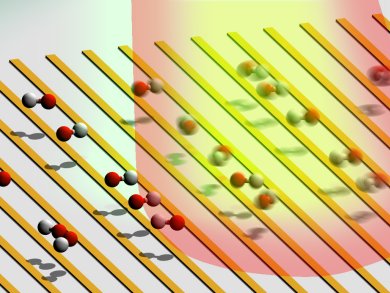
Scientists in Germany and the USA have been able to induce rotational transitions in molecules trapped at a close distance above a chip using a terahertz source. The new results, which are published in ChemPhysChem, could have interesting applications in quantum computing.
Switching Qubits with a Terahertz Source?
Berlin, Germany | Posted on March 2nd, 2011Polar molecules in selected quantum states can be guided, decelerated and trapped using electric fields created by microstructured electrodes on a chip. One of the possible applications of such molecules on a chip is their use in future quantum computers. However, to achieve this, researchers must be able to drive transitions from a certain quantum state to another one, that is, they should to be able "to switch a qubit (or quantum bit)". A transition between two rotational levels in a molecule is very well suited for this, and that is the reason why Gabriele Santambrogio and co-workers at the Fritz Haber Institute of the Max Planck Society in Berlin and Liam Duffy of the University of North Carolina at Greensboro decided to use a rather uncommon narrowband terahertz (THz) source to induce rotational transitions in laser-prepared metastable CO molecules. The researchers coupled the source to a chip setup that had been previously developed by them and studied the transitions between two quantum states in polar molecules trapped on the chip.
Unique Approach
According to co-author Gerard Meijer, both the experimental approach and the results of this work are unique. The combination of laser-prepared molecules in a single rotational level, tunable narrow-band mm-wave radiation that can transfer the population to another rotational level, and state-selective detection of the molecules at a known delay and position, offers many interesting possibilities. With this approach, the research team has not only been able to trap the polar molecules on a chip but has also played further games with them — like inducing the rotational transitions. Meijer believes that these results could find important applications in quantum computing: "In the future, it is conceivable that compact THz sources are integrated on a chip, and that one can use this to switch between qubits in a routine fashion", he says.
####
Copyright © Wiley-VCH Verlag GmbH & Co. KGaA
If you have a comment, please Contact us.Issuers of news releases, not 7th Wave, Inc. or Nanotechnology Now, are solely responsible for the accuracy of the content.
Bookmark:


| Related Links |
 Driving Rotational Transitions in Molecules on a Chip
| Related News Press |
News and information
Simulating magnetization in a Heisenberg quantum spin chain April 5th, 2024
NRL charters Navy’s quantum inertial navigation path to reduce drift April 5th, 2024
Discovery points path to flash-like memory for storing qubits: Rice find could hasten development of nonvolatile quantum memory April 5th, 2024
Chip Technology
Discovery points path to flash-like memory for storing qubits: Rice find could hasten development of nonvolatile quantum memory April 5th, 2024
Utilizing palladium for addressing contact issues of buried oxide thin film transistors April 5th, 2024
HKUST researchers develop new integration technique for efficient coupling of III-V and silicon February 16th, 2024
Quantum Computing
Simulating magnetization in a Heisenberg quantum spin chain April 5th, 2024
Discovery points path to flash-like memory for storing qubits: Rice find could hasten development of nonvolatile quantum memory April 5th, 2024
With VECSELs towards the quantum internet Fraunhofer: IAF achieves record output power with VECSEL for quantum frequency converters April 5th, 2024
Chemical reactions can scramble quantum information as well as black holes April 5th, 2024
Announcements
NRL charters Navy’s quantum inertial navigation path to reduce drift April 5th, 2024
Discovery points path to flash-like memory for storing qubits: Rice find could hasten development of nonvolatile quantum memory April 5th, 2024
Interviews/Book Reviews/Essays/Reports/Podcasts/Journals/White papers/Posters
Simulating magnetization in a Heisenberg quantum spin chain April 5th, 2024
Discovery points path to flash-like memory for storing qubits: Rice find could hasten development of nonvolatile quantum memory April 5th, 2024
 |
||
 |
||
| The latest news from around the world, FREE | ||
 |
||
|
|
||
| Premium Products | ||
 |
||
|
Only the news you want to read!
Learn More |
||
 |
||
|
Full-service, expert consulting
Learn More |
||
|
|
||