Home > Press > With Chemical Modification, Stable RNA Nanoparticles Go 3-D
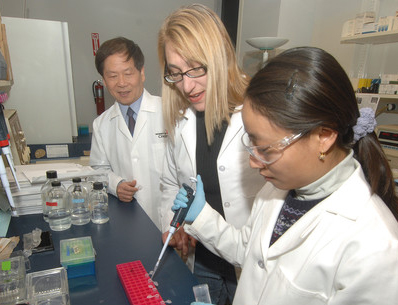 |
| Peixuan Guo, PhD, Dane and Mary Louise Miller Endowed Chair in biomedical engineering with students in his lab at the Vontz Center for Molecular Studies |
Abstract:
Researchers have found a way to bypass RNase and create stable three-dimensional configurations of RNA, greatly expanding the possibilities for RNA in nanotechnology (the engineering of functional systems at the molecular scale).
With Chemical Modification, Stable RNA Nanoparticles Go 3-D
Cincinnati, OH | Posted on January 24th, 2011For years, RNA has seemed an elusive tool in nanotechnology research—easily manipulated into a variety of structures, yet susceptible to quick destruction when confronted with a commonly found enzyme.
"The enzyme RNase cuts RNA randomly into small pieces, very efficiently and within minutes," explains Peixuan Guo, PhD, Dane and Mary Louise Miller Endowed Chair and professor of biomedical engineering at the University of Cincinnati (UC). "Moreover, RNase is present everywhere, making the preparation of RNA in a lab extremely difficult."
But by replacing a chemical group in the macromolecule, Guo says he and fellow researchers have found a way to bypass RNase and create stable three-dimensional configurations of RNA, greatly expanding the possibilities for RNA in nanotechnology (the engineering of functional systems at the molecular scale).
Their results, "Fabrication of Stable and RNase-Resistant RNA Nanoparticles Active in Gearing the Nanomotors for Viral DNA Packaging," are published online in the journal ACS Nano.
In their work, Guo and his colleagues focused on the ribose rings that, together with alternating phosphate groups, form the backbone of RNA. By changing one section of the ribose ring, Guo and his team altered the structure of the molecule, making it unable to bind with RNase and able to resist degradation.
"RNase interaction with RNA requires a match of structural conformation," says Guo. "When RNA conformation has changed, the RNase cannot recognize RNA and the binding becomes an issue."
While he says previous researchers have shown this alteration makes RNA stable in a double helix, they did not study its potential to affect the folding of RNA into a three-dimensional structure necessary for nanotechnology.
After creating the RNA nanoparticle, Guo and his colleagues successfully used it to power the DNA packaging nanomotor of bacteriophage phi29, a virus that infects bacteria.
"We found that the modified RNA can fold into its 3-D structure appropriately, and can carry out its biological functions after modification," says Guo. "Our results demonstrate that it is practical to produce RNase-resistant, biologically active, and stable RNA for application in nanotechnology."
Because stable RNA molecules can be used to assemble a variety of nanostructures, Guo says they are an ideal tool to deliver targeted therapies to cancerous or viral-infected cells:
"RNA nanoparticles can be fabricated with a level of simplicity characteristic of DNA while possessing versatile structure and catalytic function similar to that of proteins. With this RNA modification, hopefully we can open new avenues of study in RNA nanotechnology."
Guo serves as director of UC's National Institutes of Health (NIH) Nanomedicine Development Center and Nanobiomedical Center. This work was funded by grants from the NIH.
Co-authors include Jing Liu, Mathieu Cinier and Yi Shu from UC, Chaoping Chen from Colorado State University, Guanxin Shen from Huazhong University of Science and Technology in China, and Songchuan Guo from Kylin Therapeutics, Inc.
####
For more information, please click here
Contacts:
Media Contact:
Katy Cosse
(513) 558-0207
Copyright © University of Cincinnati
If you have a comment, please Contact us.Issuers of news releases, not 7th Wave, Inc. or Nanotechnology Now, are solely responsible for the accuracy of the content.
Bookmark:


| Related News Press |
News and information
 Simulating magnetization in a Heisenberg quantum spin chain April 5th, 2024
NRL charters Navy’s quantum inertial navigation path to reduce drift April 5th, 2024
Discovery points path to flash-like memory for storing qubits: Rice find could hasten development of nonvolatile quantum memory April 5th, 2024
Good as gold - improving infectious disease testing with gold nanoparticles April 5th, 2024
Synthetic Biology
New micromaterial releases nanoparticles that selectively destroy cancer cells April 5th, 2024
Rice University launches Rice Synthetic Biology Institute to improve lives January 12th, 2024
Possible Futures
Discovery points path to flash-like memory for storing qubits: Rice find could hasten development of nonvolatile quantum memory April 5th, 2024
With VECSELs towards the quantum internet Fraunhofer: IAF achieves record output power with VECSEL for quantum frequency converters April 5th, 2024
Academic/Education
Rice University launches Rice Synthetic Biology Institute to improve lives January 12th, 2024
Multi-institution, $4.6 million NSF grant to fund nanotechnology training September 9th, 2022
Nanomedicine
New micromaterial releases nanoparticles that selectively destroy cancer cells April 5th, 2024
Good as gold - improving infectious disease testing with gold nanoparticles April 5th, 2024
Researchers develop artificial building blocks of life March 8th, 2024
Announcements
NRL charters Navy’s quantum inertial navigation path to reduce drift April 5th, 2024
Discovery points path to flash-like memory for storing qubits: Rice find could hasten development of nonvolatile quantum memory April 5th, 2024
Nanobiotechnology
New micromaterial releases nanoparticles that selectively destroy cancer cells April 5th, 2024
Good as gold - improving infectious disease testing with gold nanoparticles April 5th, 2024
Researchers develop artificial building blocks of life March 8th, 2024
 |
||
 |
||
| The latest news from around the world, FREE | ||
 |
||
|
|
||
| Premium Products | ||
 |
||
|
Only the news you want to read!
Learn More |
||
 |
||
|
Full-service, expert consulting
Learn More |
||
|
|
||