Home > Press > Nanoparticles Deliver One-Two Therapeutic Punch to Kill Tumor Cells
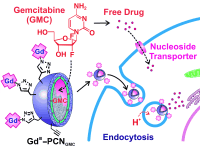 |
| Polymer-caged nanobins (PCNs) that can undergo Cu(I)-catalyzed click reactions enable the combination of GdIII magnetic resonance imaging (MRI) contrast agents and an anticancer drug (gemcitabine, GMC) into a single theranostic platform (see picture). The resulting gadolinium(III)-conjugated, GMC-loaded PCNs (GdIII–PCNGMC) exhibit a significantly superior performance in r1 relaxivity, drug uptake, and pH-sensitive drug release. Credit Angewandte Chemie International Edition |
Abstract:
The standard approach to cancer therapy today is to mix and match chemotherapy drugs in order to attack tumors in multiple ways. Now, two separate teams of investigators have demonstrated that using nanoparticles to deliver multiple drugs simultaneously can produce a synergistic effect that boosts the cell-killing ability of both drugs.
Nanoparticles Deliver One-Two Therapeutic Punch to Kill Tumor Cells
Bethesda, MD | Posted on December 17th, 2010In one study, a team of investigators at Northwestern University has shown that they can combine two powerful but extremely toxic anticancer agents - cisplatin and doxorubicin - in one polymer nanoparticle, producing a substantial boost in their ability of the combination to destroy tumors. In addition, the two-in-one nanoparticle reduces the amount of both drugs needed to kill cancer cells, which presumably would reduce the toxic side effects associated with these drugs.
SonBinh Nguyen and Thomas O'Halloran led this study, which was published in the Journal of the American Chemical Society. Dr. O'Halloran is the co-principal investigator of one of 12 Cancer Nanotechnology Platform Partnerships funded by the National Cancer Institute Alliance for Nanotechnology in Cancer. He is also a member of the Northwestern University Center for Cancer Nanotechnology Excellence (CCNE), which is also part of the Alliance for Nanotechnology in Cancer.
Though originally designed to carry arsenic trioxide to solid tumors, the nanoparticles used in this study are proving to be quite versatile in their ability to ferry a wide range of cargos to malignancies. In this study, the investigators wanted to see if delivering two drugs in one nanoparticle offered any advantages of delivering them without the nanoparticle or in separate nanoparticles. The nanoparticles, which the researchers call nanobins, are made by encasing a liposome inside a pH-responsive polymer cage. In this case, doxorubicin is entrapped within the liposome's core, while cisplatin was entrapped in the polymer cage.
In an initial set of experiments, the investigators determined that a 5 to 1 ratio of cisplatin to doxorubicin was the most effective at treating ovarian tumors when the two drugs were combined in the same nanoparticle. When the two drugs were administered at this ratio but with each in its own nanoparticle, the combination was not only less effective at killing malignant cells, but the two drugs appeared to be interfering with each other, a phenomenon often observed in clinical practice. Administering the two drugs in the same nanoparticle ensures that the drugs are hitting their intracellular targets at the same time, which is what likely leads to the synergism observed in this study.
Meanwhile, Mansoor Amiji and Zhenfeng Duan, co-principle investigators of the Cancer Nanotechnology Platform Partnership at Northeastern University, have shown that a different type of polymer nanoparticle can also deliver two anticancer agents simultaneously and as a result can kill cancer cells that have become resistant to drug therapy. In this case, the researchers synthesized biocompatible polymer nanoparticles that entrapped paclitaxel and lonidamine and that targeted the epidermal growth factor receptor (EGFR) that is overexpressed on highly aggressive tumors. When added to tumor cells growing in culture, the nanoparticle containing both drugs was far more effective at killing the drug-resistance cells than when the two drugs were co-administered in separate nanoparticles. The investigators reported their findings in the journal Molecular Pharmaceutics.
In a separate set of experiments, the results of which were published in the journal Angewandte Chemie International Edition, Drs. Nguyen and O'Halloran, joined by Thomas Meade, another member of the Northwestern CCNE, demonstrated that nanobins can also co-deliver a therapeutic and magnetic resonance imaging agent to tumors. In this study, the researchers loaded the anticancer agent gemcitabine into the nanobin's core and added a gadolinium magnetic resonance contrast agent to the nanobin's surface. When added to mouse tumor cells, the nanobins were taken up rapidly and the nanobins were clearly visible in magnetic resonance images. In addition, the nanoparticles released their gemcitabine payload once the nanobins were taken up by the cultured cells.
This work, which is detailed in three papers, was supported in part by the NCI Alliance for Nanotechnology in Cancer, a comprehensive initiative designed to accelerate the application of nanotechnology to the prevention, diagnosis, and treatment of cancer. Abstracts of the papers are available at the journals' websites.
Journal of the American Chemical Society paper -
View abstract here pubs.acs.org/doi/abs/10.1021/ja107333g
Molecular Pharmaceutics paper -
View abstract here pubs.acs.org/doi/abs/10.1021/mp1002653
Angewandte Chemie International Edition paper -
View abstract here tinyurl.com/28yfmcv
####
About NCI Alliance for Nanotechnology in Cancer
To help meet the goal of reducing the burden of cancer, the National Cancer Institute (NCI), part of the National Institutes of Health, is engaged in efforts to harness the power of nanotechnology to radically change the way we diagnose, treat and prevent cancer.
The NCI Alliance for Nanotechnology in Cancer is a comprehensive, systematized initiative encompassing the public and private sectors, designed to accelerate the application of the best capabilities of nanotechnology to cancer.
Currently, scientists are limited in their ability to turn promising molecular discoveries into benefits for cancer patients. Nanotechnology can provide the technical power and tools that will enable those developing new diagnostics, therapeutics, and preventives to keep pace with today’s explosion in knowledge.
For more information, please click here
Copyright © NCI Alliance for Nanotechnology in Cancer
If you have a comment, please Contact us.Issuers of news releases, not 7th Wave, Inc. or Nanotechnology Now, are solely responsible for the accuracy of the content.
Bookmark:


| Related News Press |
News and information
 Simulating magnetization in a Heisenberg quantum spin chain April 5th, 2024
NRL charters Navy’s quantum inertial navigation path to reduce drift April 5th, 2024
Discovery points path to flash-like memory for storing qubits: Rice find could hasten development of nonvolatile quantum memory April 5th, 2024
Govt.-Legislation/Regulation/Funding/Policy
NRL charters Navy’s quantum inertial navigation path to reduce drift April 5th, 2024
Discovery points path to flash-like memory for storing qubits: Rice find could hasten development of nonvolatile quantum memory April 5th, 2024
Chemical reactions can scramble quantum information as well as black holes April 5th, 2024
Possible Futures
Discovery points path to flash-like memory for storing qubits: Rice find could hasten development of nonvolatile quantum memory April 5th, 2024
With VECSELs towards the quantum internet Fraunhofer: IAF achieves record output power with VECSEL for quantum frequency converters April 5th, 2024
Academic/Education
Rice University launches Rice Synthetic Biology Institute to improve lives January 12th, 2024
Multi-institution, $4.6 million NSF grant to fund nanotechnology training September 9th, 2022
Nanomedicine
New micromaterial releases nanoparticles that selectively destroy cancer cells April 5th, 2024
Good as gold - improving infectious disease testing with gold nanoparticles April 5th, 2024
Researchers develop artificial building blocks of life March 8th, 2024
Announcements
NRL charters Navy’s quantum inertial navigation path to reduce drift April 5th, 2024
Discovery points path to flash-like memory for storing qubits: Rice find could hasten development of nonvolatile quantum memory April 5th, 2024
Nanobiotechnology
New micromaterial releases nanoparticles that selectively destroy cancer cells April 5th, 2024
Good as gold - improving infectious disease testing with gold nanoparticles April 5th, 2024
Researchers develop artificial building blocks of life March 8th, 2024
 |
||
 |
||
| The latest news from around the world, FREE | ||
 |
||
|
|
||
| Premium Products | ||
 |
||
|
Only the news you want to read!
Learn More |
||
 |
||
|
Full-service, expert consulting
Learn More |
||
|
|
||