Home > Press > Tracking Therapeutic Nanoparticles that Target Breast Tumors
 |
| Credit Nano Letters |
Abstract:
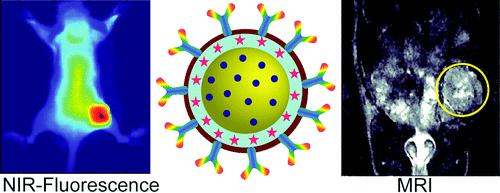
Researchers at Rice University, collaborating with investigators at the Baylor College of Medicine, have used two different types of imaging technologies to track the delivery of a therapeutic nanoparticle to breast tumors.
Tracking Therapeutic Nanoparticles that Target Breast Tumors
Bethesda, MD | Posted on December 17th, 2010The results of this study, which appear in the journal Nano Letters, not only demonstrate the ability to create and track multimodal nanoparticles in the body, but also provide valuable information about how targeting agents impact the fate of complex nanoparticles in the body.
This work was led by Naomi Halas at Rice and Amit Joshi at Baylor. Dr. Halas is co-principal investigator of one of 12 Cancer Nanotechnology Platform Partnerships funded by the National Cancer Institute Alliance for Nanotechnology in Cancer. Dr. Joshi is a member of the Texas Center for Cancer Nanomedicine, one of nine Centers of Cancer Nanotechnology Excellence funded by the National Cancer Institute Alliance for Nanotechnology in Cancer.
The investigators conducted their studies using a gold nanoshell to which they added a magnetic iron oxide nanoparticles embedded in a thin layer of silicon dioxide, followed by a layer of a fluorescent molecule known as ICG and targeting antibody, and finally a layer of polyethylene glycol (PEG) to render the entire construct biocompatible. For targeting breast tumors, the researchers used an antibody that recognizes the HER2 surface protein found on some forms of breast cancer.
After injecting this nanoparticle into mice bearing human tumors that overexpress the HER2 protein, the researchers used both near-infrared imaging and magnetic resonance imaging to follow the particles for the next 72 hours. Tumor levels of the nanoparticle peaked at about 4 hours after injection. In contrast, there was little nanoparticle accumulation in tumors when injected into mice bearing tumors that do not overexpress the HER2 protein. The results obtained when the animals were imaged using magnetic resonance imaging differed in that tumor levels did not peak until 24 hours after injection. The researchers hypothesized that the two results differed because fluorescence imaging detects nanoparticles attached to the outer edge of the tumor while magnetic resonance imaging detects nanoparticles distributed throughout the tumor mass. The fact that it takes longer for nanoparticles to diffuse into the core of a tumor than to merely bind to its surface would explain the time discrepancy. Additional experiments confirmed that the nanoparticles remained intact throughout the experiment.
This work, which was supported in part by the National Cancer Institute, is detailed in a paper titled "Tracking of Multimodal Therapeutic Nanocomplexes Targeting Breast Cancer in Vivo." An abstract of this paper is available at the journal's website.
View abstract at pubs.acs.org/doi/abs/10.1021/nl102889y
####
For more information, please click here
Copyright © NCI Alliance for Nanotechnology in Cancer
If you have a comment, please Contact us.Issuers of news releases, not 7th Wave, Inc. or Nanotechnology Now, are solely responsible for the accuracy of the content.
Bookmark:


| Related News Press |
News and information
 Simulating magnetization in a Heisenberg quantum spin chain April 5th, 2024
NRL charters Navy’s quantum inertial navigation path to reduce drift April 5th, 2024
Discovery points path to flash-like memory for storing qubits: Rice find could hasten development of nonvolatile quantum memory April 5th, 2024
Govt.-Legislation/Regulation/Funding/Policy
NRL charters Navy’s quantum inertial navigation path to reduce drift April 5th, 2024
Discovery points path to flash-like memory for storing qubits: Rice find could hasten development of nonvolatile quantum memory April 5th, 2024
Chemical reactions can scramble quantum information as well as black holes April 5th, 2024
Possible Futures
Discovery points path to flash-like memory for storing qubits: Rice find could hasten development of nonvolatile quantum memory April 5th, 2024
With VECSELs towards the quantum internet Fraunhofer: IAF achieves record output power with VECSEL for quantum frequency converters April 5th, 2024
Academic/Education
Rice University launches Rice Synthetic Biology Institute to improve lives January 12th, 2024
Multi-institution, $4.6 million NSF grant to fund nanotechnology training September 9th, 2022
Nanomedicine
New micromaterial releases nanoparticles that selectively destroy cancer cells April 5th, 2024
Good as gold - improving infectious disease testing with gold nanoparticles April 5th, 2024
Researchers develop artificial building blocks of life March 8th, 2024
Announcements
NRL charters Navy’s quantum inertial navigation path to reduce drift April 5th, 2024
Discovery points path to flash-like memory for storing qubits: Rice find could hasten development of nonvolatile quantum memory April 5th, 2024
Nanobiotechnology
New micromaterial releases nanoparticles that selectively destroy cancer cells April 5th, 2024
Good as gold - improving infectious disease testing with gold nanoparticles April 5th, 2024
Researchers develop artificial building blocks of life March 8th, 2024
 |
||
 |
||
| The latest news from around the world, FREE | ||
 |
||
|
|
||
| Premium Products | ||
 |
||
|
Only the news you want to read!
Learn More |
||
 |
||
|
Full-service, expert consulting
Learn More |
||
|
|
||