Home > Press > Structural Distortions Emerge From Nothing At The Nanoscale
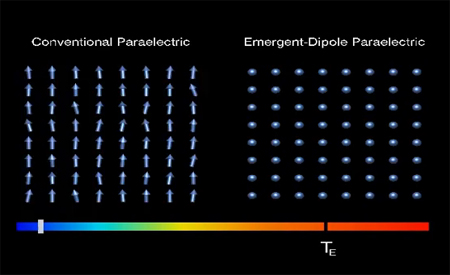 |
| As the emergent-dipole material (right) is warmed, fluctuating local dipoles appear from an undisturbed ground state (i.e., from “nothing”). This is in contrast to the conventional material (left), which has aligned dipoles at low temperatures. The flip-flopping displacements impede the movement of heat through the material, allowing a strong temperature gradient to be maintained. Heat on one side of the material can then induce a flow of electrons from the hot to the cooler side. Capturing this current could put waste heat to work. (View the animation here engineering.columbia.edu/billinge-team-makes-discovery-thermoelectrics) |
Abstract:
Newly Discovered Phase Helps Explain Materials' Ability to Convert Waste Heat to Electricity
Structural Distortions Emerge From Nothing At The Nanoscale
Upton, NY | Posted on December 16th, 2010Scientists have discovered that a class of materials known to convert heat to electricity and vice versa behaves quite unexpectedly at the nanoscale in response to changes in temperature. The discovery — described in the December 17, 2010, issue of Science — is a new "opposite-direction" phase transition that helps explain the strong thermoelectric response of these materials. It may also help scientists identify other useful thermoelectrics, and could further their application in capturing energy lost as heat, for example, in automotive and factory exhaust.
The scientists — from Columbia University's School of Engineering and Applied Science, the U.S. Department of Energy's (DOE) Brookhaven National Laboratory, Argonne National Laboratory, Los Alamos National Laboratory, Northwestern University, and the Swiss Federal Institute of Technology — were studying lead chalcogenides (lead paired with tellurium, selenium, or sulfur) using newly available experimental techniques and theoretical approaches that allow them to "see" and model behavior of individual atoms at the nanoscale, or on the order of billionths of a meter. With those tools they were able to observe subtle changes in atomic arrangements invisible to conventional probes of structure.
To understand the phase transition the scientists observed, think of the everyday response of a gas like steam cooling to form liquid water, and then freezing to form solid ice. In each case, the atoms undergo some form of structural rearrangement, explains Simon Billinge, a physicist at Columbia Engineering and Brookhaven Lab and a lead author on the Science paper.
"Sometimes, further cooling will lead to further structural transitions: Atoms in the crystal rearrange or become displaced to lower the overall symmetry," Billinge says. The development of such localized atomic distortions upon cooling is normal, he says. "What we discovered in lead chalcogenides is the opposite behavior: At the very lowest temperature, there were no atomic displacements, nothing — but on warming, displacements appear!"
The techniques the scientists used to observe this nanoscale atomic action were high-tech versions of x-ray vision, aided by mathematical and computer analysis of the results. First the lead materials were made in a purified powder form at Northwestern University. Then the scientists bombarded the samples with two kinds of beams — x-rays at the Advanced Photon Source at Argonne and neutrons at the Lujan Neutron Scattering Center at Los Alamos. Detectors gather information about how these beams scatter off the sample to produce diffraction patterns that indicate positions and arrangements of the atoms. Further mathematical and computational analysis of the data using computer programs developed at Brookhaven and Columbia allowed the scientists to model and interpret what was happening at the atomic level over a range of temperatures.
Brookhaven physicist Emil Bozin, first author on the paper, was the first to notice the odd behavior in the data, and he worked tenaciously to prove it was something new and not a data artifact. "If we had just looked at the average structure, we never would have observed this effect. Our analysis of atomic pair distribution functions gives us a much more local view — the distance from one particular atom to its nearest neighbors — rather than just the average," Bozin says. The detailed analysis revealed that, as the material got warmer, these distances were changing on a tiny scale — about 0.025 nanometers — indicating that individual atoms were becoming displaced.
The scientists have made an animation to illustrate the emergence of these displacements upon heating. In it, the displacements are represented by arrows to indicate the changing orientations of the atoms as they flip back and forth, or fluctuate, like tiny dipoles.
According to the scientists, it is this random flipping behavior that is key to the materials' ability to convert heat into electricity.
"The randomly flipping dipoles impede the movement of heat through the material in much the same way that it is more difficult to move through a disorderly wood than an orderly apple orchard where the trees are lined up in rows," Billinge says. "This low thermal conductivity allows a large temperature gradient to be maintained across the sample, which is crucial to the thermoelectric properties."
When one side of the material comes in contact with heat — say, in the exhaust system of a car — the gradient will cause charge carriers in the thermoelectric material (e.g., electrons) to diffuse from the hot side to the cold side. Capturing this thermally induced electric current could put the "waste" heat to use.
This research may help scientists search for other thermoelectric materials with exceptional properties, since it links the good thermoelectric response to the existence of fluctuating dipoles.
"Our next step will be searching for new materials that show this novel phase transition, and finding other structural signatures for this behavior," Billinge said. "The new tools that allow us to probe nanoscale structures are essential to this research.
"Such studies of complex materials at the nanoscale hold the key to many of the transformative technological breakthroughs we seek to solve problems in energy, health, and the environment."
This research was funded by the DOE Office of Science, the Office of Naval Research, and the National Science Foundation.
####
About Brookhaven National Laboratory
One of ten national laboratories overseen and primarily funded by the Office of Science of the U.S. Department of Energy (DOE), Brookhaven National Laboratory conducts research in the physical, biomedical, and environmental sciences, as well as in energy technologies and national security. Brookhaven Lab also builds and operates major scientific facilities available to university, industry, and government researchers. Brookhaven is operated and managed for DOE’s Office of Science by Brookhaven Science Associates, a limited-liability company founded by the Research Foundation of the State University of New York, for and on behalf of Stony Brook University, the largest academic user of Laboratory facilities; and Battelle Memorial Institute, a nonprofit, applied science and technology organization. Visit Brookhaven Lab's electronic newsroom for links, news archives, graphics, and more (www.bnl.gov/newsroom), or follow Brookhaven Lab on Twitter (twitter.com/BrookhavenLab).
About Columbia Engineering
Columbia University’s Fu Foundation School of Engineering and Applied Science offers programs to both undergraduate and graduate students who undertake a course of study leading to the bachelor's, master's, or doctoral degree in engineering and applied science. With facilities specifically designed and equipped to meet the laboratory and research needs of faculty and students, Columbia Engineering is home to a broad array of basic and advanced research installations, from the Columbia Center for Electron Transport in Molecular Nanostructures to the Columbia Genome Center. These interdisciplinary centers in science and engineering, materials research, nanoscale research, and genomic research are leading the way in their respective fields while individual groups of engineers and scientists collaborate to solve some of society’s more vexing challenges. www.engineering.columbia.edu
For more information, please click here
Contacts:
Columbia Engineering contact:
Holly Evarts
212 854-3206
Brookhaven Lab contact:
Karen McNulty Walsh
631 344-8350
Copyright © Brookhaven National Laboratory
If you have a comment, please Contact us.Issuers of news releases, not 7th Wave, Inc. or Nanotechnology Now, are solely responsible for the accuracy of the content.
Bookmark:


| Related News Press |
News and information
 Quantum computer improves AI predictions April 17th, 2026
Flexible sensor gains sensitivity under pressure April 17th, 2026
A reusable chip for particulate matter sensing April 17th, 2026
Detecting vibrational quantum beating in the predissociation dynamics of SF6 using time-resolved photoelectron spectroscopy April 17th, 2026
Physics
UC Irvine physicists discover method to reverse ‘quantum scrambling’ : The work addresses the problem of information loss in quantum computing system April 17th, 2026
Quantum computers simulate fundamental physics: shedding light on the building blocks of nature June 6th, 2025
Govt.-Legislation/Regulation/Funding/Policy
Quantum computer improves AI predictions April 17th, 2026
Metasurfaces smooth light to boost magnetic sensing precision January 30th, 2026
New imaging approach transforms study of bacterial biofilms August 8th, 2025
Possible Futures
A fundamentally new therapeutic approach to cystic fibrosis: Nanobody repairs cellular defect April 17th, 2026
UC Irvine physicists discover method to reverse ‘quantum scrambling’ : The work addresses the problem of information loss in quantum computing system April 17th, 2026
Academic/Education
Rice University launches Rice Synthetic Biology Institute to improve lives January 12th, 2024
Multi-institution, $4.6 million NSF grant to fund nanotechnology training September 9th, 2022
Discoveries
Quantum computer improves AI predictions April 17th, 2026
Flexible sensor gains sensitivity under pressure April 17th, 2026
A reusable chip for particulate matter sensing April 17th, 2026
Detecting vibrational quantum beating in the predissociation dynamics of SF6 using time-resolved photoelectron spectroscopy April 17th, 2026
Materials/Metamaterials/Magnetoresistance
First real-time observation of two-dimensional melting process: Researchers at Mainz University unveil new insights into magnetic vortex structures August 8th, 2025
Researchers unveil a groundbreaking clay-based solution to capture carbon dioxide and combat climate change June 6th, 2025
A 1960s idea inspires NBI researchers to study hitherto inaccessible quantum states June 6th, 2025
Institute for Nanoscience hosts annual proposal planning meeting May 16th, 2025
Announcements
A fundamentally new therapeutic approach to cystic fibrosis: Nanobody repairs cellular defect April 17th, 2026
UC Irvine physicists discover method to reverse ‘quantum scrambling’ : The work addresses the problem of information loss in quantum computing system April 17th, 2026
 |
||
 |
||
| The latest news from around the world, FREE | ||
 |
||
|
|
||
| Premium Products | ||
 |
||
|
Only the news you want to read!
Learn More |
||
 |
||
|
Full-service, expert consulting
Learn More |
||
|
|
||