Home > Press > Nano squid skin: DOD awards $6M for metamaterials research
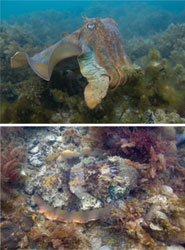 |
| Giant Australian cuttlefish, Sepia apama, in a conspicuous pattern while swimming, and then in a camouflaged pattern that combines “mottle” with “disruptive” coloration. Credit: Roger Hanlon. |
Abstract:
Engineers, marine biologists will study, emulate nature's camouflage masters
Nano squid skin: DOD awards $6M for metamaterials research
Houston, TX | Posted on December 9th, 2010Nanotechnologists, marine biologists and signal-processing experts from Rice University, the Marine Biological Laboratory in Woods Hole, Mass., and other U.S. universities have won a $6 million grant from the Office of Naval Research to unlock the secrets of nature's best camouflage artists. Ultimately, the team hopes to create "metamaterials" that emulate some of the elegant skin colors and patterns produced by marine animals.
"Our internal nickname for this project is 'squid skin,' but it is really about fundamental research," said Naomi Halas, a nano-optics pioneer at Rice and the principal investigator on the four-year grant. "Our deliverable is knowledge -- the basic discoveries that will allow us to make materials that are observant, adaptive and responsive to their environment."
Halas said the project was inspired by the groundbreaking work of grant co-investigator Roger Hanlon, a Woods Hole marine biologist who has spent more than three decades studying the class of animals called cephalopods that includes the squid, octopus and cuttlefish. One of Hanlon's many discoveries is that cephalopod skins contain opsins, the same type of light-sensing proteins that function in eyes.
"The presence of opsin means they have some primitive vision sensor embedded in their skin," Halas said. "So the questions we have are, 'What can we, as engineers, learn from the way these animals perceive light and color? Do their brains play a part, or is this totally downloaded into the skin so it's not using animal CPU time?"
Halas said the project has several tracks. The team's marine biologists -- Hanlon and Thomas Cronin of the University of Maryland, Baltimore County -- will investigate how cephalopods sense and use light to regulate their skin's patterns, colors and contrasts.
"This project will enable us to explore an exciting new avenue of vision research -- distributed light sensing throughout the skin," Hanlon said. "How and where that visual information is used by the nervous system is likely to uncover some novel neural circuitry."
It will be up to the team's engineers to try and emulate cephalopod skin using new metamaterials, materials that blur the line between material and machine. Halas said the group plans to use patterns of organized nanostructures to create sheets of materials that can change colors quickly -- like the pixels of a high-definition television screen -- but which can also "see" light in the same way that squid skins do. A key component of the material will be unique clusters of nanomaterials discovered by Rice chemist Stephan Link, a co-investigator on the grant. Halas said Link's materials are very sensitive to changes in their environment and can more easily change colors than other nanomaterials.
Another type of nanoparticle will likely be used for light sensing, and the team will also need a control mechanism, a system for processing incoming light signals and generating camouflage output. Co-investigator Peter Nordlander, a Rice physicist, will work on optics, and materials scientist John Rogers, a co-investigator at the University of Illinois, will help bring everything together into a package that's large enough to be seen without a microscope.
"This is an inherently multidisciplinary problem," Halas said. "No one is going to understand this unless you have marine biologists talking in detail to systems engineers, who talk in detail to nanotechnologists, who talk in detail to the people who integrate everything. There has to be strong dialogue among everyone."
Halas said the biggest surprise so far has been the close affinity that's developed between Hanlon and Rice signal-processing expert Rich Baraniuk, the leader of the team's systems engineering effort.
"You would think that applied mathematicians and marine biologists would have almost nothing in common," she said. "But they have more in common than the rest of us. They are thinking about basically the same problems, but they are thinking about them from very different points of view."
Related materials:
PBS NOVA ScienceNOW profile of Naomi Halas: www.pbs.org/wgbh/nova/body/naomi-halas.html
Images, video and information about Roger Hanlon's research:
www.mbl.edu/news/press_releases/2009/2009_pr_01_15.html
####
About Rice University
Located in Houston, Rice University is consistently ranked one of America's best teaching and research universities. Known for its "unconventional wisdom," Rice is distinguished by its: size -- 3,279 undergraduates and 2,277 graduate students; selectivity -- 12 applicants for each place in the freshman class; resources -- an undergraduate student-to-faculty ratio of 5-to-1; sixth largest endowment per student among American private research universities; residential college system, which builds communities that are both close-knit and diverse; and collaborative culture, which crosses disciplines, integrates teaching and research, and intermingles undergraduate and graduate work.
For more information, please click here
Contacts:
Jade Boyd
713-348-6778
Copyright © Rice University
If you have a comment, please Contact us.Issuers of news releases, not 7th Wave, Inc. or Nanotechnology Now, are solely responsible for the accuracy of the content.
Bookmark:


| Related News Press |
News and information
 Simulating magnetization in a Heisenberg quantum spin chain April 5th, 2024
NRL charters Navy’s quantum inertial navigation path to reduce drift April 5th, 2024
Discovery points path to flash-like memory for storing qubits: Rice find could hasten development of nonvolatile quantum memory April 5th, 2024
Academic/Education
Rice University launches Rice Synthetic Biology Institute to improve lives January 12th, 2024
Multi-institution, $4.6 million NSF grant to fund nanotechnology training September 9th, 2022
Announcements
NRL charters Navy’s quantum inertial navigation path to reduce drift April 5th, 2024
Discovery points path to flash-like memory for storing qubits: Rice find could hasten development of nonvolatile quantum memory April 5th, 2024
Grants/Sponsored Research/Awards/Scholarships/Gifts/Contests/Honors/Records
Discovery points path to flash-like memory for storing qubits: Rice find could hasten development of nonvolatile quantum memory April 5th, 2024
Chemical reactions can scramble quantum information as well as black holes April 5th, 2024
Research partnerships
Discovery points path to flash-like memory for storing qubits: Rice find could hasten development of nonvolatile quantum memory April 5th, 2024
Researchers’ approach may protect quantum computers from attacks March 8th, 2024
'Sudden death' of quantum fluctuations defies current theories of superconductivity: Study challenges the conventional wisdom of superconducting quantum transitions January 12th, 2024
 |
||
 |
||
| The latest news from around the world, FREE | ||
 |
||
|
|
||
| Premium Products | ||
 |
||
|
Only the news you want to read!
Learn More |
||
 |
||
|
Full-service, expert consulting
Learn More |
||
|
|
||