Home > Press > Graphene rising
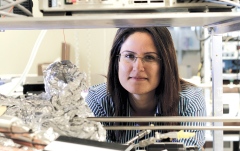 |
| Graduate student Muge Acik - Courtesy of Rodolfo Guzman |
Abstract:
Grad student publishes on new material
By Rebecca Gomez
Graphene rising
Dallas, TX | Posted on November 1st, 2010Before her research was published in the Oct. 2010 issue of the scientific journal Nature Materials, before her discovery of a radical new formation of graphene oxide, before she could even conceive of what the data from her experiments was telling her, materials science graduate student Muge Acik had to prove quantum physics wrong.
Acik, more familiar with chemistry than physics, worked with Materials Science Department Head Yves Chabal to observe the unusual behavior of electrons in the experiments.
"The exciting part was that to discover this conformation of graphene oxide, we had to solve how this conformation occurred," Chabal said.
The phenomena couldn't be explained by current physics. It was because of the unique properties of a new material called graphene.
According to the Royal Swedish Academy of Sciences (RASA), who awarded the 2010 Nobel Prize in Physics for the isolation and identification of graphene done by other physicists, graphene is a single layer of carbon just one atom thick. RASA has produced a public information document that states graphene is the strongest, thinnest material known on earth. Not only is it transparent, but it's also an ultra-fast conductor of electrons and heat.
Chabal was granted funding by Nanotech Research Initiative (NRI) and Texas Instruments (TI) to determine if graphene could be modified to supersede silicon-based transistors in creating faster, more powerful microelectronic devices.
"Transistors are very small switches that comprise the basic function of every electronic device. They give you a one or a zero, a yes or a no," Chabal said.
Chabal chose Acik, who had been endowed by a TI Diversity Fellowship, to create a stable attachment of graphene to oxygen that would render the material functional as a transistor.
"Imagine knowing only bicycles and being told to figure out how to use a car," Acik said. "That was graphene for me."
The research required completely new machines to experiment with the nano-scale material, machines that came with digital displays Acik said she was not familiar with. Acik enlisted the help of Natural Science and Engineering Research Laboratory (NSERL) lab assistant and computer engineering senior Rudolfo Guzman to understand the computer side of the experiments.
"At first their research was foreign to me, but I was able to help with any electrical system or computer programming issues in the lab," Guzman said.
The cross-disciplinary team collaborated with materials science professor Kyeongjae Cho and the entire faculty of NSERL to find out exactly what they had created.
"The formation we discovered was functional ether bound at the edges of graphene. This detail may seem mundane, but once discovered it can have great results," Chabal said.
The results as concluded in their Nature Materials article, ‘unusual infrared-absorption mechanism in thermally reduced graphene oxide,' stated this conformation of graphene oxide showed promise in applications of solar panels or thermal-infrared remote sensing (night vision).
Even though the research was driven by creating a graphene based transistor, Chabal said it is common that nanotechnology research will lead to unexpected applications.
He used similar research into microelectronic device applications for carbon nanotubules as an example.
"While people are waiting for the microelectronic devices, they may not know that tennis balls are already being manufactured with carbon nanotubules."
####
For more information, please click here
Copyright © University of Texas at Dallas
If you have a comment, please Contact us.Issuers of news releases, not 7th Wave, Inc. or Nanotechnology Now, are solely responsible for the accuracy of the content.
Bookmark:


| Related News Press |
News and information
 Quantum computer improves AI predictions April 17th, 2026
Flexible sensor gains sensitivity under pressure April 17th, 2026
A reusable chip for particulate matter sensing April 17th, 2026
Detecting vibrational quantum beating in the predissociation dynamics of SF6 using time-resolved photoelectron spectroscopy April 17th, 2026
Physics
UC Irvine physicists discover method to reverse ‘quantum scrambling’ : The work addresses the problem of information loss in quantum computing system April 17th, 2026
Quantum computers simulate fundamental physics: shedding light on the building blocks of nature June 6th, 2025
Govt.-Legislation/Regulation/Funding/Policy
Quantum computer improves AI predictions April 17th, 2026
Metasurfaces smooth light to boost magnetic sensing precision January 30th, 2026
New imaging approach transforms study of bacterial biofilms August 8th, 2025
Academic/Education
Rice University launches Rice Synthetic Biology Institute to improve lives January 12th, 2024
Multi-institution, $4.6 million NSF grant to fund nanotechnology training September 9th, 2022
Nanotubes/Buckyballs/Fullerenes/Nanorods/Nanostrings/Nanosheets
Tiny nanosheets, big leap: A new sensor detects ethanol at ultra-low levels January 30th, 2026
Enhancing power factor of p- and n-type single-walled carbon nanotubes April 25th, 2025
Chainmail-like material could be the future of armor: First 2D mechanically interlocked polymer exhibits exceptional flexibility and strength January 17th, 2025
Innovative biomimetic superhydrophobic coating combines repair and buffering properties for superior anti-erosion December 13th, 2024
Announcements
A fundamentally new therapeutic approach to cystic fibrosis: Nanobody repairs cellular defect April 17th, 2026
UC Irvine physicists discover method to reverse ‘quantum scrambling’ : The work addresses the problem of information loss in quantum computing system April 17th, 2026
Tools
Metasurfaces smooth light to boost magnetic sensing precision January 30th, 2026
From sensors to smart systems: the rise of AI-driven photonic noses January 30th, 2026
Japan launches fully domestically produced quantum computer: Expo visitors to experience quantum computing firsthand August 8th, 2025
Research partnerships
Lab to industry: InSe wafer-scale breakthrough for future electronics August 8th, 2025
HKU physicists uncover hidden order in the quantum world through deconfined quantum critical points April 25th, 2025
Quantum nanoscience
Beyond silicon: Electronics at the scale of a single molecule January 30th, 2026
MXene nanomaterials enter a new dimension Multilayer nanomaterial: MXene flakes created at Drexel University show new promise as 1D scrolls January 30th, 2026
ICFO researchers overcome long-standing bottleneck in single photon detection with twisted 2D materials August 8th, 2025
 |
||
 |
||
| The latest news from around the world, FREE | ||
 |
||
|
|
||
| Premium Products | ||
 |
||
|
Only the news you want to read!
Learn More |
||
 |
||
|
Full-service, expert consulting
Learn More |
||
|
|
||