Home > Press > Understanding How Cells Respond to Nanoparticles
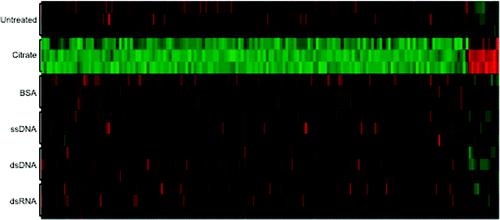 |
| Nanoparticles are finding utility in myriad biotechnological applications, including gene regulation, intracellular imaging, and medical diagnostics. Thus, evaluating the biocompatibility of these nanomaterials is imperative. Here we use genome-wide expression profiling to study the biological response of HeLa cells to gold nanoparticles functionalized with nucleic acids. |
Abstract:
Gold nanoparticles are showing real promise as vehicles for efficiently delivering therapeutic nucleic acids, such as disease-fighting genes and small interfering RNA (siRNA) molecules, to tumors. Now, a team of investigators from Northwestern University has shown that the safety of gold nanoparticle-nucleic acid formulations depends significantly on how the nucleic acids and nanoparticles are linked to one another, a finding with important implications for those researchers developing such constructs.
Understanding How Cells Respond to Nanoparticles
Bethesda, MD | Posted on October 27th, 2010Chad Mirkin, co-principal investigator of the Northwestern University Center for Cancer Nanotechnology Excellence, one of nice such centers established by the National Cancer Institute (NCI), led the team of investigators that studied how cells respond to different nucleic acid-nanoparticle formulations. The investigators published their results in the journal ACS Nano.
To measure how cancer cells respond when they take up nanoparticles, Dr. Mirkin and his colleagues used a technique known as genome-wide expression profiling, which measures relative changes in global gene expression. The investigators added different types of nanoparticles to cancer cells growing in culture dishes and then obtained whole genome expression profiles for the cells. In all the experiments, the researchers attached non-targeting nucleic acids attached to the nanoparticles in order to minimize gene changes that might be triggered through a therapeutic effect relating to a specific, designed interaction between the nucleic acid and a targeted gene.
The results of these comparison studies showed that the surface properties of the nanoparticles had a profound impact on how a given nanoparticle impacts gene expression within a cell. The researchers observed the most surprising and noteworthy difference when they compared two nanoparticles that differed only in the manner in which the nucleic acids were attached to the nanoparticle surface. Nanoparticles loosely linked to the nucleic acids triggered large-scale changes in gene expression, while in contrast, nanoparticles linked tightly to nucleic acids through a covalent chemical bond had virtually no effect on gene expression. These findings, the researchers noted, show how important it is to fully characterize nanoparticles not only in terms of the shape and size, but also with respect to their surface properties.
This work, which is detailed in a paper titled, "Cellular Response of Polyvalent Oligonucleotide-Gold Nanoparticle Conjugates," was supported in part by the NCI Alliance for Nanotechnology in Cancer, a comprehensive initiative designed to accelerate the application of nanotechnology to the prevention, diagnosis, and treatment of cancer. An abstract of this paper is available at the journal's website.
View abstract at pubs.acs.org/doi/abs/10.1021/nn102228s
####
About NCI Alliance for Nanotechnology in Cancer
To help meet the goal of reducing the burden of cancer, the National Cancer Institute (NCI), part of the National Institutes of Health, is engaged in efforts to harness the power of nanotechnology to radically change the way we diagnose, treat and prevent cancer.
The NCI Alliance for Nanotechnology in Cancer is a comprehensive, systematized initiative encompassing the public and private sectors, designed to accelerate the application of the best capabilities of nanotechnology to cancer.
Currently, scientists are limited in their ability to turn promising molecular discoveries into benefits for cancer patients. Nanotechnology can provide the technical power and tools that will enable those developing new diagnostics, therapeutics, and preventives to keep pace with today’s explosion in knowledge.
For more information, please click here
Copyright © NCI Alliance for Nanotechnology in Cancer
If you have a comment, please Contact us.Issuers of news releases, not 7th Wave, Inc. or Nanotechnology Now, are solely responsible for the accuracy of the content.
Bookmark:


| Related News Press |
News and information
 Simulating magnetization in a Heisenberg quantum spin chain April 5th, 2024
NRL charters Navy’s quantum inertial navigation path to reduce drift April 5th, 2024
Discovery points path to flash-like memory for storing qubits: Rice find could hasten development of nonvolatile quantum memory April 5th, 2024
Govt.-Legislation/Regulation/Funding/Policy
NRL charters Navy’s quantum inertial navigation path to reduce drift April 5th, 2024
Discovery points path to flash-like memory for storing qubits: Rice find could hasten development of nonvolatile quantum memory April 5th, 2024
Chemical reactions can scramble quantum information as well as black holes April 5th, 2024
Academic/Education
Rice University launches Rice Synthetic Biology Institute to improve lives January 12th, 2024
Multi-institution, $4.6 million NSF grant to fund nanotechnology training September 9th, 2022
Nanomedicine
New micromaterial releases nanoparticles that selectively destroy cancer cells April 5th, 2024
Good as gold - improving infectious disease testing with gold nanoparticles April 5th, 2024
Researchers develop artificial building blocks of life March 8th, 2024
Announcements
NRL charters Navy’s quantum inertial navigation path to reduce drift April 5th, 2024
Discovery points path to flash-like memory for storing qubits: Rice find could hasten development of nonvolatile quantum memory April 5th, 2024
Nanobiotechnology
New micromaterial releases nanoparticles that selectively destroy cancer cells April 5th, 2024
Good as gold - improving infectious disease testing with gold nanoparticles April 5th, 2024
Researchers develop artificial building blocks of life March 8th, 2024
 |
||
 |
||
| The latest news from around the world, FREE | ||
 |
||
|
|
||
| Premium Products | ||
 |
||
|
Only the news you want to read!
Learn More |
||
 |
||
|
Full-service, expert consulting
Learn More |
||
|
|
||