Home > Press > Gradient Multi-Layer Nano-films for Photovoltaic and other applications
 |
| GML (Gradient Multi-Layer) nano-film |
Abstract:
Recently, a new type of nanostructure - GML (Gradient Multi-Layer) nano-film - attracted attention of the researchers in the solar cell industry. The properties of this structure can be used in design of more efficient and less expensive solar cells, as well as other nano-structured devices.
Gradient Multi-Layer Nano-films for Photovoltaic and other applications
Posted on October 7th, 2010GML Nano films
Quantum Dots are spherical nano-particles (or nano-crystals) typically made of semiconductor or metal.
Nano-structured Materials (or Devices) typically contain two or more interpenetrating nano-scale networks (Bulk Hetero Junctions or BHJs) including Organic (Polymer Blends), Inorganic (Quantum Dots only), and Hybrid (Polymer with Embedded Quantum Dots).
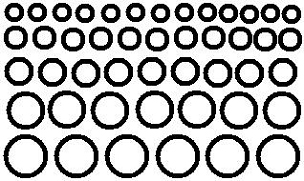
Gradient Multi-Layer (GML) Nano-structure (or nano-film) is a stack of Quantum Dot layers arranged to form a size gradient, composition gradient, density gradient or composition/size modulation with the strict control of each layer thickness and composition. The GML nano-film may include two or more types of Quantum Dot material to form Bulk Hetero Junctions or it can be embedded in the organic material (polymer).
GML Nano films have been described so far in only a few publications i.e. "Microchemical Nanofactories", US Patent Publ. 20080108122 (chemical method of building GML Nano); "Nanophotovoltaic Device with Improved Quantum Efficiency", US Patent Publ. 2008142075 2008.(mine); "Energy transfer between quantum dots of different sizes for quantum dot solar cells", 34th PV Spec.Conf., 2009 (Stanford research).
GML Nano films applications for PhotoVoltaics
Assembly of Quantum Dot layers can be designed to efficiently absorb the most of the Sun spectrum (0.3-2.0+ eV) by size and composition tuning. Specifically, one type of Quantum Dots can be selected from the low band-gap material (i.e. PbSe, InAs, Ge, others) to be able to absorb InfraRead part of the spectrum, and by tuning the QDs' sizes Quantum Dots made from the same material will absorb "green/yellow" part. The other Quantum Dots may have a wider band gap to absorb the "blue/UV" part of Spectrum. Due to the Quantum Confinement light absorption in Quantum Dot layers is very strong so the entire Sun spectrum can be absorbed within several tens to a hundred of nanometers.
Quantum Dots generally exhibit Multi Exciton Generation (MEG) phenomena, i.e. generation of more than one electron-hole pair by a single high-energy photon. GML Nano-films, containing low band gap QD's are expected to exhibit and utilize this phenomena, at least in some portion of the film thus enhancing Power Conversion Efficiency of GML Nano-film solar cell.
Size gradient in the GML Nano film creates corresponding gradient of the electro-chemical potential, which is equivalent to generation of high built-in Electric field in the film, which enhances transport of electrons and holes thus improving internal quantum efficiency (IQE) and photo current.
GML Nano films can exhibit phenomena of light trapping and photon re-emission, which additionally enhances IQE.
In case the efficient method of building GML Nano film is available the efficient PV structure can be formed that will provide the highest possible Power Conversion Efficiency.
PV expectations and main challenges
Theoretically, assuming a perfect transport (IQE), Multi Exciton Generation and perfect light trapping/photon re-emission and max possible Voc, the PCE can reach 65+% (still below the thermodynamic limit of about 86%). It is, however, a very challenging goal (see e.g. "Prospects of Nanostructure-Based Solar Cells...", Int. Journ. Of Photoenergy, 2009, id 154059).
One challenge here is to design a GML Nano structure in such precise and well-controlled way that allows for successful utilizing most or all of the above advantages of QD systems. But, even if the "smart" design of an efficient GML Nano structure had been available it would be unclear as to how to build such a structure in a well controlled, reliable, inexpensive and production-worthy way.
This represent another big challenge as most of the known methods of building nanostructured material are either unable to form a GML Nano structure (spin-coating, generally all solution coating methods) or are very expensive with low throughput and difficulties to be transferred to a full-scale production environment (Atomic Layer Deposition (ALD), Langmuir-Blodget or Microchemical method of US 20080108122).
####
For more information, please click here
Contacts:
Dr. Boris Gilman
Copyright © Coolsol R&C
If you have a comment, please Contact us.Issuers of news releases, not 7th Wave, Inc. or Nanotechnology Now, are solely responsible for the accuracy of the content.
Bookmark:


| Related News Press |
News and information
 Quantum computer improves AI predictions April 17th, 2026
Flexible sensor gains sensitivity under pressure April 17th, 2026
A reusable chip for particulate matter sensing April 17th, 2026
Detecting vibrational quantum beating in the predissociation dynamics of SF6 using time-resolved photoelectron spectroscopy April 17th, 2026
Energy
Sensors innovations for smart lithium-based batteries: advancements, opportunities, and potential challenges August 8th, 2025
Simple algorithm paired with standard imaging tool could predict failure in lithium metal batteries August 8th, 2025
Quantum Dots/Rods
A new kind of magnetism November 17th, 2023
IOP Publishing celebrates World Quantum Day with the announcement of a special quantum collection and the winners of two prestigious quantum awards April 14th, 2023
Qubits on strong stimulants: Researchers find ways to improve the storage time of quantum information in a spin rich material January 27th, 2023
NIST’s grid of quantum islands could reveal secrets for powerful technologies November 18th, 2022
Solar/Photovoltaic
Spinel-type sulfide semiconductors to operate the next-generation LEDs and solar cells For solar-cell absorbers and green-LED source October 3rd, 2025
KAIST researchers introduce new and improved, next-generation perovskite solar cell November 8th, 2024
Groundbreaking precision in single-molecule optoelectronics August 16th, 2024
Development of zinc oxide nanopagoda array photoelectrode: photoelectrochemical water-splitting hydrogen production January 12th, 2024
 |
||
 |
||
| The latest news from around the world, FREE | ||
 |
||
|
|
||
| Premium Products | ||
 |
||
|
Only the news you want to read!
Learn More |
||
 |
||
|
Full-service, expert consulting
Learn More |
||
|
|
||