Home > Press > Nanotechnology Now Congratulates Winners of 2010 Nobel Prize in Physics
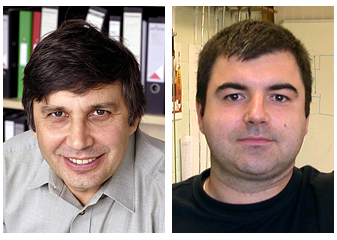 |
| Andre Geim & Konstantin Novoselov. Photos: Sergeom, Wikimedia Commons. |
Abstract:
Prize awarded jointly to Andre Geim and Konstantin Novoselov "for groundbreaking experiments regarding the two-dimensional material graphene"
SEK 10 million to be shared equally between the Nobel Laureates
Nanotechnology Now Congratulates Winners of 2010 Nobel Prize in Physics
Portland, OR | Posted on October 6th, 2010Nanotechnology Now wishes to congratulate Andre Geim and Konstantin Novoselov for "producing, isolating, identifying and characterizing graphene."
From the Nobel Prize press release, October 5, 2010:
"A thin flake of ordinary carbon, just one atom thick, lies behind this year's Nobel Prize in Physics. Andre Geim and Konstantin Novoselov have shown that carbon in such a flat form has exceptional properties that originate from the remarkable world of quantum physics.
Graphene is a form of carbon. As a material it is completely new - not only the thinnest ever but also the strongest. As a conductor of electricity it performs as well as copper. As a conductor of heat it outperforms all other known materials. It is almost completely transparent, yet so dense that not even helium, the smallest gas atom, can pass through it. Carbon, the basis of all known life on earth, has surprised us once again.
Geim and Novoselov extracted the graphene from a piece of graphite such as is found in ordinary pencils. Using regular adhesive tape they managed to obtain a flake of carbon with a thickness of just one atom. This at a time when many believed it was impossible for such thin crystalline materials to be stable.
However, with graphene, physicists can now study a new class of two-dimensional materials with unique properties. Graphene makes experiments possible that give new twists to the phenomena in quantum physics. Also a vast variety of practical applications now appear possible including the creation of new materials and the manufacture of innovative electronics. Graphene transistors are predicted to be substantially faster than today's silicon transistors and result in more efficient computers.
Since it is practically transparent and a good conductor, graphene is suitable for producing transparent touch screens, light panels, and maybe even solar cells.
When mixed into plastics, graphene can turn them into conductors of electricity while making them more heat resistant and mechanically robust. This resilience can be utilised in new super strong materials, which are also thin, elastic and lightweight. In the future, satellites, airplanes, and cars could be manufactured out of the new composite materials.
This year's Laureates have been working together for a long time now. Konstantin Novoselov, 36, first worked with Andre Geim, 51, as a PhD-student in the Netherlands. He subsequently followed Geim to the United Kingdom. Both of them originally studied and began their careers as physicists in Russia. Now they are both professors at the University of Manchester.
Playfulness is one of their hallmarks, one always learns something in the process and, who knows, you may even hit the jackpot. Like now when they, with graphene, write themselves into the annals of science."
Scientific Background on the Nobel Prize in Physics 2010 (PDF)
static.nobelprize.org/nobel_prizes/physics/laureates/2010/sciback_phy_10.pdf
Read the entire release here nobelprize.org/nobel_prizes/physics/laureates/2010/press.html
Prize Announcement
See a Video of the Announcement at nobelprize.org/mediaplayer/index.php?id=1369
View related youtube videos
www.youtube.com/watch?v=G6ZBkpWqrzg
www.youtube.com/watch?v=qVGCGdOAJLc
www.youtube.com/watch?v=JycZxzNyoPQ
####
Copyright © Nanotechnology Now
If you have a comment, please Contact us.Issuers of news releases, not 7th Wave, Inc. or Nanotechnology Now, are solely responsible for the accuracy of the content.
Bookmark:


| Related News Press |
News and information
 Quantum computer improves AI predictions April 17th, 2026
Flexible sensor gains sensitivity under pressure April 17th, 2026
A reusable chip for particulate matter sensing April 17th, 2026
Detecting vibrational quantum beating in the predissociation dynamics of SF6 using time-resolved photoelectron spectroscopy April 17th, 2026
Nanotubes/Buckyballs/Fullerenes/Nanorods/Nanostrings/Nanosheets
Tiny nanosheets, big leap: A new sensor detects ethanol at ultra-low levels January 30th, 2026
Enhancing power factor of p- and n-type single-walled carbon nanotubes April 25th, 2025
Chainmail-like material could be the future of armor: First 2D mechanically interlocked polymer exhibits exceptional flexibility and strength January 17th, 2025
Innovative biomimetic superhydrophobic coating combines repair and buffering properties for superior anti-erosion December 13th, 2024
Announcements
A fundamentally new therapeutic approach to cystic fibrosis: Nanobody repairs cellular defect April 17th, 2026
UC Irvine physicists discover method to reverse ‘quantum scrambling’ : The work addresses the problem of information loss in quantum computing system April 17th, 2026
Grants/Sponsored Research/Awards/Scholarships/Gifts/Contests/Honors/Records
Quantum computer improves AI predictions April 17th, 2026
Detecting vibrational quantum beating in the predissociation dynamics of SF6 using time-resolved photoelectron spectroscopy April 17th, 2026
Metasurfaces smooth light to boost magnetic sensing precision January 30th, 2026
 |
||
 |
||
| The latest news from around the world, FREE | ||
 |
||
|
|
||
| Premium Products | ||
 |
||
|
Only the news you want to read!
Learn More |
||
 |
||
|
Full-service, expert consulting
Learn More |
||
|
|
||