Home > Press > Atherosclerosis Nanotoolbox: NIH Awards $14.6M Translational Cardiovascular Nanomedicine Center for Detecting and Treating Atherosclerosis
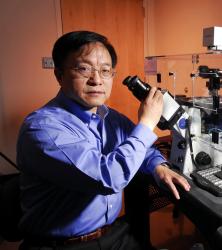 |
| Gang Bao Biomedical Engineering As director of the Center for Translational Cardiovascular Nanomedicine, Gang Bao will lead a research team in developing nanotechnology and biomolecular engineering tools and methodologies for detecting and treating atherosclerosis. (Photo: Gary Meek) |
Abstract:
Georgia Tech and Emory University have received a five-year $14.6 million contract from the National Institutes of Health (NIH) to continue the development of nanotechnology and biomolecular engineering tools and methodologies for detecting and treating atherosclerosis.
by Abby Vogel Robinson
Atherosclerosis Nanotoolbox: NIH Awards $14.6M Translational Cardiovascular Nanomedicine Center for Detecting and Treating Atherosclerosis
Atlanta, GA | Posted on October 5th, 2010Atherosclerosis typically occurs in branched or curved regions of arteries where plaques form because of cholesterol build-up. Inflammation can alter the structure of plaques so they become more likely to rupture, potentially causing a blood vessel blockage and leading to heart attack or stroke.
The award will support the interdisciplinary Center for Translational Cardiovascular Nanomedicine as the second phase of the Program of Excellence in Nanotechnology (PEN), originally established in 2005 with funding from the National Heart, Lung, and Blood Institute of the NIH. This Center integrates the biomedical engineering expertise of Georgia Tech and the cardiology strengths of Emory University's School of Medicine. The broad and long-term goal of the PEN is to improve the diagnosis and treatment of cardiovascular disease, which is the leading cause of death for men and women in the United States.
"In the last five years, we developed a suite of nanotechnology approaches for diagnosing and treating cardiovascular disease and we have demonstrated their efficacy in terms of potential clinical application," said Gang Bao, the program's director and the Robert A. Milton Chair in Biomedical Engineering in the Wallace H. Coulter Department of Biomedical Engineering at Georgia Tech and Emory University. "For the next five years, we will focus on translating these technologies into clinical utility and we would like to have some of these nanotechnologies ready for human clinical trials by the end of this five-year period."
During the first five years of the PEN, the Georgia Tech and Emory University researchers have made contributions in nanotechnology development, basic cardiology research and inflammatory biomarker detection. The research team has published or submitted more than 80 peer-reviewed papers, filed nine patents and established three startup companies to commercialize the nanotechnologies.
"There is a great unmet need to develop innovative diagnostic modalities that inform the activity of the inflammatory disease and to guide evaluation of therapy," explained Bao, who is also a Georgia Tech College of Engineering Distinguished Professor. "Our nanotechnology toolbox will allow us to translate more mature nanotechnologies to clinical utility and evaluate new nanotechnologies that will provide unique functionalities and novel applications."
The second phase of the PEN will build on the foundation developed and progress made during the last five years to accomplish four goals:
• Using nanoparticle probes to image and characterize atherosclerotic plaques
• Diagnosing cardiovascular disease from a blood sample
• Designing new methods for delivering anti-atherosclerosis drugs and genes into the body
• Developing stem cell based therapies to repair damaged heart tissue
The researchers will use the suite of nanotechnologies they developed in the last five years -- including molecular beacons, magnetic nanoparticles, gold nanoparticles, quantum dots, polyketals and hydrocyanine dyes -- to accomplish these goals.
The first goal focuses on determining if an individual's atherosclerotic plaque will grow and rupture. Having this information would allow physicians to treat atherosclerosis more effectively.
"By using nanoparticle probes in vitro and in vivo, we hope to be able to detect early-stage cardiovascular disease," noted Bao, "but many important issues such as detection specificity, toxicity and safety still need to be addressed."
In addition to in vivo imaging of plaques using magnetic resonance imaging (MRI) and positron emission tomography (PET), the research team is developing a laboratory diagnostic test for detecting cardiovascular disease from a blood sample. The presence or levels of specific micro-RNAs, reactive oxygen species or protein markers in the blood will be tested as an indication of the presence and stage of atherosclerosis. This diagnostic approach has the advantages of being fast, inexpensive and nontoxic.
Once atherosclerosis is detected in an individual, it needs to be treated. Several small molecule drugs have been identified as potent therapeutic agents for cardiovascular diseases, but their clinical utility is limited due to their water-repellant nature and short circulation half-life. A novel approach for targeted drug or gene delivery is to use nanoparticles to carry the small molecules into the body. This type of delivery system has the advantage of combining targeting, imaging and controlled release, and can be tailored to optimize circulation time and reduce toxicity.
"Delivering these small molecules in a specific, sufficient and sustained manner to localized vascular lesions may significantly improve the clinical outcomes of cardiovascular diseases," said Bao.
For the final goal, the research team will use stem cells to create a personalized treatment strategy for repairing damage caused by atherosclerosis. The researchers plan to use nanotechnologies to generate and deliver patient-specific induced pluripotent stem cells to the injured vasculature and heart to repair the damage.
"Our goals are ambitious as we plan to further develop our nanoscale tools and nanocardiology knowledge base, to translate the new tools and nanotechnologies to clinical applications in diagnosing and treating cardiovascular disease, and to train the next generation of leaders in cardiovascular nanomedicine," added Bao.
Also contributing from the Coulter Department are professors Don Giddens, Xiaoping Hu, Hanjoong Jo, Shuming Nie, and W. Robert Taylor; associate professors Niren Murthy and May Dongmei Wang; and assistant professor Michael Davis. Giddens is also dean of Georgia Tech's College of Engineering. Taylor is also the director of Emory's Division of Cardiology and a member of the Atlanta VA Medical Center's Division of Cardiology.
Contributors from Emory University include Department of Medicine chair Wayne Alexander; Division of Cardiology professors David Harrison and Kathy Griendling, associate professor Young-sup Yoon and assistant professor Charles Searles Jr.; and Department of Radiology professor Mark Goodman. Katherine Ferrara, a biomedical engineering professor at the University of California, Davis, is also collaborating on the project.
####
For more information, please click here
Contacts:
Media Relations Contacts:
Abby Vogel Robinson
404-385-3364
or
John Toon
404-894-6986
Copyright © Georgia Institute of Technology
If you have a comment, please Contact us.Issuers of news releases, not 7th Wave, Inc. or Nanotechnology Now, are solely responsible for the accuracy of the content.
Bookmark:


| Related News Press |
News and information
 Simulating magnetization in a Heisenberg quantum spin chain April 5th, 2024
NRL charters Navy’s quantum inertial navigation path to reduce drift April 5th, 2024
Discovery points path to flash-like memory for storing qubits: Rice find could hasten development of nonvolatile quantum memory April 5th, 2024
Govt.-Legislation/Regulation/Funding/Policy
NRL charters Navy’s quantum inertial navigation path to reduce drift April 5th, 2024
Discovery points path to flash-like memory for storing qubits: Rice find could hasten development of nonvolatile quantum memory April 5th, 2024
Chemical reactions can scramble quantum information as well as black holes April 5th, 2024
Possible Futures
Discovery points path to flash-like memory for storing qubits: Rice find could hasten development of nonvolatile quantum memory April 5th, 2024
With VECSELs towards the quantum internet Fraunhofer: IAF achieves record output power with VECSEL for quantum frequency converters April 5th, 2024
Academic/Education
Rice University launches Rice Synthetic Biology Institute to improve lives January 12th, 2024
Multi-institution, $4.6 million NSF grant to fund nanotechnology training September 9th, 2022
Nanomedicine
New micromaterial releases nanoparticles that selectively destroy cancer cells April 5th, 2024
Good as gold - improving infectious disease testing with gold nanoparticles April 5th, 2024
Researchers develop artificial building blocks of life March 8th, 2024
Announcements
NRL charters Navy’s quantum inertial navigation path to reduce drift April 5th, 2024
Discovery points path to flash-like memory for storing qubits: Rice find could hasten development of nonvolatile quantum memory April 5th, 2024
Nanobiotechnology
New micromaterial releases nanoparticles that selectively destroy cancer cells April 5th, 2024
Good as gold - improving infectious disease testing with gold nanoparticles April 5th, 2024
Researchers develop artificial building blocks of life March 8th, 2024
Research partnerships
Discovery points path to flash-like memory for storing qubits: Rice find could hasten development of nonvolatile quantum memory April 5th, 2024
Researchers’ approach may protect quantum computers from attacks March 8th, 2024
'Sudden death' of quantum fluctuations defies current theories of superconductivity: Study challenges the conventional wisdom of superconducting quantum transitions January 12th, 2024
 |
||
 |
||
| The latest news from around the world, FREE | ||
 |
||
|
|
||
| Premium Products | ||
 |
||
|
Only the news you want to read!
Learn More |
||
 |
||
|
Full-service, expert consulting
Learn More |
||
|
|
||