Home > Press > 2010 Kavli Prize Laureates Honored in Oslo
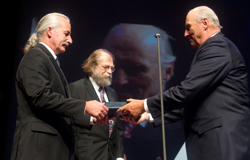 |
| Majesty King Harald of Norway presents the Kavli Prize in Nanoscience. Left to right: Donald M. Eigler (IBM Almaden Research Center, San Jose , US); Nadrian C. Seeman (New York University, US); His Majesty King Harald. (Credit: Terje Bendiksby/Scanpix) |
Abstract:
The 2010 Kavli Prize laureates were presented their awards Tuesday by His Majesty King Harald of Norway during a ceremony at the Oslo Concert Hall.
2010 Kavli Prize Laureates Honored in Oslo
Oslo, Norway | Posted on September 8th, 2010The 90-minute celebration in honor of the laureates also featured addresses by Fred Kavli, founder and chairman of The Kavli Foundation, Nils Christian Stenseth, president of the Norwegian Academy of Science and Letters, and the chairs of the committees charged with selecting the prize recipients.
"Today we celebrate the best of science by honoring these esteemed scientists who, with their groundbreaking work, have taken us a step forward on humanity's journey to better understand and utilize nature," said Fred Kavli.
The masters of ceremony were Åse Kleveland, artist and former Minister of culture for Norway, and Alan Alda, actor, director and writer whose long-time interest and support of science has been recognized and honored with the National Science Board's Public Service Award.
The Kavli Prizes recognize scientists for their seminal advances in three research areas: astrophysics, nanoscience and neuroscience, and are awarded biennially. The 2010 Kavli Prize laureates were chosen for research that has transformed our knowledge of basic units of matter, laid the foundations for the field of nanotechnology, revealed the molecular basis for the transfer of brain signals and other physiological functions, and made possible the building of telescopes that can see deeper into space and further back in time. Each laureate was presented with a gold medal and scroll. Each prize area also included a cash award of one million dollars.
The Kavli Prizes is a partnership between the Norwegian Academy of Science and Letters, The Kavli Foundation, and the Norwegian Ministry of Education and Research. Independent of The Kavli Foundation, Kavli Prize recipients are chosen by three prize committees comprised of distinguished international scientists recommended by the Chinese Academy of Sciences, the French Academy of Sciences, the Max Planck Society, the U.S. National Academy of Sciences and The Royal Society. After making their selection for prize recipients, the recommendations of these prize committees are confirmed by the Norwegian Academy of Science and Letters.
2010 Kavli Prize Laureates in Astrophysics
Citation: "for their contributions to the development of giant telescopes"
Jerry Earl Nelson- University of California, Santa Cruz, US
Raymond Neil Wilson - formerly of Imperial College, London, UK and the European Southern Observatory, Garching, Germany
J. Roger P. Angel - Steward Observatory, University of Arizona, US
2010 Kavli Prize Laureates in Nanoscience
Citation: for their development of unprecedented methods to control matter on the nanoscale"
Donald M. Eigler - IBM Almaden Research Center, San Jose, US
Nadrian C. Seeman - New York University, US
2010 Kavli Prize Laureates in Neuroscience
Citation: "for discovering the molecular basis of neurotransmitter release"
Richard H. Scheller - Genentech, US
Thomas C. Südhof - Stanford University School of Medicine, US
James E. Rothman - Yale University, US
Each laureate was presented with a gold medal and scroll. Each prize area also included a cash award of one million dollars.
The Kavli Prizes is a partnership between the Norwegian Academy of Science and Letters, The Kavli Foundation, and the Norwegian Ministry of Education and Research. Independent of The Kavli Foundation, Kavli Prize recipients are chosen by three prize committees comprised of distinguished international scientists recommended by the Chinese Academy of Sciences, the French Academy of Sciences, the Max Planck Society, the U.S. National Academy of Sciences and The Royal Society. After making their selection for prize recipients, the recommendations of these prize committees are confirmed by the Norwegian Academy of Science and Letters.
####
For more information, please click here
Copyright © Kavli Foundation
If you have a comment, please Contact us.Issuers of news releases, not 7th Wave, Inc. or Nanotechnology Now, are solely responsible for the accuracy of the content.
Bookmark:


| Related News Press |
News and information
 Simulating magnetization in a Heisenberg quantum spin chain April 5th, 2024
NRL charters Navy’s quantum inertial navigation path to reduce drift April 5th, 2024
Discovery points path to flash-like memory for storing qubits: Rice find could hasten development of nonvolatile quantum memory April 5th, 2024
Announcements
NRL charters Navy’s quantum inertial navigation path to reduce drift April 5th, 2024
Discovery points path to flash-like memory for storing qubits: Rice find could hasten development of nonvolatile quantum memory April 5th, 2024
Grants/Sponsored Research/Awards/Scholarships/Gifts/Contests/Honors/Records
Discovery points path to flash-like memory for storing qubits: Rice find could hasten development of nonvolatile quantum memory April 5th, 2024
Chemical reactions can scramble quantum information as well as black holes April 5th, 2024
 |
||
 |
||
| The latest news from around the world, FREE | ||
 |
||
|
|
||
| Premium Products | ||
 |
||
|
Only the news you want to read!
Learn More |
||
 |
||
|
Full-service, expert consulting
Learn More |
||
|
|
||