Home > Press > A new generation of power: Hi-tech rechargeable batteries developed for military
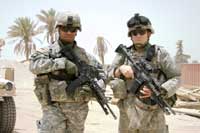 |
| High-performance batteries could soon be woven into fabrics such as military uniforms to provide rechargeable clothing. Credit: Craig DeBourbon |
Abstract:
Scientists reported progress today in using a common virus to develop improved materials for high-performance, rechargeable lithium-ion batteries that could be woven into clothing to power portable electronic devices. They discussed development of the new materials for the battery's cathode, or positive electrode, at the 240th National Meeting of the American Chemical Society (ACS), being held here this week.
A new generation of power: Hi-tech rechargeable batteries developed for military
Washington, DC | Posted on August 27th, 2010These new power sources could in the future be woven into fabrics such as uniforms or ballistic vests, and poured or sprayed into containers of any size and shape, said Mark Allen, Ph.D., who presented the report. He is a postdoc in Angela Belcher's group at the Massachusetts Institute of Technology (MIT). These conformable batteries could power smart phones, GPS units, and other portable electronic devices.
"We're talking about fabrics that also are batteries," Allen said. "The batteries, once woven into clothing, could provide power for a range of high-tech devices, including handheld radios, GPS devices and personal digital assistants. They could also be used in everyday cell phones and smart phones."
Batteries produce electricity by converting chemical energy into electrical energy using two electrodes — an anode and cathode — separated by an electrolyte. At the ACS meeting, Allen described development of new cathodes made from an iron-fluoride material that could soon produce lightweight and flexible batteries with minimal loss of power, performance, or chargeability compared to today's rechargeable power sources.
Allen has extended ground-breaking work done last year by MIT scientist Angela Belcher and her colleagues, who were the first to engineer a virus as a biotemplate for preparing lithium ion battery anodes and cathodes. The virus, called M13 bacteriophage, consists of an outer coat of protein surrounding an inner core of genes. It infects bacteria and is harmless to people.
"Using M13 bacteriophage as a template is an example of green chemistry, an environmentally friendly method of producing the battery," Allen said. "It enables the processing of all materials at room temperature and in water." And these materials, he said, should be less dangerous than those used in current lithium-ion batteries because they produce less heat, which reduces flammability risks.
The Belcher Biomaterials group is in the beginning stages of testing and scaling up the virus-enabled battery materials, which includes powering unmanned aerial vehicles for surveillance operations. Making light-weight and long-lasting batteries that could result in rechargeable clothing would have several advantages for both military personnel and civilians, Allen added.
"Typical soldiers have to carry several pounds of batteries. But if you could turn their clothing into a battery pack, they could drop a lot of weight. The same could be true for frequent business travellers ¯ the road warriors ¯ who lug around batteries and separate rechargers for laptop computers, cell phones, and other devices. They could shed some weight."
####
About American Chemical Society
The American Chemical Society is a non-profit organization chartered by the U.S. Congress. With more than 161,000 members, ACS is the world's largest scientific society and a global leader in providing access to chemistry-related research through its multiple databases, peer-reviewed journals and scientific conferences. Its main offices are in Washington, D.C., and Columbus, Ohio.
For more information, please click here
Contacts:
Michael Bernstein
202-872-6042
617-954-3522 (During the meeting)
Michael Woods
202-872-6293
617-954-3522 (During the meeting)
American Chemical Society
Copyright © American Chemical Society
If you have a comment, please Contact us.Issuers of news releases, not 7th Wave, Inc. or Nanotechnology Now, are solely responsible for the accuracy of the content.
Bookmark:


| Related News Press |
News and information
 Quantum computer improves AI predictions April 17th, 2026
Flexible sensor gains sensitivity under pressure April 17th, 2026
A reusable chip for particulate matter sensing April 17th, 2026
Detecting vibrational quantum beating in the predissociation dynamics of SF6 using time-resolved photoelectron spectroscopy April 17th, 2026
Possible Futures
A fundamentally new therapeutic approach to cystic fibrosis: Nanobody repairs cellular defect April 17th, 2026
UC Irvine physicists discover method to reverse ‘quantum scrambling’ : The work addresses the problem of information loss in quantum computing system April 17th, 2026
Announcements
A fundamentally new therapeutic approach to cystic fibrosis: Nanobody repairs cellular defect April 17th, 2026
UC Irvine physicists discover method to reverse ‘quantum scrambling’ : The work addresses the problem of information loss in quantum computing system April 17th, 2026
Military
Quantum engineers ‘squeeze’ laser frequency combs to make more sensitive gas sensors January 17th, 2025
Chainmail-like material could be the future of armor: First 2D mechanically interlocked polymer exhibits exceptional flexibility and strength January 17th, 2025
Single atoms show their true color July 5th, 2024
NRL charters Navy’s quantum inertial navigation path to reduce drift April 5th, 2024
Battery Technology/Capacitors/Generators/Piezoelectrics/Thermoelectrics/Energy storage
Decoding hydrogen‑bond network of electrolyte for cryogenic durable aqueous zinc‑ion batteries January 30th, 2026
COF scaffold membrane with gate‑lane nanostructure for efficient Li+/Mg2+ separation January 30th, 2026
MXene nanomaterials enter a new dimension Multilayer nanomaterial: MXene flakes created at Drexel University show new promise as 1D scrolls January 30th, 2026
 |
||
 |
||
| The latest news from around the world, FREE | ||
 |
||
|
|
||
| Premium Products | ||
 |
||
|
Only the news you want to read!
Learn More |
||
 |
||
|
Full-service, expert consulting
Learn More |
||
|
|
||