Home > Press > Bioengineering design makes health diagnosis simpler, quicker
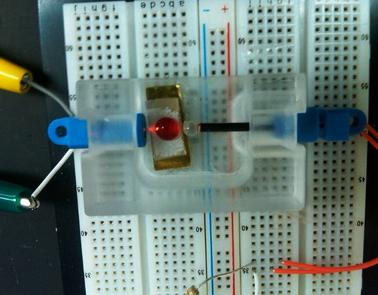 |
| Pictured is a drop of blood on a prototype of a diagnostic device developed by ASU researchers. It works by shining a near-infrared light-emitting diode (LED) on a drop of whole blood sitting on a water-repellent surface. The shape of the drop focuses the light into an intense beam measured by a second LED. Nanoparticles or microparticles in the drop begin to stick together when the fluid sample from a patient contains an infectious agent or a protein. This leads to the self-mixing action that enables detection of indications of infectious diseases and unhealthy protein levels. |
Abstract:
ASU bioengineering research produces design for new device to help detect diseases quickly and at lower costs
Bioengineering design makes health diagnosis simpler, quicker
Phoenix, AZ | Posted on August 24th, 2010Arizona State University researchers have demonstrated a way to dramatically simplify testing patients for infectious diseases and unhealthy protein levels.
New testing instrumentation developed by Antonia Garcia and John Schneider promises to make the procedure less costly and produce results in less time.
Current testing is slow and expensive because of the complications of working with blood, saliva, urine and other biological fluids, said Garcia, a professor in the School of Biological and Health Systems Engineering, one of ASU's Ira A. Fulton Schools of Engineering.
Such samples "are complex mixtures that require sophisticated instruments capable of mixing a sample with antibodies or other biological reactants to produce an accurate positive or negative reaction," Garcia said.
He and Schneider, a bioengineering graduate student researcher, have come up with a testing method that enables the patient sample itself to act in concert with a rudimentary, low-cost testing device.
The method uses common light-emitting diodes (LEDs) and simple microeletronic amplifiers rather than more technologically intensive and costly lasers and robotics.
Fluids and light working together
Garcia and Schneider have demonstrated that superhydrophobic surfaces can shape blood, saliva, urine and other fluids into round drops. The drops can focus light and quickly mix and move microparticles and nanopartices that can be examined to reveal a specific infectious agent or protein.
Superhydrophobicity is a property of materials that repel water, such as ducks' feather or leaves of the lotus plant. Such materials are used commercially in textiles, building materials and surface coatings.
The new device operates by placing a drop of nanoparticles or microparticles on top of a drop of a patient fluid sample on a superhydrophobic surface. The surface has a small depression that holds the liquid sample in place so that it forms a spherical drop.
The drop acts as a lens due to surface tension. An LED is shined on the drop and the drop shape focuses the light into an intense beam measured by a second LED.
Because the drop is slowly evaporating, Garcia explains, nanoparticles or microparticles quickly begin to stick together when the patient fluid sample contains the infectious agent or protein being targeted. The infectious agent or protein migrates to the center of the drop, leaving the particles that have not yet stuck together to move to the surface.
This leads to the self-mixing action that speeds up the diagnostic process so that detection can occur in less than two minutes, he said.
Measuring overall health
Because the fluid sample becomes integrated with the simple LEDs and microelectronics, the researchers call the new device design the Integrascope.
Garcia and Schneider have built several laboratory prototype devices based on the design and have demonstrated how the device can be used to measure C Reactive Protein in human serum, which is an indicator of a variety of inflammatory conditions when the protein is present at high levels.
High levels of protein can indicate cell and tissue damage, inflammation, disruption in kidney function, or an immune system that is pumping out antibodies due to an infection or autoimmune disease. Low protein levels can indicate malnutrition or the presence of diseases that prevent the body from producing sufficient blood protein.
The device also can be used to provide an indication of overall health by measuring total protein in human serum, saliva and urine.
Potential global impact
Development of the device was sparked during Schneider's studies for his doctoral degree, as he experimented with shining an LED on a drop of liquid resting on a superhydrophobic surface. He was trying to see if he could detect changes in light transmission that would tell whether a protein was present in the liquid.
"To our surprise," Garcia said, "we quickly realized that his laboratory set-up generated a very strong beam of light that could be easily measured using a fiber-optic light detector we had in the lab."
The research results have been posted on the web site Nature Precedings. The report describes how the new device works and gives details of the information the diagnostic test provides within the first few minutes of its use.
Low-cost solutions
The most common low-cost devices on the market now are lateral-flow immunoassays similar in look and function to the early pregnancy test.
The biggest stumbling block in making low-cost diagnostic devices for many conditions and diseases is that sensitivity is compromised for specificity in these lateral-flow immunoassays.
A different strategy to miniaturize complex instruments suffers from the difficulty in reducing the cost to what most people would be able to afford - about $1 to $2 dollars per test - as well as the need for spare parts and special handling.
"To have a global impact, we need to have accurate and sensitive tools that can help health care providers treat patients at a low cost during their first visit", Schneider said.
"Our goal is to translate this technology and design into a rugged and easy-to-use device that we would give away for free to clinics. The only costs involved with using the Integrascope would be in the drop of particles and a small piece of a superhydrophobic surface - about $1 to $2 dollars," Garcia said.
International collaboration
With the repeated and more frequent spread of infectious diseases around the globe, it's becoming more critical to have good diagnostic systems in poor countries so proper treatment can be provided rapidly - and so that there is a global early-warning system to alert the public if new and significant outbreaks of disease emerge, Garcia said.
To help accomplish that, Garcia and Schneider are teaming with nanotechnology experts Vladimiro Mujica and Manuel Marquez.
They hope to establish collaborations with Latin American universities, government leaders and entrepreneurs to develop the new diagnostic device.
"We believe a joint U.S.-Latin America technology development effort will spark economic activity that will benefit both regions and prevent disease outbreaks and social unrest in our part of the world", said Mujica, a professor in the Department of Chemistry and Biochemistry in ASU's College of Liberal Arts & Sciences.
Marquez, an entrepreneur and adjunct faculty member in the School of Biological and Health Systems Engineering, is president and research leader of the company YNANO. The company specializes in droplet-nanoengineering for biomedical applications, including Integrascope for disease diagnosis.
"I'm excited about the potential for this device, and that students can be directly engaged in the research and development process," Marquez said. "I've devoted more than a decade of my career to enabling engineers and scientists to rapidly apply their basic discoveries to solving real-life problems."
For more information, read the article "Rapid antigen detection using the liquid sample as a lens and self-mixer for light scattering detection," by Garcia and Schneider posted on the web site Nature Precedings.
####
For more information, please click here
Contacts:
Joe Kullman
(480) 965-8122
Ira A. Fulton Schools of Engineering
Copyright © Arizona State University
If you have a comment, please Contact us.Issuers of news releases, not 7th Wave, Inc. or Nanotechnology Now, are solely responsible for the accuracy of the content.
Bookmark:


| Related News Press |
News and information
 Quantum computer improves AI predictions April 17th, 2026
Flexible sensor gains sensitivity under pressure April 17th, 2026
A reusable chip for particulate matter sensing April 17th, 2026
Detecting vibrational quantum beating in the predissociation dynamics of SF6 using time-resolved photoelectron spectroscopy April 17th, 2026
Possible Futures
A fundamentally new therapeutic approach to cystic fibrosis: Nanobody repairs cellular defect April 17th, 2026
UC Irvine physicists discover method to reverse ‘quantum scrambling’ : The work addresses the problem of information loss in quantum computing system April 17th, 2026
Academic/Education
Rice University launches Rice Synthetic Biology Institute to improve lives January 12th, 2024
Multi-institution, $4.6 million NSF grant to fund nanotechnology training September 9th, 2022
Nanomedicine
A fundamentally new therapeutic approach to cystic fibrosis: Nanobody repairs cellular defect April 17th, 2026
New molecular technology targets tumors and simultaneously silences two ‘undruggable’ cancer genes August 8th, 2025
New imaging approach transforms study of bacterial biofilms August 8th, 2025
Electrifying results shed light on graphene foam as a potential material for lab grown cartilage June 6th, 2025
Announcements
A fundamentally new therapeutic approach to cystic fibrosis: Nanobody repairs cellular defect April 17th, 2026
UC Irvine physicists discover method to reverse ‘quantum scrambling’ : The work addresses the problem of information loss in quantum computing system April 17th, 2026
Nanobiotechnology
A fundamentally new therapeutic approach to cystic fibrosis: Nanobody repairs cellular defect April 17th, 2026
New molecular technology targets tumors and simultaneously silences two ‘undruggable’ cancer genes August 8th, 2025
New imaging approach transforms study of bacterial biofilms August 8th, 2025
Electrifying results shed light on graphene foam as a potential material for lab grown cartilage June 6th, 2025
 |
||
 |
||
| The latest news from around the world, FREE | ||
 |
||
|
|
||
| Premium Products | ||
 |
||
|
Only the news you want to read!
Learn More |
||
 |
||
|
Full-service, expert consulting
Learn More |
||
|
|
||