Home > Press > New technique announced to turn windows into power generators
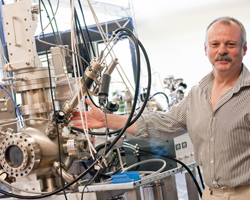 |
| Chris Binns, Professor of Nanotechnology, in the nanoparticle facility at Leicester. |
Abstract:
Norwegian company EnSol AS to develop unique patented technology in collaboration with University of Leicester
New technique announced to turn windows into power generators
Leicester, England | Posted on August 12th, 2010An international team of scientists and industrialists is to meet at the University of Leicester to develop of a revolutionary new technique for harnessing green energy.
Norwegian company EnSol AS has patented a ground breaking, novel thin film solar cell technology which they seek to develop commercially by 2016.
The company is now working with experts in the University of Leicester Department of Physics and Astronomy to develop the revolutionary new type of solar cell material that could be coated as a thin film on, for example, windows in buildings to produce power on a large scale.
Experts will meet at the University from August 10- 11 to officially launch the collaboration between EnSol AS and the University of Leicester.
Professor of Nanotechnology at the University of Leicester, Professor Chris Binns, said the collaboration offered a tremendous opportunity to develop a new method for harnessing solar energy:
"The material has been designed by EnSol AS and is based on nanoparticles that can be synthesised in Leicester. In fact, following some initial investment by the company, the equipment we have here at the University of Leicester is uniquely suited in the world to produce small amounts of the material for prototypes
"The work is important since the solar cells are based on a new operating principle and different to Si solar cells. One of the key advantages is that it is a transparent thin film that can be coated onto window glass so that windows in buildings can also become power generators. Obviously some light has to be absorbed in order to generate power but the windows would just have a slight tinting (though a transmission of only 8-10% is common place for windows in the "sun belt" areas of the world) . Conversely the structural material of the building can also be coated with a higher degree of absorption. This could be side panels of the building itself, or even in the form of "clip-together" solar roof tiles.
"Also since it is a thin film that can be coated onto large areas it could become very much cheaper than conventional devices.
"Photovoltaics are destined to form a key power generating method as part of a low carbon economy and the new technology will bring that a stage closer."
The material is composed of metal nanoparticles (diameters ~ 10 nm) embedded in a transparent composite matrix..
A spokesperson for EnSol AS said: "The basic cell concept has been demonstrated, and it will be the objective of this research and development project to systematically refine this PV cell technology to achieve a cell efficiency of 20% or greater.
"A thin film deposition system with nanoparticle source, will be designed and constructed in collaboration with the University of Leicester for the fabrication of prototype cells based on this design.
"This experimental facility will be designed to produce PV cells with an active area in excess of 16 cm2 (40 mm x 40 mm) deposited onto standard glass substrates. These prototype cells will subsequently be characterised and tested in collaboration with our academic partners.
"EnSol's next generation PV cell technology has tremendous potential for industrial scale, low environmental impact, cost effective production via standard "spray on" techniques."
• Visit www.ensol.no for details of the meeting at the University of Leicester.
####
For more information, please click here
Contacts:
Copyright © University of Leicester
If you have a comment, please Contact us.Issuers of news releases, not 7th Wave, Inc. or Nanotechnology Now, are solely responsible for the accuracy of the content.
Bookmark:


| Related News Press |
News and information
 Quantum computer improves AI predictions April 17th, 2026
Flexible sensor gains sensitivity under pressure April 17th, 2026
A reusable chip for particulate matter sensing April 17th, 2026
Detecting vibrational quantum beating in the predissociation dynamics of SF6 using time-resolved photoelectron spectroscopy April 17th, 2026
Thin films
Tiny nanosheets, big leap: A new sensor detects ethanol at ultra-low levels January 30th, 2026
Utilizing palladium for addressing contact issues of buried oxide thin film transistors April 5th, 2024
Understanding the mechanism of non-uniform formation of diamond film on tools: Paving the way to a dry process with less environmental impact March 24th, 2023
New study introduces the best graphite films: The work by Distinguished Professor Feng Ding at UNIST has been published in the October 2022 issue of Nature Nanotechnology November 4th, 2022
Possible Futures
A fundamentally new therapeutic approach to cystic fibrosis: Nanobody repairs cellular defect April 17th, 2026
UC Irvine physicists discover method to reverse ‘quantum scrambling’ : The work addresses the problem of information loss in quantum computing system April 17th, 2026
Academic/Education
Rice University launches Rice Synthetic Biology Institute to improve lives January 12th, 2024
Multi-institution, $4.6 million NSF grant to fund nanotechnology training September 9th, 2022
Announcements
A fundamentally new therapeutic approach to cystic fibrosis: Nanobody repairs cellular defect April 17th, 2026
UC Irvine physicists discover method to reverse ‘quantum scrambling’ : The work addresses the problem of information loss in quantum computing system April 17th, 2026
Energy
Sensors innovations for smart lithium-based batteries: advancements, opportunities, and potential challenges August 8th, 2025
Simple algorithm paired with standard imaging tool could predict failure in lithium metal batteries August 8th, 2025
Solar/Photovoltaic
Spinel-type sulfide semiconductors to operate the next-generation LEDs and solar cells For solar-cell absorbers and green-LED source October 3rd, 2025
KAIST researchers introduce new and improved, next-generation perovskite solar cell November 8th, 2024
Groundbreaking precision in single-molecule optoelectronics August 16th, 2024
Development of zinc oxide nanopagoda array photoelectrode: photoelectrochemical water-splitting hydrogen production January 12th, 2024
 |
||
 |
||
| The latest news from around the world, FREE | ||
 |
||
|
|
||
| Premium Products | ||
 |
||
|
Only the news you want to read!
Learn More |
||
 |
||
|
Full-service, expert consulting
Learn More |
||
|
|
||