Home > Press > The Forschungszentrum Dresden-Rossendorf chooses NanoSight to characterize magnetic nanoparticles
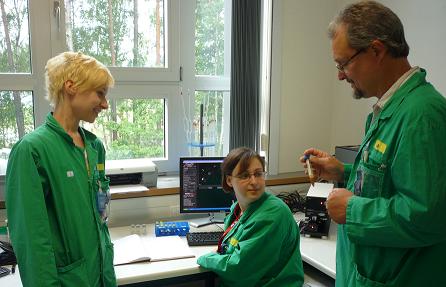 |
| Dr Holger Stephan of the Forschungszentrum Dresden-Rossendorf with two of his team, Anja Höhle & Madlen Matterna |
Abstract:
The Institute for Radiopharmacy at the Forschungszentrum Dresden-Rossendorf is using NanoSight's LM-20 nanoparticle characterization system to study magnetic nanoparticles for applications in cancer therapy.
The Forschungszentrum Dresden-Rossendorf chooses NanoSight to characterize magnetic nanoparticles
Salisbury, UK | Posted on August 11th, 2010The research team of Dr Holger Stephan is working to develop magnetic nanoparticles which can be applied in cancer therapy, preferably in combination with intracellular hyperthermia/ablation and endoradionuclide therapies. This requires nanoparticles to be very stable under physiological conditions and they should also avoid accumulation in the reticuloendothelial system.
Many techniques had been used to characterize the nanoparticles before Dr Stephan discovered the NanoSight system. These included Photon Correlation Spectroscopy (PCS), scanning electron microscopy (SEM) and ultra centrifugation. The NanoSight ability to track individual particles by the scattering of a laser beam has made the study of nanoparticle stability much more convenient. Nanoparticle Tracking Analysis, NTA, has been used to successfully follow the stability of different systems as a function of temperature in EDTA and different cell media.
There are three specific goals for measurement: First is to get information about the size distribution of nanoparticles and, more importantly, their stability under physiological relevant conditions, Next is to study the influence of nanoparticle surface modification on the size distribution finally to achieve structure-activity relationships for the nanoparticles on the cellular uptake behaviour (first step) and cancer tissue accumulation (second step).
Dr Stephan has described several advantages of the NanoSight LM-20 system. He says "the NanoSight provides reliable results on nanoparticles as small as 50nm. Sample handling and measurement is straightforward and experiments are performed more quickly than using PCS. The ability to work directly with relevant solutions removes another block to quickly understanding the behaviour of these magnetic nanoparticles and their ultimate use in treating cancers."
"Our goal," continues Dr Stephan "is to rewrite the medical paradigm, currently being "see and treat" and to make the future one of "detect and prevent." By working on the combining of different therapeutic methodologies, we will provide synergetic medical effectiveness."
To learn more about nanoparticle characterisation using Nanoparticle Tracking Analysis, NTA, please visit the company website (www.nanosight.com) and register for the latest issue of NanoTrail, the company's electronic newsletter.
####
About NanoSight
NanoSight Limited, of Salisbury, UK, provides unique nanoparticle characterization technology. “Nanoparticle Tracking Analysis” (NTA) detects and visualizes populations of nanoparticles in liquids down to 10nm (material dependent) and measures the size of each particle from direct observations of diffusion. This particle-by-particle methodology goes beyond traditional light scattering techniques such as Dynamic Light Scattering (DLS), or Photon Correlation Spectroscopy (PCS), in providing high-resolution particle size distributions. Additionally NanoSight measures concentration and validates all data with video of particles moving under Brownian motion.
This characterization information is highly informative in understanding the more complex suspensions in biological systems, hence its wide application in development of drug delivery systems, viral vaccines, the study of toxicology of nanoparticles and their environmental fate and in biomarker detection. This real-time data also provides insight into the kinetics of protein aggregation and other time-dependent phenomena in a quantitative manner, at deeply sub-micron sizes.
NanoSight has more than 250 systems installed worldwide with users including BASF, BP, GlaxoSmithKline, Novartis, 3M Corp., Roche, Solvay and Unilever together with many universities and research institutes. There are currently 100+ third party papers citing NanoSight results, with this reference base growing very rapidly as NanoSight consolidates its key contribution to nanoparticle characterization. For more information, visit www.nanosight.com
For more information, please click here
Contacts:
Jezz Leckenby
+44 (0) 1799 521881
Copyright © NanoSight
If you have a comment, please Contact us.Issuers of news releases, not 7th Wave, Inc. or Nanotechnology Now, are solely responsible for the accuracy of the content.
Bookmark:


| Related News Press |
News and information
 Quantum computer improves AI predictions April 17th, 2026
Flexible sensor gains sensitivity under pressure April 17th, 2026
A reusable chip for particulate matter sensing April 17th, 2026
Detecting vibrational quantum beating in the predissociation dynamics of SF6 using time-resolved photoelectron spectroscopy April 17th, 2026
Academic/Education
Rice University launches Rice Synthetic Biology Institute to improve lives January 12th, 2024
Multi-institution, $4.6 million NSF grant to fund nanotechnology training September 9th, 2022
Nanomedicine
A fundamentally new therapeutic approach to cystic fibrosis: Nanobody repairs cellular defect April 17th, 2026
New molecular technology targets tumors and simultaneously silences two ‘undruggable’ cancer genes August 8th, 2025
New imaging approach transforms study of bacterial biofilms August 8th, 2025
Electrifying results shed light on graphene foam as a potential material for lab grown cartilage June 6th, 2025
Announcements
A fundamentally new therapeutic approach to cystic fibrosis: Nanobody repairs cellular defect April 17th, 2026
UC Irvine physicists discover method to reverse ‘quantum scrambling’ : The work addresses the problem of information loss in quantum computing system April 17th, 2026
Nanobiotechnology
A fundamentally new therapeutic approach to cystic fibrosis: Nanobody repairs cellular defect April 17th, 2026
New molecular technology targets tumors and simultaneously silences two ‘undruggable’ cancer genes August 8th, 2025
New imaging approach transforms study of bacterial biofilms August 8th, 2025
Electrifying results shed light on graphene foam as a potential material for lab grown cartilage June 6th, 2025
 |
||
 |
||
| The latest news from around the world, FREE | ||
 |
||
|
|
||
| Premium Products | ||
 |
||
|
Only the news you want to read!
Learn More |
||
 |
||
|
Full-service, expert consulting
Learn More |
||
|
|
||