Home > Press > Quantum networds advance with entanglement of photons, solid-state qubits
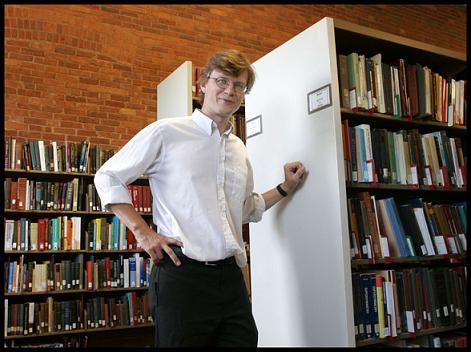 |
| "In quantum computing and quantum communication, a big question has been whether or how it would be possible to actually connect qubits, separated by long distances, to one another," says Mikhail Lukin, senior author of the new study. File photograph by Rose Lincoln/Harvard Staff Photographer |
Abstract:
Physicists demonstrate means for quantum bits to communicate over long distances
By Steve Bradt, Harvard Staff Writer
Quantum networds advance with entanglement of photons, solid-state qubits
Cambridge, MA | Posted on August 9th, 2010A team of Harvard physicists led by Mikhail D. Lukin has achieved the first-ever quantum entanglement of photons and solid-state materials. The work marks a key advance toward practical quantum networks, as the first experimental demonstration of a means by which solid-state quantum bits, or "qubits," can communicate with one another over long distances.
Quantum networking applications such as long-distance communication and distributed computing would require the nodes that process and store quantum data in qubits to be connected to one another by entanglement, a state where two different atoms become indelibly linked such that one inherits the properties of the other.
"In quantum computing and quantum communication, a big question has been whether or how it would be possible to actually connect qubits, separated by long distances, to one another," says Lukin, professor of physics at Harvard and co-author of a paper describing the work in this week's issue of the journal Nature. "Demonstration of quantum entanglement between a solid-state material and photons is an important advance toward linking qubits together into a quantum network."
Quantum entanglement has previously been demonstrated only with photons and individual ions or atoms.
"Our work takes this one step further, showing how one can engineer and control the interaction between individual photons and matter in a solid-state material," says first author Emre Togan, a graduate student in physics at Harvard. "What's more, we show that the photons can be imprinted with the information stored in a qubit."
Quantum entanglement, famously termed "spooky action at a distance" by a skeptical Albert Einstein, is a fundamental property of quantum mechanics. It allows one to distribute quantum information over tens of thousands of kilometers, limited only by how fast and how far members of the entangled pair can propagate in space.
The new result builds upon earlier work by Lukin's group to use single atom impurities in diamonds as qubits. Lukin and colleagues have previously shown that these impurities can be controlled by focusing laser light on a diamond lattice flaw where nitrogen replaces an atom of carbon. That previous work showed that the so-called spin degrees of freedom of these impurities make excellent quantum memory.
Lukin and his co-authors now say that these impurities are also remarkable because, when excited with a sequence of finely tuned microwave and laser pulses, they can emit photons one at a time, such that photons are entangled with quantum memory. Such a stream of single photons can be used for secure transmission of information.
"Since photons are the fastest carriers of quantum information, and spin memory can robustly store quantum information for relatively long periods of time, entangled spin-photon pairs are ideal for the realization of quantum networks," Lukin says. "Such a network, a quantum analog to the conventional internet, could allow for absolutely secure communication over long distances."
####
For more information, please click here
Copyright © Harvard University
If you have a comment, please Contact us.Issuers of news releases, not 7th Wave, Inc. or Nanotechnology Now, are solely responsible for the accuracy of the content.
Bookmark:


| Related News Press |
News and information
 Quantum computer improves AI predictions April 17th, 2026
Flexible sensor gains sensitivity under pressure April 17th, 2026
A reusable chip for particulate matter sensing April 17th, 2026
Detecting vibrational quantum beating in the predissociation dynamics of SF6 using time-resolved photoelectron spectroscopy April 17th, 2026
Physics
UC Irvine physicists discover method to reverse ‘quantum scrambling’ : The work addresses the problem of information loss in quantum computing system April 17th, 2026
Quantum computers simulate fundamental physics: shedding light on the building blocks of nature June 6th, 2025
Possible Futures
A fundamentally new therapeutic approach to cystic fibrosis: Nanobody repairs cellular defect April 17th, 2026
UC Irvine physicists discover method to reverse ‘quantum scrambling’ : The work addresses the problem of information loss in quantum computing system April 17th, 2026
Academic/Education
Rice University launches Rice Synthetic Biology Institute to improve lives January 12th, 2024
Multi-institution, $4.6 million NSF grant to fund nanotechnology training September 9th, 2022
Spintronics
Quantum materials: Electron spin measured for the first time June 9th, 2023
Quantum Computing
Quantum computer improves AI predictions April 17th, 2026
UC Irvine physicists discover method to reverse ‘quantum scrambling’ : The work addresses the problem of information loss in quantum computing system April 17th, 2026
Researchers develop molecular qubits that communicate at telecom frequencies October 3rd, 2025
Announcements
A fundamentally new therapeutic approach to cystic fibrosis: Nanobody repairs cellular defect April 17th, 2026
UC Irvine physicists discover method to reverse ‘quantum scrambling’ : The work addresses the problem of information loss in quantum computing system April 17th, 2026
Quantum nanoscience
Beyond silicon: Electronics at the scale of a single molecule January 30th, 2026
MXene nanomaterials enter a new dimension Multilayer nanomaterial: MXene flakes created at Drexel University show new promise as 1D scrolls January 30th, 2026
ICFO researchers overcome long-standing bottleneck in single photon detection with twisted 2D materials August 8th, 2025
 |
||
 |
||
| The latest news from around the world, FREE | ||
 |
||
|
|
||
| Premium Products | ||
 |
||
|
Only the news you want to read!
Learn More |
||
 |
||
|
Full-service, expert consulting
Learn More |
||
|
|
||