Home > Press > New findings promising for 'transformation optics,' cloaking
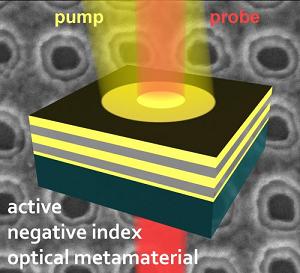 |
| This illustration shows the structure of a new device created by Purdue researchers to overcome a fundamental obstacle in using new "metamaterials" for radical advances in optical technologies, including ultrapowerful microscopes and computers and a possible invisibility cloak. The material developed by the researchers is a perforated, fishnet-like film made of repeating layers of silver and aluminum oxide. The researchers etched away a portion of the aluminum oxide between silver layers and replaced it with a "gain medium" to amplify light. (Birck Nanotechnology Center, Purdue University) |
Abstract:
Researchers have overcome a fundamental obstacle in using new "metamaterials" for radical advances in optical technologies, including ultra-powerful microscopes and computers and a possible invisibility cloak.
By Emil Venere
New findings promising for 'transformation optics,' cloaking
West Lafayette, IN | Posted on August 5th, 2010The metamaterials have been plagued by a major limitation: too much light is "lost," or absorbed by metals such as silver and gold contained in the metamaterials, making them impractical for optical devices.
However, a Purdue University team has solved this hurdle, culminating three years of research based at the Birck Nanotechnology Center at the university's Discovery Park.
"This finding is fundamental to the whole field of metamaterials," said Vladimir M. Shalaev, Purdue's Robert and Anne Burnett Professor of Electrical and Computer Engineering. "We showed that, in principle, it's feasible to conquer losses and develop these materials for many applications."
Research findings are detailed in a paper appearing on Aug. 5 in the journal Nature.
The material developed by Purdue researchers is made of a fishnet-like film containing holes about 100 nanometers in diameter and repeating layers of silver and aluminum oxide. The researchers etched away a portion of the aluminum oxide between silver layers and replaced it with a "gain medium" formed by a colored dye that can amplify light.
Other researchers have applied various gain media to the top of the fishnet film, but that approach does not produce sufficient amplification to overcome losses, Shalaev said.
Instead, the Purdue team found a way to place the dye between the two fishnet layers of silver, where the "local field" of light is far stronger than on the surface of the film, causing the gain medium to work 50 times more efficiently.
The approach was first developed by former Purdue doctoral student Hsiao-Kuan Yuan, now at Intel Corp., and it was further developed and applied by doctoral student Shumin Xiao.
Unlike natural materials, metamaterials are able to reduce the "index of refraction" to less than one or less than zero. Refraction occurs as electromagnetic waves, including light, bend when passing from one material into another. It causes the bent-stick-in-water effect, which occurs when a stick placed in a glass of water appears bent when viewed from the outside.
Being able to create materials with an index of refraction that's negative or between one and zero promises a range of potential breakthroughs in a new field called transformation optics. Possible applications include a "planar hyperlens" that could make optical microscopes 10 times more powerful and able to see objects as small as DNA; advanced sensors; new types of "light concentrators" for more efficient solar collectors; computers and consumer electronics that use light instead of electronic signals to process information; and a cloak of invisibility.
Excitement about metamaterials has been tempered by the fact that too much light is absorbed by the materials. However, the new approach can dramatically reduce the "absorption coefficient," or how much light and energy is lost, and might amplify the incident light so that the metamaterial becomes "active," Shalaev said.
"What's really important is that the absorption coefficient can be as small as only one-millionth of what it was before using our approach," Shalaev said. "We can even have amplification of light instead of its absorption. Here, for the first time, we showed that metamaterials can have a negative refractive index and amplify light."
The Nature paper was written by Xiao, senior research scientist Vladimir P. Drachev, principal research scientist Alexander V. Kildishev, doctoral student Xingjie Ni, postdoctoral fellow Uday K. Chettiar, Yuan, and Shalaev.
Fabricating the material was a major challenge, Shalaev said.
First, the researchers had to learn how to precisely remove as much as possible of the aluminum oxide layer in order to vacate space for dye without causing a collapse of the structure.
"You remove it almost completely but leave a little bit to act as pillars to support the structure, and then you spin coat the dye-doped polymer inside the structure," he said.
The researchers also had to devise a way to deposit just the right amount of dye mixed with an epoxy between the silver layers of the perforated film.
"You can't deposit too much dye and epoxy, which have a positive refractive index, but only a thin layer about 50 nanometers thick, or you lose the negative refraction," Shalaev said.
Future work may involve creating a technology that uses an electrical source instead of a light source, like semiconductor lasers now in use, which would make them more practical for computer and electronics applications.
The work was funded by the U.S. Army Research Office and the National Science Foundation.
####
For more information, please click here
Contacts:
Writer:
Emil Venere
(765) 494-4709
Source:
Vladimir Shalaev
(765) 494-9855
Copyright © Purdue University
If you have a comment, please Contact us.Issuers of news releases, not 7th Wave, Inc. or Nanotechnology Now, are solely responsible for the accuracy of the content.
Bookmark:


| Related News Press |
News and information
 Quantum computer improves AI predictions April 17th, 2026
Flexible sensor gains sensitivity under pressure April 17th, 2026
A reusable chip for particulate matter sensing April 17th, 2026
Detecting vibrational quantum beating in the predissociation dynamics of SF6 using time-resolved photoelectron spectroscopy April 17th, 2026
Govt.-Legislation/Regulation/Funding/Policy
Quantum computer improves AI predictions April 17th, 2026
Metasurfaces smooth light to boost magnetic sensing precision January 30th, 2026
New imaging approach transforms study of bacterial biofilms August 8th, 2025
Possible Futures
A fundamentally new therapeutic approach to cystic fibrosis: Nanobody repairs cellular defect April 17th, 2026
UC Irvine physicists discover method to reverse ‘quantum scrambling’ : The work addresses the problem of information loss in quantum computing system April 17th, 2026
Academic/Education
Rice University launches Rice Synthetic Biology Institute to improve lives January 12th, 2024
Multi-institution, $4.6 million NSF grant to fund nanotechnology training September 9th, 2022
Chip Technology
A reusable chip for particulate matter sensing April 17th, 2026
Metasurfaces smooth light to boost magnetic sensing precision January 30th, 2026
Nanomedicine
A fundamentally new therapeutic approach to cystic fibrosis: Nanobody repairs cellular defect April 17th, 2026
New molecular technology targets tumors and simultaneously silences two ‘undruggable’ cancer genes August 8th, 2025
New imaging approach transforms study of bacterial biofilms August 8th, 2025
Electrifying results shed light on graphene foam as a potential material for lab grown cartilage June 6th, 2025
Sensors
Flexible sensor gains sensitivity under pressure April 17th, 2026
Tiny nanosheets, big leap: A new sensor detects ethanol at ultra-low levels January 30th, 2026
From sensors to smart systems: the rise of AI-driven photonic noses January 30th, 2026
Sensors innovations for smart lithium-based batteries: advancements, opportunities, and potential challenges August 8th, 2025
Announcements
A fundamentally new therapeutic approach to cystic fibrosis: Nanobody repairs cellular defect April 17th, 2026
UC Irvine physicists discover method to reverse ‘quantum scrambling’ : The work addresses the problem of information loss in quantum computing system April 17th, 2026
Tools
Metasurfaces smooth light to boost magnetic sensing precision January 30th, 2026
From sensors to smart systems: the rise of AI-driven photonic noses January 30th, 2026
Japan launches fully domestically produced quantum computer: Expo visitors to experience quantum computing firsthand August 8th, 2025
Photonics/Optics/Lasers
Metasurfaces smooth light to boost magnetic sensing precision January 30th, 2026
From sensors to smart systems: the rise of AI-driven photonic noses January 30th, 2026
Solar/Photovoltaic
Spinel-type sulfide semiconductors to operate the next-generation LEDs and solar cells For solar-cell absorbers and green-LED source October 3rd, 2025
KAIST researchers introduce new and improved, next-generation perovskite solar cell November 8th, 2024
Groundbreaking precision in single-molecule optoelectronics August 16th, 2024
Development of zinc oxide nanopagoda array photoelectrode: photoelectrochemical water-splitting hydrogen production January 12th, 2024
 |
||
 |
||
| The latest news from around the world, FREE | ||
 |
||
|
|
||
| Premium Products | ||
 |
||
|
Only the news you want to read!
Learn More |
||
 |
||
|
Full-service, expert consulting
Learn More |
||
|
|
||