Home > Press > Microbial world’s use of metals mostly unmapped
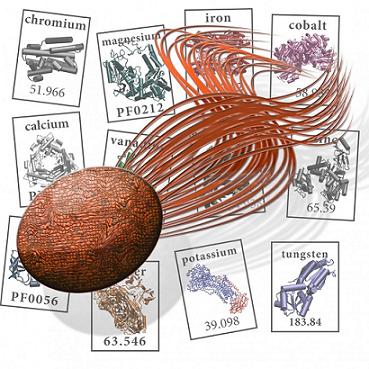 |
| More surprises from an extremophile that thrives in the near-boiling waters of undersea thermal vents: Scientists know Pyrococcus furiosus assimilates metals such as tungsten. But a new way of surveying microbes for metal-containing proteins found several unexpected metals in P. furiosus such as lead and manganese. Similar surprises from other microbes reveal that scientists have underestimated the extent and diversity of metal-driven chemical processes in microbes, which are single-cell microorganisms that include bacteria, fungi, plants, and animals. (Illustration by Berkeley Lab's Steve Yannone and Robert Rambo) |
Abstract:
New method could lead to innovative clean energy and bioremediation technologies, and help explain how microbes shape Earth's climate
Microbial world’s use of metals mostly unmapped
Berkeley, CA | Posted on July 20th, 2010A new way of surveying microbes for the metals they contain reveals that biologists have been relying on the equivalent of a 15th century map of the world.
It turns out that there are many more metal-containing proteins in microbes than previously recognized.
This means the microbial world boasts a broader and more diverse array of metal-driven chemical processes than scientists have imagined. In fact, most have yet to be discovered, according to a first-of-its-kind survey of the metals in three microbes conducted by scientists from the U.S. Department of Energy's Lawrence Berkeley National Laboratory in collaboration with scientists at the University of Georgia.
Their research will help chart a more complete understanding of the far-reaching roles of microbial metals in biology and the Earth's climate. It could also lead to new ways to harness metal-driven chemical processes to create next-generation biofuels or to clean up environmental contaminants.
Microbes assimilate metals from their environment and incorporate them into proteins in order to power life's most important chemical processes, such as photosynthesis, respiration, and DNA repair. Metal-containing proteins in microbes also helped oxygenate the planet's atmosphere billions of years ago, enabling life as we know it, and they continue to play a critical role in the Earth's carbon cycle.
But the diversity and extent of microbial metals had eluded scientists until now.
"This is a huge surprise. It reveals how naive we are about the wide range of chemistries that microbes do," says John Tainer of Berkeley Lab's Life Sciences Division and the Scripps Research Institute in La Jolla, CA. Tainer conducted the research with Michael Adams of the University of Georgia and a team of scientists that includes Steven Yannone and Gary Siuzdak of Berkeley Lab's Life Sciences Division.
The scientists report their research July 18 in an advance online publication of the journal Nature.
Using state-of-the-art techniques, the team catalogued the metals in three microbes: one that lives in human intestines, one plucked from a hotspring in Yellowstone National Park, and one that thrives in the near-boiling waters of undersea thermal vents.
They uncovered a microbial world far richer in metals than ever expected. For example, in the undersea thermal-vent loving microbe, or Pyrococcus furiosus, they found metals such as lead, manganese, and molybdenum that P. furiosus wasn't known to use.
The scientists traced these newfound metals to the proteins that contain them, called metalloproteins. They discovered four new metalloproteins in the microbe, which increased the number of known metalloproteins in P. furiosus by almost a quarter. Their discovery also increased the number of nickel-containing enzymes in all of biology from eight to ten.
A similar survey of the other two microbes unearthed additional unexpected metals and new metalloproteins. Based on this sizeable haul from only three microbes, the team believes that metalloproteins are much more extensive and diverse in the microbial world than scientists realized.
"We thought we knew most of the metalloproteins out there," says Tainer. "But it turns out we only know a tiny fraction of them. We now have to look at microbial genomes with a fresh eye."
The team used a first-of-its-kind combination of two techniques to envisage this uncharted microbial landscape. Biochemical fractionation enabled them to take apart a microbe while keeping its proteins intact and stable, ready to be analyzed in their natural state. Next, a technology called inductively coupled plasma mass spectrometry allowed them to identify extremely low quantities of individual metals in these proteins.
Together, these tools provide a quick tally of the metalloproteins in a microbe.
The current way to discover metalloproteins is much slower. Simply stated, it involves genetically sequencing a microbe, identifying the proteins encoded by its genes, and structurally characterizing each protein.
"Standard methods of identifying metalloproteins can take years," says Yannone. "By directly surveying all microbial proteins for metals we can rapidly identify the majority of metalloproteins within any cell."
In addition to gaining a better understanding of the biochemical diversity of microbes, the team's new metal-hunting technique could expedite the search for new biochemical capabilities in microbial life that can be harnessed for clean energy development, carbon sequestration, and other applications.
"If you want to degrade cellulose to make biofuel, and you know the enzymes involved require a specific metal-driven chemistry, then you can use this technique to find those enzymes in microbes," says Yannone.
Adds Tainer, "Knowing that all of these metal-containing proteins are out there, waiting to be found, is kind of like being in a candy store. We might discover new proteins that we can put to use."
The research was funded by the Department of Energy Office of Science.
Berkeley Lab scientists provided the inductively coupled plasma mass spectrometry equipment. They contributed to the experimental design and data analysis in collaboration with University of Georgia scientists.
####
About Lawrence Berkeley National Laboratory
Lawrence Berkeley National Laboratory provides solutions to the world’s most urgent scientific challenges including clean energy, climate change, human health, and a better understanding of matter and force in the universe. It is a world leader in improving our lives and knowledge of the world around us through innovative science, advanced computing, and technology that makes a difference. Berkeley Lab is a U.S. Department of Energy (DOE) national laboratory managed by the University of California for the DOE Office of Science.
For more information, please click here
Contacts:
Dan Krotz
(510) 486-4019
Copyright © Lawrence Berkeley National Laboratory
If you have a comment, please Contact us.Issuers of news releases, not 7th Wave, Inc. or Nanotechnology Now, are solely responsible for the accuracy of the content.
Bookmark:


| Related News Press |
News and information
 Simulating magnetization in a Heisenberg quantum spin chain April 5th, 2024
NRL charters Navy’s quantum inertial navigation path to reduce drift April 5th, 2024
Discovery points path to flash-like memory for storing qubits: Rice find could hasten development of nonvolatile quantum memory April 5th, 2024
Chemistry
What heat can tell us about battery chemistry: using the Peltier effect to study lithium-ion cells March 8th, 2024
Nanoscale CL thermometry with lanthanide-doped heavy-metal oxide in TEM March 8th, 2024
Possible Futures
Discovery points path to flash-like memory for storing qubits: Rice find could hasten development of nonvolatile quantum memory April 5th, 2024
With VECSELs towards the quantum internet Fraunhofer: IAF achieves record output power with VECSEL for quantum frequency converters April 5th, 2024
Academic/Education
Rice University launches Rice Synthetic Biology Institute to improve lives January 12th, 2024
Multi-institution, $4.6 million NSF grant to fund nanotechnology training September 9th, 2022
Discoveries
Chemical reactions can scramble quantum information as well as black holes April 5th, 2024
New micromaterial releases nanoparticles that selectively destroy cancer cells April 5th, 2024
Utilizing palladium for addressing contact issues of buried oxide thin film transistors April 5th, 2024
Announcements
NRL charters Navy’s quantum inertial navigation path to reduce drift April 5th, 2024
Discovery points path to flash-like memory for storing qubits: Rice find could hasten development of nonvolatile quantum memory April 5th, 2024
Environment
Billions of nanoplastics released when microwaving baby food containers: Exposure to plastic particles kills up to 75% of cultured kidney cells July 21st, 2023
Energy
Development of zinc oxide nanopagoda array photoelectrode: photoelectrochemical water-splitting hydrogen production January 12th, 2024
Shedding light on unique conduction mechanisms in a new type of perovskite oxide November 17th, 2023
Inverted perovskite solar cell breaks 25% efficiency record: Researchers improve cell efficiency using a combination of molecules to address different November 17th, 2023
The efficient perovskite cells with a structured anti-reflective layer – another step towards commercialization on a wider scale October 6th, 2023
 |
||
 |
||
| The latest news from around the world, FREE | ||
 |
||
|
|
||
| Premium Products | ||
 |
||
|
Only the news you want to read!
Learn More |
||
 |
||
|
Full-service, expert consulting
Learn More |
||
|
|
||