Home > Press > DZero tries to beat the odds
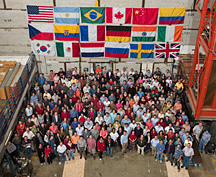 |
| Some of the 500 scientists from 19 countries who are members of the DZero collaboration. (Click image for larger display) |
Abstract:
According to the Standard Model of particle physics, the collider experiments at DOE's Fermi National Accelerator Laboratory should never observe certain types of subatomic processes. But for a dedicated group of experimentalists, the word "never" just raises the stakes. The observation of one of these forbidden processes could open the window to a great discovery and change our understanding of the fundamental laws that govern matter and energy.
DZero tries to beat the odds
Batavia, IL | Posted on July 19th, 2010To find signs of a theory known as Supersymmetry—a proposed extension to the Standard Model—the DZero collaboration at Fermilab is looking for "forbidden" processes known as flavor changing neutral currents. For their latest analysis, submitted to Physics Letters B, DZero scientists looked for the unlikely event in which an up quark or charm quark emits a gluon and turns into a top quark. But even after sifting through billions of collisions, scientists did not find any evidence for the process; instead, the large set of collision data provided by the Tevatron collider allowed scientists to nearly double the exclusion limits obtained from the last such search.
Given that the observation of this process could revolutionize our understanding of matter and energy, it's a sure bet that the DZero physicists will try again next year, when they'll sift through an even bigger set of collision data.
####
For more information, please click here
Contacts:
Kurt Riesselmann
630.840.5681
Copyright © DOE Pulse
If you have a comment, please Contact us.Issuers of news releases, not 7th Wave, Inc. or Nanotechnology Now, are solely responsible for the accuracy of the content.
Bookmark:


| Related News Press |
Physics
 Simulating magnetization in a Heisenberg quantum spin chain April 5th, 2024
News and information
Simulating magnetization in a Heisenberg quantum spin chain April 5th, 2024
NRL charters Navy’s quantum inertial navigation path to reduce drift April 5th, 2024
Discovery points path to flash-like memory for storing qubits: Rice find could hasten development of nonvolatile quantum memory April 5th, 2024
Academic/Education
Rice University launches Rice Synthetic Biology Institute to improve lives January 12th, 2024
Multi-institution, $4.6 million NSF grant to fund nanotechnology training September 9th, 2022
Announcements
NRL charters Navy’s quantum inertial navigation path to reduce drift April 5th, 2024
Discovery points path to flash-like memory for storing qubits: Rice find could hasten development of nonvolatile quantum memory April 5th, 2024
 |
||
 |
||
| The latest news from around the world, FREE | ||
 |
||
|
|
||
| Premium Products | ||
 |
||
|
Only the news you want to read!
Learn More |
||
 |
||
|
Full-service, expert consulting
Learn More |
||
|
|
||