Home > Press > Nanowires Deliver Biochemical Payloads to One Cell Among Many
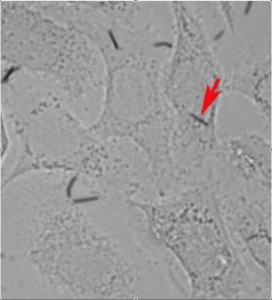 |
| Arrow points to nanowire placed on cell surface. (Image: Levchenko Lab) |
Abstract:
Imagine being able to drop a toothpick on the head of one particular person standing among 100,000 people in a sports stadium. It sounds impossible, yet this degree of precision at the cellular level has been demonstrated by researchers affiliated with The Johns Hopkins University Institute for NanoBioTechnology. Their study was published online in June in Nature Nanotechnology.
Nanowires Deliver Biochemical Payloads to One Cell Among Many
Baltimore, MD | Posted on July 7th, 2010The team used precise electrical fields as "tweezers" to guide and place gold nanowires, each about one-two hundredth the size of a cell, on predetermined spots, each on a single cell. Molecules coating the surfaces of the nanowires then triggered a biochemical cascade of actions only in the cell where the wire touched, without affecting other cells nearby. The researchers say this technique could lead to better ways of studying individual cells or even cell parts, and eventually could produce novel methods of delivering medication.
Indeed, the techniques not relying on this new nanowire-based technology either are not very precise, leading to stimulation of multiple cells, or require complex biochemical alterations of the cells. With the new technique the researchers can, for instance, target cells that have cancer properties (higher cell division rate or abnormal morphology), while sparing their healthy neighbors.
"One of the biggest challenges in cell biology is the ability to manipulate the cell environment in as precise a way as possible," said principal investigator Andre Levchenko, an associate professor of biomedical engineering in Johns Hopkins' Whiting School of Engineering. In previous studies, Levchenko has used lab-on-a-chip or microfluidic devices to manipulate cell behavior. But, he said, lab-on-a-chip methods are not as precise as researchers would like them to be. "In microfluidic chips, if you alter the cell environment, it affects all the cells at the same time," he said.
Such is not the case with the gold nanowires, which are metallic cylinders a few hundred nanometers or smaller in diameter. Just as the unsuspecting sports spectator would feel only a light touch from a toothpick being dropped on the head, the cell reacts only to the molecules released from the nanowire in one very precise place where the wire touches the cell's surface.
With contributions from Chia-Ling Chien, a professor of physics and astronomy in the Krieger School of Arts and Sciences, and Robert Cammarata, a professor of materials science and engineering in the Whiting School, the team developed nanowires coated with a molecule called tumor necrosis factor-alpha (TNF?), a substance released by pathogen-gobbling macrophages, commonly called white blood cells. Under certain cellular conditions, the presence of TNF? triggers cells to switch on genes that help fight infection, but TNF? also is capable of blocking tumor growth and halting viral replication.
Exposure to too much TNF?, however, causes an organism to go into a potentially lethal state called septic shock, Levchenko said. Fortunately, TNF? stays put once it is released from the wire to the cell surface, and because the effect of TNF? is localized, the tiny bit delivered by the wire is enough to trigger the desired cellular response. Much the same thing happens when TNF? is excreted by a white blood cell.
Additionally, the coating of TNF? gives the nanowire a negative charge, making the wire easier to maneuver via the two perpendicular electrical fields of the "tweezer" device, a technique developed by Donglei Fan as part of her Johns Hopkins doctoral research in materials science and engineering. "The electric tweezers were initially developed to assemble, transport and rotate nanowires in solution," Cammarata said. "Donglei then showed how to use the tweezers to produce patterned nanowire arrays as well as construct nanomotors and nano-oscillators. This new work with Dr. Levchenko's group demonstrates just how extremely versatile a technique it is."
To test the system, the team cultured cervical cancer cells in a dish. Then, using electrical fields perpendicular to one another, they were able to zap the nanowires into a pre-set spot and plop them down in a precise location. "In this way, we can predetermine the path that the wires will travel and deliver a molecular payload to a single cell among many, and even to a specific part of the cell," Levchenko said.
During the course of this study, the team also established that the desired effect generated by the nanowire-delivered TNF? was similar to that experienced by a cell in a living organism.
The team members envision many possibilities for this method of subcellular molecule delivery. "For example, there are many other ways to trigger the release of the molecule from the wires: photo release, chemical release, temperature release. Furthermore, one could attach many molecules to the nanowires at the same time," Levchenko said. He added that the nanowires can be made much smaller, but said that for this study the wires were made large enough to see with optical microscopy.
Ultimately, Levchenko sees the nanowires becoming a useful tool for basic research. "With these wires, we are trying to mimic the way that cells talk to each other," he said. "They could be a wonderful tool that could be used in fundamental or applied research." Drug delivery applications could be much further off. However, Levchenko said, "If the wires retain their negative charge, electrical fields could be used to manipulate and maneuver their position in the living tissue."
The lead author for this Nature Nanotechnology article was Fan, a former postdoctoral fellow in the departments of materials science and engineering and in physics and astronomy. Additional authors included Zhizhong Yin, a former postdoctoral fellow in the Department of Biomedical Engineering; Raymond Cheong, a doctoral student in the Department of Biomedical Engineering; and Frank Q. Zhu, a former doctoral student in the Department of Physics and Astronomy. The research was funded by the National Science Foundation and the National Institutes of Health.
####
About Johns Hopkins University Institute for NanoBioTechnology
The Institute for NanoBioTechnology at Johns Hopkins University brings together 212 researchers from: Bloomberg School of Public Health, Krieger School of Arts and Sciences, School of Medicine, Applied Physics Laboratory, and Whiting School of Engineering to create new knowledge and new technologies at the interface of nanoscience and medicine.
For more information, please click here
Contacts:
For media inquiries contact
Mary Spiro
410 516-4802
Copyright © Johns Hopkins University Institute for NanoBioTechnology
If you have a comment, please Contact us.Issuers of news releases, not 7th Wave, Inc. or Nanotechnology Now, are solely responsible for the accuracy of the content.
Bookmark:


| Related News Press |
News and information
 Simulating magnetization in a Heisenberg quantum spin chain April 5th, 2024
NRL charters Navy’s quantum inertial navigation path to reduce drift April 5th, 2024
Discovery points path to flash-like memory for storing qubits: Rice find could hasten development of nonvolatile quantum memory April 5th, 2024
Govt.-Legislation/Regulation/Funding/Policy
NRL charters Navy’s quantum inertial navigation path to reduce drift April 5th, 2024
Discovery points path to flash-like memory for storing qubits: Rice find could hasten development of nonvolatile quantum memory April 5th, 2024
Chemical reactions can scramble quantum information as well as black holes April 5th, 2024
Possible Futures
Discovery points path to flash-like memory for storing qubits: Rice find could hasten development of nonvolatile quantum memory April 5th, 2024
With VECSELs towards the quantum internet Fraunhofer: IAF achieves record output power with VECSEL for quantum frequency converters April 5th, 2024
Academic/Education
Rice University launches Rice Synthetic Biology Institute to improve lives January 12th, 2024
Multi-institution, $4.6 million NSF grant to fund nanotechnology training September 9th, 2022
Nanomedicine
New micromaterial releases nanoparticles that selectively destroy cancer cells April 5th, 2024
Good as gold - improving infectious disease testing with gold nanoparticles April 5th, 2024
Researchers develop artificial building blocks of life March 8th, 2024
Announcements
NRL charters Navy’s quantum inertial navigation path to reduce drift April 5th, 2024
Discovery points path to flash-like memory for storing qubits: Rice find could hasten development of nonvolatile quantum memory April 5th, 2024
Nanobiotechnology
New micromaterial releases nanoparticles that selectively destroy cancer cells April 5th, 2024
Good as gold - improving infectious disease testing with gold nanoparticles April 5th, 2024
Researchers develop artificial building blocks of life March 8th, 2024
Research partnerships
Discovery points path to flash-like memory for storing qubits: Rice find could hasten development of nonvolatile quantum memory April 5th, 2024
Researchers’ approach may protect quantum computers from attacks March 8th, 2024
'Sudden death' of quantum fluctuations defies current theories of superconductivity: Study challenges the conventional wisdom of superconducting quantum transitions January 12th, 2024
 |
||
 |
||
| The latest news from around the world, FREE | ||
 |
||
|
|
||
| Premium Products | ||
 |
||
|
Only the news you want to read!
Learn More |
||
 |
||
|
Full-service, expert consulting
Learn More |
||
|
|
||