Home > Press > Opposites attract and inspire electrocatalyst
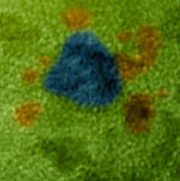 |
| Gold particles (colored in blue) will surround themselves with even smaller platinum particles (colored in orange), creating a structure that could turn a common preservative into electricity in a fuel cell. |
Abstract:
Tiny gold particles surround themselves with even smaller platinum bits, creating a complex structure that could turn a common preservative, formic acid, into electricity in a fuel cell, according to scientists from China's Harbin Institute of Technology and DOE's Pacific Northwest National Laboratory.
Opposites attract and inspire electrocatalyst
Richland, WA | Posted on July 7th, 2010The team used a novel electrostatic self-assembly method to create platinum-surrounded gold nanomaterial. This method relies on the attraction between positive and negative charges to inspire nanoparticles to form new structures on their own. "To our knowledge, this is the first time that this method has been used to create such catalysts," said Dr. Yuehe Lin, a chemist at PNNL and a co-corresponding author of the paper. This paper was named a Very Important Paper by Angewandte Chemie International Edition. Less than 5% of the journal's manuscripts receive such a positive recommendation, and this was the only one in the current issue. Key work was done in DOE's EMSL, a national scientific user facility.
####
For more information, please click here
Contacts:
Kristin Manke
509.372.6011
Copyright © Pacific Northwest National Laboratory
If you have a comment, please Contact us.Issuers of news releases, not 7th Wave, Inc. or Nanotechnology Now, are solely responsible for the accuracy of the content.
Bookmark:


| Related News Press |
News and information
 Quantum computer improves AI predictions April 17th, 2026
Flexible sensor gains sensitivity under pressure April 17th, 2026
A reusable chip for particulate matter sensing April 17th, 2026
Detecting vibrational quantum beating in the predissociation dynamics of SF6 using time-resolved photoelectron spectroscopy April 17th, 2026
Self Assembly
Diamond glitter: A play of colors with artificial DNA crystals May 17th, 2024
Liquid crystal templated chiral nanomaterials October 14th, 2022
Nanoclusters self-organize into centimeter-scale hierarchical assemblies April 22nd, 2022
Atom by atom: building precise smaller nanoparticles with templates March 4th, 2022
Announcements
A fundamentally new therapeutic approach to cystic fibrosis: Nanobody repairs cellular defect April 17th, 2026
UC Irvine physicists discover method to reverse ‘quantum scrambling’ : The work addresses the problem of information loss in quantum computing system April 17th, 2026
Energy
Sensors innovations for smart lithium-based batteries: advancements, opportunities, and potential challenges August 8th, 2025
Simple algorithm paired with standard imaging tool could predict failure in lithium metal batteries August 8th, 2025
Fuel Cells
Deciphering local microstrain-induced optimization of asymmetric Fe single atomic sites for efficient oxygen reduction August 8th, 2025
Current and Future Developments in Nanomaterials and Carbon Nanotubes: Applications of Nanomaterials in Energy Storage and Electronics October 28th, 2022
Research partnerships
Lab to industry: InSe wafer-scale breakthrough for future electronics August 8th, 2025
HKU physicists uncover hidden order in the quantum world through deconfined quantum critical points April 25th, 2025
 |
||
 |
||
| The latest news from around the world, FREE | ||
 |
||
|
|
||
| Premium Products | ||
 |
||
|
Only the news you want to read!
Learn More |
||
 |
||
|
Full-service, expert consulting
Learn More |
||
|
|
||