Home > Press > UCI researchers develop world’s first plastic antibodies
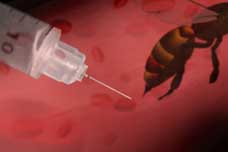 |
| “Plastic antibodies” that UCI scientists used to stop the spread of bee venom in mice could be designed to combat deadlier toxins and pathogens. Photo by Hoang Xuan Pham / University Communications |
Abstract:
In a breakthrough, UCI chemists create synthetic antibodies that block bee venom
UCI researchers develop world’s first plastic antibodies
Irvine, CA | Posted on June 23rd, 2010UC Irvine researchers have developed the first "plastic antibodies" successfully employed in live organisms - stopping the spread of bee venom through the bloodstream of mice.
Tiny polymeric particles - just 1/50,000th the width of a human hair - were designed to match and encase melittin, a peptide in bee venom that causes cells to rupture, releasing their contents. Large quantities of melittin can lead to organ failure and death.
The polymer nanoparticles were prepared by "molecular imprinting" a technique similar to plaster casting: UCI chemistry professor Kenneth Shea and project scientist Yu Hoshino linked melittin with small molecules called monomers, solidifying the two into a network of long polymer chains. After the plastic hardened, they removed the melittin, leaving nanoparticles with minuscule melittin-shaped holes.
When injected into mice given high doses of melittin, these precisely imprinted nanoparticles enveloped the matching melittin molecules, "capturing" them before they could disperse and wreak havoc - greatly reducing deaths among the rodents.
"Never before have synthetic antibodies been shown to effectively function in the bloodstream of living animals," Shea says. "This technique could be utilized to make plastic nanoparticles designed to fight more lethal toxins and pathogens."
Takashi Kodama of Stanford University and Hiroyuki Koide, Takeo Urakami, Hiroaki Kanazawa and Naoto Oku of Japan's University of Shizuoka also contributed to the study, published recently in the Journal of the American Chemical Society.
Unlike natural antibodies produced by live organisms and harvested for medical use, synthetic antibodies can be created in laboratories at a lower cost and have a longer shelf life.
"The bloodstream includes a sea of competing molecules - such as proteins, peptides and cells - and presents considerable challenges for the design of nanoparticles," Shea says. "The success of this experiment demonstrates that these challenges can be overcome."
####
About University of California, Irvine
Founded in 1965, UCI is a top-ranked university dedicated to research, scholarship and community service. Led by Chancellor Michael Drake since 2005, UCI is among the most dynamic campuses in the University of California system, with nearly 28,000 undergraduate and graduate students, 1,100 faculty and 9,000 staff. Orange County’s largest employer, UCI contributes an annual economic impact of $3.9 billion. For more UCI news, visit www.today.uci.edu.
For more information, please click here
Contacts:
Media Contact
Laura Rico
University Communications
949-824-9055
Copyright © University of California, Irvine
If you have a comment, please Contact us.Issuers of news releases, not 7th Wave, Inc. or Nanotechnology Now, are solely responsible for the accuracy of the content.
Bookmark:


| Related News Press |
News and information
 Simulating magnetization in a Heisenberg quantum spin chain April 5th, 2024
NRL charters Navy’s quantum inertial navigation path to reduce drift April 5th, 2024
Discovery points path to flash-like memory for storing qubits: Rice find could hasten development of nonvolatile quantum memory April 5th, 2024
Good as gold - improving infectious disease testing with gold nanoparticles April 5th, 2024
Synthetic Biology
New micromaterial releases nanoparticles that selectively destroy cancer cells April 5th, 2024
Rice University launches Rice Synthetic Biology Institute to improve lives January 12th, 2024
Possible Futures
Discovery points path to flash-like memory for storing qubits: Rice find could hasten development of nonvolatile quantum memory April 5th, 2024
With VECSELs towards the quantum internet Fraunhofer: IAF achieves record output power with VECSEL for quantum frequency converters April 5th, 2024
Academic/Education
Rice University launches Rice Synthetic Biology Institute to improve lives January 12th, 2024
Multi-institution, $4.6 million NSF grant to fund nanotechnology training September 9th, 2022
Nanomedicine
New micromaterial releases nanoparticles that selectively destroy cancer cells April 5th, 2024
Good as gold - improving infectious disease testing with gold nanoparticles April 5th, 2024
Researchers develop artificial building blocks of life March 8th, 2024
Announcements
NRL charters Navy’s quantum inertial navigation path to reduce drift April 5th, 2024
Discovery points path to flash-like memory for storing qubits: Rice find could hasten development of nonvolatile quantum memory April 5th, 2024
Nanobiotechnology
New micromaterial releases nanoparticles that selectively destroy cancer cells April 5th, 2024
Good as gold - improving infectious disease testing with gold nanoparticles April 5th, 2024
Researchers develop artificial building blocks of life March 8th, 2024
 |
||
 |
||
| The latest news from around the world, FREE | ||
 |
||
|
|
||
| Premium Products | ||
 |
||
|
Only the news you want to read!
Learn More |
||
 |
||
|
Full-service, expert consulting
Learn More |
||
|
|
||