Home > Press > Quantum Future: GTRI Researchers are Designing and Testing Microfabricated Planar Ion Traps
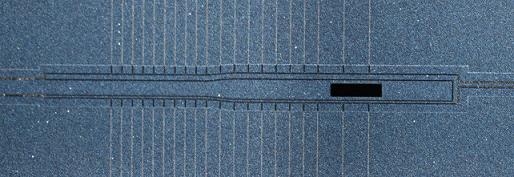 |
| Optical microscope image of an ion trap designed at GTRI. The dark rectangle is the loading slot that calcium atoms stream through before they are hit with a laser and trapped. Credit: Charlie Doret |
Abstract:
Despite a steady improvement in the speed of conventional computers during the last few decades, certain types of problems remain computationally difficult to solve. Quantum computers hold the promise of offering a new route to solving some classes of these problems, such as breaking encryptions. The tremendous computing power of these devices stems from their use of quantum systems, called "qubits," which can exist in a "superposition" of two states at the same time - in stark contrast to the transistors in conventional computers that can only be in the state "0" or "1".
By Abby Vogel
Quantum Future: GTRI Researchers are Designing and Testing Microfabricated Planar Ion Traps
Atlanta, GA | Posted on May 27th, 2010"Though a practical quantum computer may still be decades away, research being conducted today is laying the groundwork for such a device by bridging the vast gap between the theory and practice of quantum information processing," said Dick Slusher, a principal research scientist at the Georgia Tech Research Institute (GTRI) and director of the Georgia Tech Quantum Institute.
One path toward creating quantum computers is to use trapped ions as the qubits. However, it is currently difficult to scale up conventional ion traps into an array large enough to create a useful quantum computer.
At GTRI, researchers are designing, fabricating and testing planar ion traps that can be more readily combined into large, interconnected trap arrays. Details of the research effort, led by Slusher and GTRI senior research scientist Alexa Harter, were presented at the annual meeting of the American Physical Society's Division of Atomic Molecular and Optical Physics on May 26 and 27.
The presentations were made by GTRI postdoctoral fellow Charlie Doret, GTRI research scientist Arkadas Ozakin and Georgia Tech electrical and computer engineering graduate student Fayaz Shaikh. This research is funded by the Intelligence Advanced Research Projects Activity (IARPA) and the Defense Advanced Research Projects Agency (DARPA) through contracts with the Army Research Office.
GTRI's microfabricated planar ion traps employ a combination of radio-frequency signals and static voltages applied to aluminum electrodes that are layered on silicon wafers.
"These planar trap geometries are advantageous because they are scalable to large systems of ions and also offer improved laser access compared to currently available traps," said Doret.
Lasers are applied to the ions to induce "entanglement" - a quantum mechanical property whereby the states involved cannot be completely described independently. Using systems of trapped ions, researchers have measured entanglement clearly and can preserve it for extended periods of time. To date, however, the largest number of entangled particles ever achieved in a quantum computer is eight calcium ions. At least thirty ions are required to perform calculations that cannot be realized on a classical computer, so a major challenge for the future is to increase the number of trapped ions that can interact.
The GTRI team has used state-of-the-art computer simulations of the electromagnetic trapping fields and the trapped ion motion to design versatile traps capable of holding many ions. Trap designs were improved using genetic algorithms that fed back to the shapes and spacing of trap electrodes to optimize trap depth and minimize heating when ions were transported between trapping zones.
Prototypes of the designs were fabricated with the help of Kevin Martin, a principal research scientist in the Georgia Tech Nanotechnology Research Center. The research team then tested the prototypes in GTRI's ion trapping laboratory, where calcium ions were first trapped in October 2009 using devices designed and fabricated at Georgia Tech.
Experimental data on trap loading efficiency, ion lifetime and ion shuttling efficiency were used to validate the designs and provide feedback for additional improvements.
The GTRI team is working with researchers at Duke University to integrate optics directly into the ion traps, while researchers at the Massachusetts Institute of Technology are testing the devices in a cryogenic environment.
In collaboration with the University of Maryland, GTRI researchers are also investigating the use of an array of trapped ions and/or ultra-cold atoms trapped in optical lattices for applications in quantum simulation.
"We still have much to learn about individual quantum systems, how to connect them, how to control them, how to measure them and how to fix the inevitable errors," added Slusher.
Future work at GTRI will include testing new trap designs, such as linear traps optimized for holding long ion chains.
"This field requires a multidisciplinary effort and Georgia Tech has the synergy and strengths in the technology and science areas and the fabrication facilities to make real progress," added Slusher.
This material is based upon work supported by the Intelligence Advanced Research Projects Activity (IARPA) Scaled Multiplexed Ion Trap project under U.S. Army Award No. W911NF-08-1-0315, and the Defense Advanced Research Projects Agency (DARPA) Optical Lattice Emulator program under U.S. Army Award No. W911NF-07-1-0576. Any opinions, findings, conclusions or recommendations expressed in this article are those of the researchers and do not necessarily reflect the views of the U.S. Army.
####
For more information, please click here
Contacts:
Media Relations Contacts:
Abby Vogel
404-385-3364
John Toon
404-894-6986
Kirk Englehardt
404-407-7280
Copyright © Georgia Tech Research Institute
If you have a comment, please Contact us.Issuers of news releases, not 7th Wave, Inc. or Nanotechnology Now, are solely responsible for the accuracy of the content.
Bookmark:


| Related News Press |
News and information
 Quantum computer improves AI predictions April 17th, 2026
Flexible sensor gains sensitivity under pressure April 17th, 2026
A reusable chip for particulate matter sensing April 17th, 2026
Detecting vibrational quantum beating in the predissociation dynamics of SF6 using time-resolved photoelectron spectroscopy April 17th, 2026
Govt.-Legislation/Regulation/Funding/Policy
Quantum computer improves AI predictions April 17th, 2026
Metasurfaces smooth light to boost magnetic sensing precision January 30th, 2026
New imaging approach transforms study of bacterial biofilms August 8th, 2025
Possible Futures
A fundamentally new therapeutic approach to cystic fibrosis: Nanobody repairs cellular defect April 17th, 2026
UC Irvine physicists discover method to reverse ‘quantum scrambling’ : The work addresses the problem of information loss in quantum computing system April 17th, 2026
Academic/Education
Rice University launches Rice Synthetic Biology Institute to improve lives January 12th, 2024
Multi-institution, $4.6 million NSF grant to fund nanotechnology training September 9th, 2022
Quantum Computing
Quantum computer improves AI predictions April 17th, 2026
UC Irvine physicists discover method to reverse ‘quantum scrambling’ : The work addresses the problem of information loss in quantum computing system April 17th, 2026
Researchers develop molecular qubits that communicate at telecom frequencies October 3rd, 2025
Announcements
A fundamentally new therapeutic approach to cystic fibrosis: Nanobody repairs cellular defect April 17th, 2026
UC Irvine physicists discover method to reverse ‘quantum scrambling’ : The work addresses the problem of information loss in quantum computing system April 17th, 2026
Research partnerships
Lab to industry: InSe wafer-scale breakthrough for future electronics August 8th, 2025
HKU physicists uncover hidden order in the quantum world through deconfined quantum critical points April 25th, 2025
 |
||
 |
||
| The latest news from around the world, FREE | ||
 |
||
|
|
||
| Premium Products | ||
 |
||
|
Only the news you want to read!
Learn More |
||
 |
||
|
Full-service, expert consulting
Learn More |
||
|
|
||