Home > Press > Brookhaven Lab Chemists Receive Patents for Fuel-Cell Catalysts
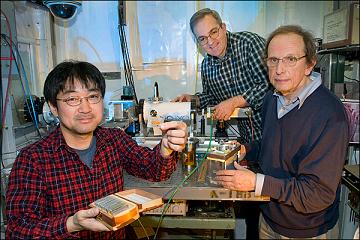 |
| (From left) Brookhaven Lab chemists Kotaro Sasaki, Miomir Branko Vukmirovic, and Radoslav Adzic work on developing catalysts for fuel cells. |
Abstract:
New catalysts reduce costly platinum use and increase its effectiveness in fuel cells
Brookhaven Lab Chemists Receive Patents for Fuel-Cell Catalysts
Upton, NY | Posted on May 21st, 2010Chemists at the U.S. Department of Energy's Brookhaven National Laboratory have received three patents for developing catalysts to accelerate chemical reactions in fuel cells. The newly patented catalysts, as well as a method for making a particular type of catalyst with a thin layer of platinum, could greatly reduce the cost and increase the use of fuel cells in electric vehicles. The catalysts and the technique are available for licensing.
Platinum is the most efficient catalyst for fuel cells. However, the platinum-based catalysts are expensive, unstable, and have low durability. The newly patented catalysts have high activity and stability, while containing much less platinum than the amount used in current fuel cells, so their cost is reduced.
"Fuel cells are expected to become a major source of clean energy that can impact both transportation and stationary power sectors," said Radoslav Adzic, the principal researcher in all three patents. "They have several advantages for automotive applications and can be used extensively in electric cars if the technology can be made to work efficiently and economically. Developing these electrocatalysts is a big step in that direction."
Several types of renewable fuel - such as hydrogen, ethanol or methanol - may be used in fuel cells. A hydrogen fuel cell, for example, converts hydrogen and oxygen into water, and, in the process, produces electricity. Hydrogen is oxidized by separating into negatively charged electrons and positively charged ions with the help of a catalyst at the fuel cell's negative pole, the anode. Electrons then travel to the positive pole, the cathode, creating electricity with their movement. At the cathode, with the aid of a catalyst, oxygen gains electrons, resulting in oxygen reduction, and combines with hydrogen ions forming water, the only byproduct of a hydrogen/oxygen fuel cell.
Two of the Brookhaven chemists' patents were awarded for catalysts that speed up oxygen reduction. One is composed of a thin layer of platinum on palladium nanoparticles, which is more efficient than current catalysts. The other includes metal oxides, such as niobium oxide and ruthenium oxide, with a thin layer of platinum. The patent also covers a unique method for depositing a thin layer of platinum on the metal-oxide catalysts.
Compared to the patented platinum-palladium catalyst, the metal oxides combined with platinum are more stable and cost-effective, although the catalytic efficiency is not as high. Thus, the patented catalysts are complementary and can be tailored for various applications.
The scientists also received a patent for adding gold clusters to platinum-based catalysts. In the reactions during the stop-and-go driving of an electric car, platinum dissolves, which reduces its efficiency as a catalyst. But the researchers have overcome this problem by adding a very small amount of gold to the platinum-based catalyst. With the addition of gold, the platinum was kept intact during an accelerated stability test, which mimicked the stop-and-go conditions of an electric car. The gold clusters protected the platinum from being oxidized, which stabilized the platinum, making possible improved platinum-based catalysts.
U.S. patent 7,691,780 B2 for the development of platinum-palladium catalysts, was issued to Brookhaven Lab's Adzic and Miomir Branko Vukmirovic, along with Junliang Zhang and Yibo Mo, formerly of Brookhaven. Adzic, Vukmirovic and Kotaro Sasaki of Brookhaven Lab received title to U.S. patent 7,704,918 for metal oxide-platinum catalysts and their unique method of making them. Adzic and Zhang received U.S. patent 7,704,919 for adding gold clusters to platinum-based electrocatalysts.
The Department of Energy's Office of Science and its Office of Energy Efficiency and Renewable Energy funded the research that led to these patented technologies. For information about licensing them, contact Kimberley Elcess at 631 344-4151, or
####
About Brookhaven National Laboratory
One of ten national laboratories overseen and primarily funded by the Office of Science of the U.S. Department of Energy (DOE), Brookhaven National Laboratory conducts research in the physical, biomedical, and environmental sciences, as well as in energy technologies and national security. Brookhaven Lab also builds and operates major scientific facilities available to university, industry, and government researchers. Brookhaven is operated and managed for DOE's Office of Science by Brookhaven Science Associates, a limited-liability company founded by the Research Foundation of the State University of New York, for and on behalf of Stony Brook University, the largest academic user of Laboratory facilities; and Battelle Memorial Institute, a nonprofit, applied science and technology organization. Visit Brookhaven Lab's electronic newsroom for links, news archives, graphics, and more at www.bnl.gov/newsroom, or follow Brookhaven Lab on Twitter at twitter.com/BrookhavenLab
For more information, please click here
Contacts:
(631)344-2347
Copyright © Brookhaven National Laboratory
If you have a comment, please Contact us.Issuers of news releases, not 7th Wave, Inc. or Nanotechnology Now, are solely responsible for the accuracy of the content.
Bookmark:


| Related News Press |
News and information
 Simulating magnetization in a Heisenberg quantum spin chain April 5th, 2024
NRL charters Navy’s quantum inertial navigation path to reduce drift April 5th, 2024
Discovery points path to flash-like memory for storing qubits: Rice find could hasten development of nonvolatile quantum memory April 5th, 2024
Good as gold - improving infectious disease testing with gold nanoparticles April 5th, 2024
Thin films
Utilizing palladium for addressing contact issues of buried oxide thin film transistors April 5th, 2024
Chemistry
What heat can tell us about battery chemistry: using the Peltier effect to study lithium-ion cells March 8th, 2024
Nanoscale CL thermometry with lanthanide-doped heavy-metal oxide in TEM March 8th, 2024
Govt.-Legislation/Regulation/Funding/Policy
NRL charters Navy’s quantum inertial navigation path to reduce drift April 5th, 2024
Discovery points path to flash-like memory for storing qubits: Rice find could hasten development of nonvolatile quantum memory April 5th, 2024
Chemical reactions can scramble quantum information as well as black holes April 5th, 2024
Possible Futures
Discovery points path to flash-like memory for storing qubits: Rice find could hasten development of nonvolatile quantum memory April 5th, 2024
With VECSELs towards the quantum internet Fraunhofer: IAF achieves record output power with VECSEL for quantum frequency converters April 5th, 2024
Announcements
NRL charters Navy’s quantum inertial navigation path to reduce drift April 5th, 2024
Discovery points path to flash-like memory for storing qubits: Rice find could hasten development of nonvolatile quantum memory April 5th, 2024
Patents/IP/Tech Transfer/Licensing
Getting drugs across the blood-brain barrier using nanoparticles March 3rd, 2023
Metasurfaces control polarized light at will: New research unlocks the hidden potential of metasurfaces August 13th, 2021
Arrowhead Pharmaceuticals Announces Closing of Agreement with Takeda November 27th, 2020
Automotive/Transportation
Researchers’ approach may protect quantum computers from attacks March 8th, 2024
Tests find no free-standing nanotubes released from tire tread wear September 8th, 2023
Fuel Cells
Current and Future Developments in Nanomaterials and Carbon Nanotubes: Applications of Nanomaterials in Energy Storage and Electronics October 28th, 2022
 |
||
 |
||
| The latest news from around the world, FREE | ||
 |
||
|
|
||
| Premium Products | ||
 |
||
|
Only the news you want to read!
Learn More |
||
 |
||
|
Full-service, expert consulting
Learn More |
||
|
|
||