Home > Press > Quantum move toward next generation computing
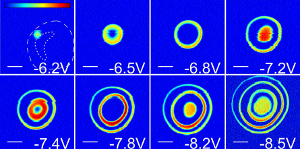 |
| This image shows the electrostatic energy given off when electrons are added to a quantum dot. It was created with an atomic-force microscope. Photo Credit: Dept. of Physics, McGill University. |
Abstract:
McGill researchers make important contribution to the development of quantum computing
Quantum move toward next generation computing
Montreal, Quebec, Canada | Posted on May 12th, 2010Physicists at McGill University have developed a system for measuring the energy involved in adding electrons to semi-conductor nanocrystals, also known as quantum dots - a technology that may revolutionize computing and other areas of science. Dr. Peter Grütter, McGill's Associate Dean of Research and Graduate Education, Faculty of Science, explains that his research team has developed a cantilever force sensor that enables individual electrons to be removed and added to a quantum dot and the energy involved in the operation to be measured.
Being able to measure the energy at such infinitesimal levels is an important step in being able to develop an eventual replacement for the silicon chip in computers - the next generation of computing. Computers currently work with processors that contain transistors that are either in an on or off position - conductors and semi-conductors - while quantum computing would allow processors to work with multiple states, vastly increasing their speed while reducing their size even more.
Although the term "quantum leap" is used in everyday language to connote something very large, the word "quantum" itself actually means the smallest amount by which certain physical quantities can change. Knowledge of these energy levels enables scientists to understand and predict the electronic properties of the nanoscale systems they are developing.
"We are determining optical and electronic transport properties," Grütter said. "This is essential for the development of components that might replace silicon chips in current computers."
The electronic principles of nanosystems also determine their chemical properties, so the team's research is relevant to making chemical processes "greener" and more energy efficient. For example, this technology could be applied to lighting systems, by using nanoparticles to improving their energy efficiency. "We expect this method to have many important applications in fundamental as well as applied research," said Lynda Cockins of McGill's Department of Physics.
The principle of the cantilever sensor sounds relatively simple. "The cantilever is about 0.5 mm in size (about the thickness of a thumbnail) and is essentially a simple driven, damped harmonic oscillator, mathematically equivalent to a child's swing being pushed," Grütter explained. "The signal we measure is the damping of the cantilever, the equivalent to how hard I have to push the kid on the swing so that she maintains a constant height, or what I would call the ‘oscillation amplitude.' "
Dr. Yoichi Miyahara, Aashish Clerk and Steven D. Bennett of McGill's Dept. of Physics, and scientists at the Institute for Microstructural Sciences of the National Research Council of Canada contributed to this research, which was published online late yesterday afternoon in the Proceedings of the National Academy of Sciences. The research received funding from the Natural Sciences and Engineering Research Council of Canada, le Fonds Québécois de le Recherche sur la Nature et les Technologies, the Carl Reinhardt Fellowship, and the Canadian Institute for Advanced Research.
####
For more information, please click here
Contacts:
William Raillant-Clark
Media Relations
McGill University
514-398-2189
Copyright © McGill University
If you have a comment, please Contact us.Issuers of news releases, not 7th Wave, Inc. or Nanotechnology Now, are solely responsible for the accuracy of the content.
Bookmark:


| Related News Press |
News and information
 Quantum computer improves AI predictions April 17th, 2026
Flexible sensor gains sensitivity under pressure April 17th, 2026
A reusable chip for particulate matter sensing April 17th, 2026
Detecting vibrational quantum beating in the predissociation dynamics of SF6 using time-resolved photoelectron spectroscopy April 17th, 2026
Chemistry
Projecting light to dispense liquids: A new route to ultra-precise microdroplets January 30th, 2026
From sensors to smart systems: the rise of AI-driven photonic noses January 30th, 2026
"Nanoreactor" cage uses visible light for catalytic and ultra-selective cross-cycloadditions October 3rd, 2025
Cambridge chemists discover simple way to build bigger molecules – one carbon at a time June 6th, 2025
Govt.-Legislation/Regulation/Funding/Policy
Quantum computer improves AI predictions April 17th, 2026
Metasurfaces smooth light to boost magnetic sensing precision January 30th, 2026
New imaging approach transforms study of bacterial biofilms August 8th, 2025
Possible Futures
A fundamentally new therapeutic approach to cystic fibrosis: Nanobody repairs cellular defect April 17th, 2026
UC Irvine physicists discover method to reverse ‘quantum scrambling’ : The work addresses the problem of information loss in quantum computing system April 17th, 2026
Academic/Education
Rice University launches Rice Synthetic Biology Institute to improve lives January 12th, 2024
Multi-institution, $4.6 million NSF grant to fund nanotechnology training September 9th, 2022
Quantum Computing
Quantum computer improves AI predictions April 17th, 2026
UC Irvine physicists discover method to reverse ‘quantum scrambling’ : The work addresses the problem of information loss in quantum computing system April 17th, 2026
Researchers develop molecular qubits that communicate at telecom frequencies October 3rd, 2025
Discoveries
Quantum computer improves AI predictions April 17th, 2026
Flexible sensor gains sensitivity under pressure April 17th, 2026
A reusable chip for particulate matter sensing April 17th, 2026
Detecting vibrational quantum beating in the predissociation dynamics of SF6 using time-resolved photoelectron spectroscopy April 17th, 2026
Announcements
A fundamentally new therapeutic approach to cystic fibrosis: Nanobody repairs cellular defect April 17th, 2026
UC Irvine physicists discover method to reverse ‘quantum scrambling’ : The work addresses the problem of information loss in quantum computing system April 17th, 2026
Environment
A reusable chip for particulate matter sensing April 17th, 2026
Researchers unveil a groundbreaking clay-based solution to capture carbon dioxide and combat climate change June 6th, 2025
Energy
Sensors innovations for smart lithium-based batteries: advancements, opportunities, and potential challenges August 8th, 2025
Simple algorithm paired with standard imaging tool could predict failure in lithium metal batteries August 8th, 2025
Research partnerships
Lab to industry: InSe wafer-scale breakthrough for future electronics August 8th, 2025
HKU physicists uncover hidden order in the quantum world through deconfined quantum critical points April 25th, 2025
Quantum nanoscience
Beyond silicon: Electronics at the scale of a single molecule January 30th, 2026
MXene nanomaterials enter a new dimension Multilayer nanomaterial: MXene flakes created at Drexel University show new promise as 1D scrolls January 30th, 2026
ICFO researchers overcome long-standing bottleneck in single photon detection with twisted 2D materials August 8th, 2025
 |
||
 |
||
| The latest news from around the world, FREE | ||
 |
||
|
|
||
| Premium Products | ||
 |
||
|
Only the news you want to read!
Learn More |
||
 |
||
|
Full-service, expert consulting
Learn More |
||
|
|
||