Home > Press > Calculating a particle spectrum in lattice QCD
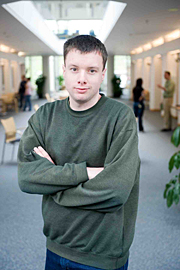 |
| Christopher Thomas |
Abstract:
In a quiet office at DOE's Jefferson Lab, you can find Christopher Thomas at his desk poring over computer code. A physicist, Thomas is working to combine theory work with existing computer code to render parts of the theory of quantum chromodynamics into a computer-solvable form, called lattice QCD.
Calculating a particle spectrum in lattice QCD
Newport News, VA | Posted on May 11th, 2010The theory of quantum chromodynamics, or QCD, describes how quarks make up protons, neutrons and other particles. Thomas is particularly interested in how QCD describes mesons, which are particles made of a quark and an anti-quark.
"I'm working on how to formulate the problem—how to write code to use lattice QCD to produce the results that we can then interpret," Thomas said. "Then we try to relate the results to experiment and models."
The oldest of three sons, Thomas was born in Bristol in the U.K. He said he has always been attracted to science and is interested in how things work.
"Originally I was attracted to aspects of chemistry, being fascinated by the structure of atoms and how they built up. But by the time I was in secondary school, I had discovered quarks," he recalled.
Thomas received his bachelor's and master's degrees from Cambridge and then completed his Ph.D. in Theoretical Particle Physics at Oxford. He came to Jefferson Lab in October 2008 as a Theory Postdoctoral Fellow.
"I have really enjoyed working with Jo Dudek, Robert Edwards and David Richards as part of the Hadron Spectrum Collaboration. We use Lattice Quantum Chromodynamics to calculate the spectrum and properties of mesons, performing calculations on the large computers here at the lab."
Thomas had only been to the U.S. once before coming to work at Jefferson Lab and has enjoyed seeing more of the country during his stay, including Seattle, Denver and the Washington, D.C. area. He says the biggest shock on arriving in the U.S. was the fact that you have to drive everywhere.
"I was much more accustomed to an environment where biking and walking were the norm," says Thomas, an avid hiker.
In addition to research, Thomas also co-organizes seminars for the Theory Center.
"I'm enjoying my time at the lab and especially the interactions with the many people who work here and visit. It's a great place to be at this time in physics."
####
About Jefferson Lab
The Thomas Jefferson National Accelerator Facility (Jefferson Lab) is funded by the U.S. Department of Energy's Office of Science with strong support from the City of Newport News and the Commonwealth of Virginia. As a user facility for scientists worldwide, its primary mission is to conduct basic research of the atom's nucleus at the quark level.
With industry and university partners, Jefferson Lab also has a derivative mission: applied research for using the Free-Electron Lasers based on technology developed at the lab to conduct physics experiments. Additionally, as a center for both basic and applied research, Jefferson Lab reaches out to help educate the next generation in science and technology.
Jefferson Lab is managed and operated for the DOE by the Jefferson Science Associates, LLC. JSA is a limited liability corporation created by Southeastern Universities Research Association and Computer Sciences Corp. specifically to manage and operate Jefferson Lab.
For more information, please click here
Copyright © Jefferson Lab
If you have a comment, please Contact us.Issuers of news releases, not 7th Wave, Inc. or Nanotechnology Now, are solely responsible for the accuracy of the content.
Bookmark:


| Related News Press |
Physics
 Simulating magnetization in a Heisenberg quantum spin chain April 5th, 2024
News and information
Simulating magnetization in a Heisenberg quantum spin chain April 5th, 2024
NRL charters Navy’s quantum inertial navigation path to reduce drift April 5th, 2024
Discovery points path to flash-like memory for storing qubits: Rice find could hasten development of nonvolatile quantum memory April 5th, 2024
Quantum nanoscience
Simulating magnetization in a Heisenberg quantum spin chain April 5th, 2024
Optically trapped quantum droplets of light can bind together to form macroscopic complexes March 8th, 2024
Bridging light and electrons January 12th, 2024
'Sudden death' of quantum fluctuations defies current theories of superconductivity: Study challenges the conventional wisdom of superconducting quantum transitions January 12th, 2024
 |
||
 |
||
| The latest news from around the world, FREE | ||
 |
||
|
|
||
| Premium Products | ||
 |
||
|
Only the news you want to read!
Learn More |
||
 |
||
|
Full-service, expert consulting
Learn More |
||
|
|
||