Home > Press > Less is more! Nanopatch is 100 times better than needle and syringe
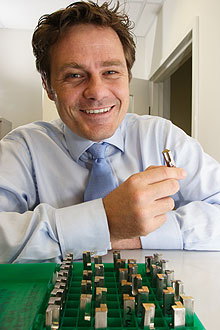 |
| Professor Kendall |
Abstract:
New research, led by Professor Mark Kendall, from UQ's Australian Institute for Bioengineering and Nanotechnology, demonstrates that a vaccine delivered by a Nanopatch induces a similarly protective immune response as a vaccine delivered by needle and syringe, but uses 100 times less vaccine.
Less is more! Nanopatch is 100 times better than needle and syringe
Brisbane, Australia | Posted on April 22nd, 2010This discovery has implications for many vaccination programs in both industrialised and developing nations, which must overcome issues with vaccine shortages and distribution.
Being both painless and needle-free, the nanopatch offers hope for those with needle phobia, as well as improving the vaccination experience for young children.
"The Nanopatch targeted specific antigen-presenting cells found in a narrow layer just beneath the skin surface and as a result we used less than one hundredth of the dose used by a needle while stimulating a comparable immune response," Professor Kendall said.
"Our result is ten times better than the best results achieved by other delivery methods and does not require the use of other immune stimulants, called adjuvants, or multiple vaccinations.
"Because the Nanopatch requires neither a trained practitioner to administer it nor refrigeration, it has enormous potential cheaply deliver vaccines in developing nations," he said.
Professor Kendall said the Nanopatch� was much smaller than a postage stamp and comprised of several thousands of densely packed projections invisible to the human eye.
The influenza vaccine was dry coated onto these projections and applied to the skin of mice for two minutes. "By using far less vaccine we believe that the Nanopatch will enable the vaccination of many more people," Professor Kendall said.
"When compared to a needle and syringe a nanopatch is cheap to produce and it is easy to imagine a situation in which a government might provide vaccinations for a pandemic such as swine flu to be collected from a chemist or sent in the mail.
"This is an exciting discovery and our next step is to prove the effectiveness of Nanopatches in human clinical trials," he said.
Professor Kendall's team includes researchers from UQ's Diamantina Institute for Cancer, Immunology and Metabolic Medicine and Faculty of Health Sciences, as well as the University of Melbourne.
The work was supported by the Australian Research Council, the National Health and Medical Research Council, and the Queensland Government's Smart State Scheme.
AIBN is a multidisciplinary research institute focused on addressing some of the intricate problems in the areas of health, energy and the environment.
####
For more information, please click here
Contacts:
Media:
Professor Mark Kendall
07 3346 4203 or 0431 162 391
Copyright © University of Queensland
If you have a comment, please Contact us.Issuers of news releases, not 7th Wave, Inc. or Nanotechnology Now, are solely responsible for the accuracy of the content.
Bookmark:


| Related News Press |
News and information
 Quantum computer improves AI predictions April 17th, 2026
Flexible sensor gains sensitivity under pressure April 17th, 2026
A reusable chip for particulate matter sensing April 17th, 2026
Detecting vibrational quantum beating in the predissociation dynamics of SF6 using time-resolved photoelectron spectroscopy April 17th, 2026
Possible Futures
A fundamentally new therapeutic approach to cystic fibrosis: Nanobody repairs cellular defect April 17th, 2026
UC Irvine physicists discover method to reverse ‘quantum scrambling’ : The work addresses the problem of information loss in quantum computing system April 17th, 2026
Academic/Education
Rice University launches Rice Synthetic Biology Institute to improve lives January 12th, 2024
Multi-institution, $4.6 million NSF grant to fund nanotechnology training September 9th, 2022
Nanomedicine
A fundamentally new therapeutic approach to cystic fibrosis: Nanobody repairs cellular defect April 17th, 2026
New molecular technology targets tumors and simultaneously silences two ‘undruggable’ cancer genes August 8th, 2025
New imaging approach transforms study of bacterial biofilms August 8th, 2025
Electrifying results shed light on graphene foam as a potential material for lab grown cartilage June 6th, 2025
Announcements
A fundamentally new therapeutic approach to cystic fibrosis: Nanobody repairs cellular defect April 17th, 2026
UC Irvine physicists discover method to reverse ‘quantum scrambling’ : The work addresses the problem of information loss in quantum computing system April 17th, 2026
Nanobiotechnology
A fundamentally new therapeutic approach to cystic fibrosis: Nanobody repairs cellular defect April 17th, 2026
New molecular technology targets tumors and simultaneously silences two ‘undruggable’ cancer genes August 8th, 2025
New imaging approach transforms study of bacterial biofilms August 8th, 2025
Electrifying results shed light on graphene foam as a potential material for lab grown cartilage June 6th, 2025
 |
||
 |
||
| The latest news from around the world, FREE | ||
 |
||
|
|
||
| Premium Products | ||
 |
||
|
Only the news you want to read!
Learn More |
||
 |
||
|
Full-service, expert consulting
Learn More |
||
|
|
||