Home > Press > Bionanotechnology has new face, world-class future at Florida State
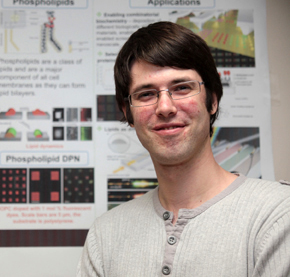 |
| Steven Lenhert (photo: Michele Edmunds, FSU Photo Lab) |
Abstract:
Imagine the marriage of hard metals or semiconductors to soft organic or biological products. Picture the strange, wonderful offspring — hybrid materials never conceived by Mother Nature.
The applications in medicine and manufacturing are staggering, says biologist Steven Lenhert, the newest faculty face of nanoscience at The Florida State University.
By Libby Fairhurst
Bionanotechnology has new face, world-class future at Florida State
Tallahassee, FL | Posted on April 20th, 2010How about a mobile phone fitted with a "lab on a chip" that can diagnose illness? That and much more are real possibilities, according to Lenhert.
"Nanotechnology is already saving lives, and will be crucial to the sustainability of life as we know it on Earth," he said.
Lenhert is the lead author of a groundbreaking paper published in the April 2010 edition of Nature Nanotechnology — the discipline's premier journal.
At age 32, he is internationally recognized for his innovative work in the evolving field of bionanotechnology — the union of biology and nanotechnology — and a related process, Dip-Pen Nanolithography (DPN), which uses a sharp, pen-like device and "ink" to "write" nanoscale patterns on solid surfaces. Both are capable of producing materials with enormous potential not only for diagnostic applications in health care but also for virtually any field that uses materials, from tissue engineering to drug discovery to computer chip fabrication.
In other words, it is big-deal technology on a nanoscale. Nanotechnology encompasses objects that measure just 100 nanometers or less in at least one of their dimensions. One nanometer equals a billionth of a meter.
"Think of one nanometer as the length that a hair grows in one second," Lenhert said.
Florida State hired Lenhert to further enhance the interdisciplinary cluster of faculty who form the Integrative NanoScience Institute (INSI) — a key part of the university's ambitious Pathways of Excellence initiative. His cutting-edge work in nanobiology is expected to serve as an ideal complement to the materials science and engineering research already underway there.
Together, they mean to make the institute a world-class bionanotechnology center.
As an INSI member, Lenhert will collaborate on the Institute's cutting-edge research with distinguished faculty from cell and molecular biology, chemistry and biochemistry, materials science, chemical and biomedical engineering, and physics.
The paper he and coworkers published ("Lipid multilayer gratings") in Nature Nanotechnology describes a DPN-based technique he devised at his former institutions, Germany's University of Muenster and Karlsruhe Institute of Technology. The technique has promising biological applications. It enables the color-coded detection of various molecules through diffraction of light and thin, nanoscale layers of lipids.
"We ended up with a fundamentally new class of material — in effect, a biometamaterial, which is a biomaterial that doesn't exist in nature," Lenhert said.
"It acts as a biosensor, which responds to the presence of a biological agent by combining a sensitive biological element with a physical device," he said. "Our biosensor actually makes the physical device out of the biological element itself.
"The closest real-world application for this material is in medical diagnostics," Lenhert said. "The idea would be to have a portable, affordable and disposable chip that could allow your mobile phone to diagnose medical conditions that currently require a visit to a doctor and samples being sent to a laboratory. This concept is known as 'lab on a chip,' and it could analyze, say, blood or urine. A home pregnancy test is a similar example that already works, but other kinds of tests still need actual, advanced laboratories."
Lenhert is a chess master who plays competitively, when he's not in his laboratory. Born in Salt Lake City, he received his doctoral degree in 2004 from the University of Muenster. Until recently, he was leading a nanoscience research group in Germany. Then, at a conference in 2009, he came across a Florida State flyer about the Integrated NanoScience Institute.
"It contained what I considered to be the perfect description of my scientific motivation," Lenhert said. "Now, here I am. What's most exciting and impressive to me is the way all the INSI members, from various FSU departments, suddenly feel right at home together because of the word 'nanoscience.'
"As a graduate student I was lucky to be able to work as a bridge between different departments, including biology, medicine, chemistry and physics," he said. "I realized that a lot of the solutions to a particular problem might already exist just across a street. That's why I like the INSI cluster at Florida State, because it is based on this principle."
"Steve Lenhert is not a traditional biologist — he is doing tomorrow's biology today," said FSU Professor Bryant Chase, chairman of the biological science department.
"His training in nanotechnology as well as biology allows him to answer biological questions through novel experiments that could not have been performed before," Chase said. "He is designing new tools with unprecedented applications in science and medicine. He also participates in an initiative called 'NanoProfessor,' which teaches faculty how to make nanoscience more accessible and engaging for undergraduate students. Steve is a 'wunderkind.'"
####
For more information, please click here
Copyright © Florida State University
If you have a comment, please Contact us.Issuers of news releases, not 7th Wave, Inc. or Nanotechnology Now, are solely responsible for the accuracy of the content.
Bookmark:


| Related News Press |
News and information
 Quantum computer improves AI predictions April 17th, 2026
Flexible sensor gains sensitivity under pressure April 17th, 2026
A reusable chip for particulate matter sensing April 17th, 2026
Detecting vibrational quantum beating in the predissociation dynamics of SF6 using time-resolved photoelectron spectroscopy April 17th, 2026
Possible Futures
A fundamentally new therapeutic approach to cystic fibrosis: Nanobody repairs cellular defect April 17th, 2026
UC Irvine physicists discover method to reverse ‘quantum scrambling’ : The work addresses the problem of information loss in quantum computing system April 17th, 2026
Academic/Education
Rice University launches Rice Synthetic Biology Institute to improve lives January 12th, 2024
Multi-institution, $4.6 million NSF grant to fund nanotechnology training September 9th, 2022
Nanomedicine
A fundamentally new therapeutic approach to cystic fibrosis: Nanobody repairs cellular defect April 17th, 2026
New molecular technology targets tumors and simultaneously silences two ‘undruggable’ cancer genes August 8th, 2025
New imaging approach transforms study of bacterial biofilms August 8th, 2025
Electrifying results shed light on graphene foam as a potential material for lab grown cartilage June 6th, 2025
Sensors
Flexible sensor gains sensitivity under pressure April 17th, 2026
Tiny nanosheets, big leap: A new sensor detects ethanol at ultra-low levels January 30th, 2026
From sensors to smart systems: the rise of AI-driven photonic noses January 30th, 2026
Sensors innovations for smart lithium-based batteries: advancements, opportunities, and potential challenges August 8th, 2025
Announcements
A fundamentally new therapeutic approach to cystic fibrosis: Nanobody repairs cellular defect April 17th, 2026
UC Irvine physicists discover method to reverse ‘quantum scrambling’ : The work addresses the problem of information loss in quantum computing system April 17th, 2026
Nanobiotechnology
A fundamentally new therapeutic approach to cystic fibrosis: Nanobody repairs cellular defect April 17th, 2026
New molecular technology targets tumors and simultaneously silences two ‘undruggable’ cancer genes August 8th, 2025
New imaging approach transforms study of bacterial biofilms August 8th, 2025
Electrifying results shed light on graphene foam as a potential material for lab grown cartilage June 6th, 2025
 |
||
 |
||
| The latest news from around the world, FREE | ||
 |
||
|
|
||
| Premium Products | ||
 |
||
|
Only the news you want to read!
Learn More |
||
 |
||
|
Full-service, expert consulting
Learn More |
||
|
|
||