Home > Press > Scientists develop green method to produce propylene oxide
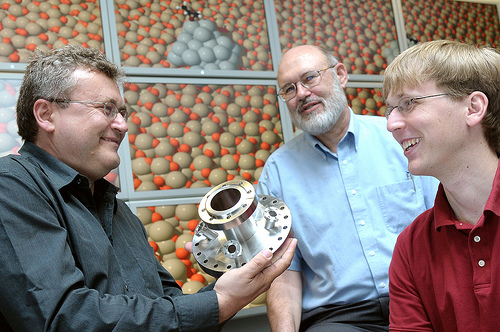 |
| Argonne scientists (from left) Stefan Vajda, Larry Curtiss and Jeff Greeley have developed a new way of creating propylene that eliminates the many environmentally unfriendly by-products. |
Abstract:
Scientists at the U.S. Department of Energy's Argonne National Laboratory have identified a new class of silver-based catalysts for the production of the industrially useful chemical propylene oxide that is both environmentally friendly and less expensive.
Scientists develop green method to produce propylene oxide
Argonne, IL | Posted on April 12th, 2010"The production of propylene oxide has a significant amount of by-products that are harmful to the environment, including chlorinated or peroxycarboxylic waste," said chemist Stefan Vajda of Argonne's Materials Science Division and Center for Nanoscale Materials. "We have identified nanoclusters of silver as a catalyst that produce this chemical with few by-products at low temperatures."
Propylene oxide is commonly used in the creation of plastics and propylene glycols for paints, household detergents and automotive brake fluids.
The study is a result of a highly collaborative team that involved five Argonne divisions and collaborators from the Fritz-Haber-Institut in Berlin and from the University of Illinois at Chicago, including a collaboration between the experimental effort led by Stefan Vajda and the theoretical analysis led by materials chemist Larry Curtiss and nanoscientist Jeff Greeley.
Large silver particles have been used to produce propylene oxide from propylene, but this method suffers from a low selectivity or low conversion to propylene oxide—creating a large amount of carbon dioxide. Vajda discovered that nanoscale clusters of silver, consisting of both three-atom clusters as well as larger clusters of 3.5 nanometers in size, are highly active and selective catalysts for the production of propylene oxide.
Curtiss and Greeley then modeled the underlying mechanism behind why these ultrasmall nanoparticles of silver were so effective in creating propylene oxide. They discovered that the open shell electronic structure of the silver catalysts was the impetus behind the nanoclusters' selectivity.
"Propylene oxide is a building block in the creation of several other industrially relevant chemicals, but the current methods of creating it are not efficient," Curtiss said. "The work opens a new chapter in the field of silver as a catalyst for propene epoxidation."
"This is basically a holy grail reaction," said Greeley.
Funding for this project was provided by the U.S. Department of Energy Office of Science and from the U.S. Air Force Office of Scientific Research. A paper on this work will be published in the April 9 issue of the journal Science.
####
About Argonne National Laboratory
Argonne National Laboratory seeks solutions to pressing national problems in science and technology. The nation's first national laboratory, Argonne conducts leading-edge basic and applied scientific research in virtually every scientific discipline. Argonne researchers work closely with researchers from hundreds of companies, universities, and federal, state and municipal agencies to help them solve their specific problems, advance America 's scientific leadership and prepare the nation for a better future. With employees from more than 60 nations, Argonne is managed by UChicago Argonne, LLC for the U.S. Department of Energy's Office of Science.
The Center for Nanoscale Materials at Argonne National Laboratory is one of five DOE Nanoscale Science Research Centers (NSRCs), premier national user facilities for inter-disciplinary research at the nanoscale, supported by the DOE Office of Science. Together the NSRCs comprise a suite of complementary facilities that provide researchers with state-of-the-art capabilities to fabricate, process, characterize and model nanoscale materials, and constitute the largest infrastructure investment of the National Nanotechnology Initiative. The NSRCs are located at DOE’s Argonne, Brookhaven, Lawrence Berkeley, Oak Ridge and Sandia and Los Alamos National Laboratories. For more information about the DOE NSRCs, please visit nano.energy.gov.
For more information, please click here
Contacts:
Brock Cooper
630/252-5565
Copyright © Argonne National Laboratory
If you have a comment, please Contact us.Issuers of news releases, not 7th Wave, Inc. or Nanotechnology Now, are solely responsible for the accuracy of the content.
Bookmark:


| Related News Press |
News and information
 Simulating magnetization in a Heisenberg quantum spin chain April 5th, 2024
NRL charters Navy’s quantum inertial navigation path to reduce drift April 5th, 2024
Discovery points path to flash-like memory for storing qubits: Rice find could hasten development of nonvolatile quantum memory April 5th, 2024
Chemistry
What heat can tell us about battery chemistry: using the Peltier effect to study lithium-ion cells March 8th, 2024
Nanoscale CL thermometry with lanthanide-doped heavy-metal oxide in TEM March 8th, 2024
Govt.-Legislation/Regulation/Funding/Policy
NRL charters Navy’s quantum inertial navigation path to reduce drift April 5th, 2024
Discovery points path to flash-like memory for storing qubits: Rice find could hasten development of nonvolatile quantum memory April 5th, 2024
Chemical reactions can scramble quantum information as well as black holes April 5th, 2024
Possible Futures
Discovery points path to flash-like memory for storing qubits: Rice find could hasten development of nonvolatile quantum memory April 5th, 2024
With VECSELs towards the quantum internet Fraunhofer: IAF achieves record output power with VECSEL for quantum frequency converters April 5th, 2024
Academic/Education
Rice University launches Rice Synthetic Biology Institute to improve lives January 12th, 2024
Multi-institution, $4.6 million NSF grant to fund nanotechnology training September 9th, 2022
Announcements
NRL charters Navy’s quantum inertial navigation path to reduce drift April 5th, 2024
Discovery points path to flash-like memory for storing qubits: Rice find could hasten development of nonvolatile quantum memory April 5th, 2024
Environment
Billions of nanoplastics released when microwaving baby food containers: Exposure to plastic particles kills up to 75% of cultured kidney cells July 21st, 2023
Alliances/Trade associations/Partnerships/Distributorships
Chicago Quantum Exchange welcomes six new partners highlighting quantum technology solutions, from Chicago and beyond September 23rd, 2022
University of Illinois Chicago joins Brookhaven Lab's Quantum Center June 10th, 2022
Research partnerships
Discovery points path to flash-like memory for storing qubits: Rice find could hasten development of nonvolatile quantum memory April 5th, 2024
Researchers’ approach may protect quantum computers from attacks March 8th, 2024
'Sudden death' of quantum fluctuations defies current theories of superconductivity: Study challenges the conventional wisdom of superconducting quantum transitions January 12th, 2024
 |
||
 |
||
| The latest news from around the world, FREE | ||
 |
||
|
|
||
| Premium Products | ||
 |
||
|
Only the news you want to read!
Learn More |
||
 |
||
|
Full-service, expert consulting
Learn More |
||
|
|
||