Home > Press > Light twists rigid structures in unexpected nanotech finding
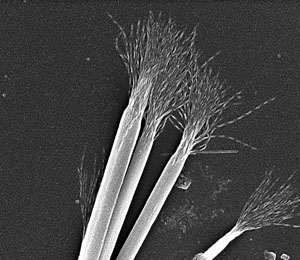 |
| After 72 hours of exposure to ambient light, strands of nanoparticles twisted and bunched together. Credit: Nicholas Kotov |
Abstract:
In findings that took the experimenters three years to believe, University of Michigan engineers and their collaborators have demonstrated that light itself can twist ribbons of nanoparticles.
The results are published in the current edition of Science.
Light twists rigid structures in unexpected nanotech finding
Ann Arbor, MI | Posted on March 17th, 2010Matter readily bends and twists light. That's the mechanism behind optical lenses and polarizing 3-D movie glasses. But the opposite interaction has rarely been observed, said Nicholas Kotov, principal investigator on the project. Kotov is a professor in the departments of Chemical Engineering, Biomedical Engineering and Materials Science and Engineering.
While light has been known to affect matter on the molecular scale—bending or twisting molecules a few nanometers in size—it has not been observed causing such drastic mechanical twisting to larger particles. The nanoparticle ribbons in this study were between one and four micrometers long. A micrometer is one-millionth of a meter.
"I didn't believe it at the beginning," Kotov said. "To be honest, it took us three and a half years to really figure out how photons of light can lead to such a remarkable change in rigid structures a thousand times bigger than molecules."
Kotov and his colleagues had set out in this study to create "superchiral" particles—spirals of nano-scale mixed metals that could theoretically focus visible light to specks smaller than its wavelength. Materials with this unique "negative refractive index" could be capable of producing Klingon-like invisibility cloaks, said Sharon Glotzer, a professor in the departments of Chemical Engineering and Materials Science and Engineering who was also involved in the experiments. The twisted nanoparticle ribbons are likely to lead to the superchiral materials, the professors say.
To begin the experiment, the researchers dispersed nanoparticles of cadmium telluride in a water-based solution. They checked on them intermittently with powerful microscopes. After about 24 hours under light, the nanoparticles had assembled themselves into flat ribbons. After 72 hours, they had twisted and bunched together in the process.
But when the nanoparticles were left in the dark, distinct, long, straight ribbons formed.
"We discovered that if we make flat ribbons in the dark and then illuminate them, we see a gradual twisting, twisting that increases as we shine more light," Kotov said. "This is very unusual in many ways."
The light twists the ribbons by causing a stronger repulsion between nanoparticles in them.
"The twisted ribbon is a new shape in nanotechnology," Kotov said. "Besides superchiral materials, he envisions clever applications for the shape and the technique used to create I it. Sudhanshu Srivastava, a postdoctoral researcher in his lab, is trying to make the spirals rotate."
"He's making very small propellers to move through fluid—nanoscale submarines, if you will," Kotov said. "You often see this motif of twisted structures in mobility organs of bacteria and cells."
The nanoscale submarines could conceivably be used for drug-delivery and in microfluidic systems that mimic the body for experiments.
This newly-discovered twisting effect could also lead to microelectromechanical systems that are controlled by light. And it could be utilized in lithography, or microchip production.
Glotzer and Aaron Santos, a postdoctoral researcher in her lab, performed computer simulations that helped Kotov and his team better understand how the ribbons form. The simulations showed that under certain circumstances, the complex combination of forces between the tetrahedrally-shaped nanoparticles could conspire to produce ribbons of just the width observed in the experiments. A tetrahedron is a pyramid-shaped, three-dimensional polyhedron.
"The precise balance of forces leading to the self-assembly of ribbons is very revealing," Glotzer said. "It could be used to stabilize other nanostructures made of non-spherical particles. It's all about how the particles want to pack themselves."
Other collaborators include researchers from the University of Leeds in the UK, Chungju National University in Korea, Argonne National Laboratory, Pusan National University in Korea and Jiangnan University in China.
The paper is titled Light-Controlled Self-Assembly of Semiconductor Nanoparticles into Twisted Ribbons. The research is funded by the Air Force Office of Scientific Research, the Korea Science and Engineering Foundation and the U.S. Department of Energy.
####
About University of Michigan College of Engineering
Michigan Engineering: The University of Michigan College of Engineering is ranked among the top engineering schools in the country. At $160 million annually, its engineering research budget is one of largest of any public university. Michigan Engineering is home to 11 academic departments and a National Science Foundation Engineering Research Center. The college plays a leading role in the Michigan Memorial Phoenix Energy Institute and hosts the world class Lurie Nanofabrication Facility. Michigan Engineering's premier scholarship, international scale and multidisciplinary scope combine to create The Michigan Difference.
For more information, please click here
Contacts:
Nicole Casal Moore
Phone: (734) 647-7087
Copyright © University of Michigan College of Engineering
If you have a comment, please Contact us.Issuers of news releases, not 7th Wave, Inc. or Nanotechnology Now, are solely responsible for the accuracy of the content.
Bookmark:


| Related News Press |
News and information
 Researchers develop molecular qubits that communicate at telecom frequencies October 3rd, 2025
Next-generation quantum communication October 3rd, 2025
"Nanoreactor" cage uses visible light for catalytic and ultra-selective cross-cycloadditions October 3rd, 2025
Display technology/LEDs/SS Lighting/OLEDs
Spinel-type sulfide semiconductors to operate the next-generation LEDs and solar cells For solar-cell absorbers and green-LED source October 3rd, 2025
Microfluidics/Nanofluidics
Implantable device shrinks pancreatic tumors: Taming pancreatic cancer with intratumoral immunotherapy April 14th, 2023
Researchers design new inks for 3D-printable wearable bioelectronics: Potential uses include printing electronic tattoos for medical tracking applications August 19th, 2022
Oregon State University research pushes closer to new therapy for pancreatic cancer May 6th, 2022
Govt.-Legislation/Regulation/Funding/Policy
New imaging approach transforms study of bacterial biofilms August 8th, 2025
Electrifying results shed light on graphene foam as a potential material for lab grown cartilage June 6th, 2025
Institute for Nanoscience hosts annual proposal planning meeting May 16th, 2025
Possible Futures
Spinel-type sulfide semiconductors to operate the next-generation LEDs and solar cells For solar-cell absorbers and green-LED source October 3rd, 2025
Academic/Education
Rice University launches Rice Synthetic Biology Institute to improve lives January 12th, 2024
Multi-institution, $4.6 million NSF grant to fund nanotechnology training September 9th, 2022
Chip Technology
Lab to industry: InSe wafer-scale breakthrough for future electronics August 8th, 2025
A 1960s idea inspires NBI researchers to study hitherto inaccessible quantum states June 6th, 2025
Programmable electron-induced color router array May 14th, 2025
Nanomedicine
New molecular technology targets tumors and simultaneously silences two ‘undruggable’ cancer genes August 8th, 2025
New imaging approach transforms study of bacterial biofilms August 8th, 2025
Cambridge chemists discover simple way to build bigger molecules – one carbon at a time June 6th, 2025
Electrifying results shed light on graphene foam as a potential material for lab grown cartilage June 6th, 2025
Announcements
Rice membrane extracts lithium from brines with greater speed, less waste October 3rd, 2025
Researchers develop molecular qubits that communicate at telecom frequencies October 3rd, 2025
Next-generation quantum communication October 3rd, 2025
"Nanoreactor" cage uses visible light for catalytic and ultra-selective cross-cycloadditions October 3rd, 2025
Photonics/Optics/Lasers
ICFO researchers overcome long-standing bottleneck in single photon detection with twisted 2D materials August 8th, 2025
Institute for Nanoscience hosts annual proposal planning meeting May 16th, 2025
Research partnerships
Lab to industry: InSe wafer-scale breakthrough for future electronics August 8th, 2025
HKU physicists uncover hidden order in the quantum world through deconfined quantum critical points April 25th, 2025
 |
||
 |
||
| The latest news from around the world, FREE | ||
 |
||
|
|
||
| Premium Products | ||
 |
||
|
Only the news you want to read!
Learn More |
||
 |
||
|
Full-service, expert consulting
Learn More |
||
|
|
||