Home > Press > MIT Commissions Peratech To Develop Next Generation Tactile Robotic Skin
 |
Abstract:
British nanotechnology pioneer develops touch sensitive skin for robots that uses quantum effects
MIT Commissions Peratech To Develop Next Generation Tactile Robotic Skin
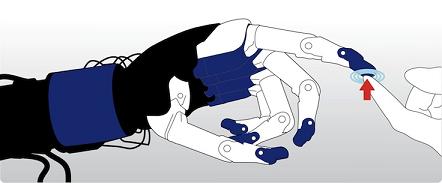
England | Posted on February 22nd, 2010Peratech Limited, the leader in new materials designed for touch technology solutions, has announced that they have been commissioned by the MIT Media Lab to develop a new type of electronic 'skin' that enables robotic devices to detect not only that they have been touched but also where and how hard the touch was.
The key to the sensing technology is Peratech's patented 'QTC' nanotechnology materials. QTC's, or Quantum Tunnelling Composites, are a unique new material type which provides a measured response to force and/or touch by changing its electrical resistance - much as a dimmer light switch controls a light bulb. This enables a simple electronic circuit within the robot to determine touch. Being easily formed into unique shapes - including being 'draped' over an object much like a garment might, QTC's provide a metaphor for how human skin works to detect touch.
Uniquely, QTC's provide a 'proportional' response - in other words detecting 'how hard' they have been touched. Further, using Peratech's patented xy scanning technology, the robot is able to detect where on a matrix of sensors applied to areas such as the forearms, shoulders and torso, it has been touched.
As robotic devices continue to make inroads to our daily life, their ability to understand the presence and interaction with humans and other objects within a space becomes critically important. This research project is hoped to produce results which could soon be applied to a range of robotics projects that MIT works upon.
Peratech's QTC technology has an established track record for use in robotics, having previously been adopted by NASA for their Robonaut device and by Shadow Robot in the UK, producers of what is widely regarded as the World's most advanced robotic hand, which have utilised QTC to sense 'touch'. However, this project with MIT is a World first in enabling a human to interact - through touch across the body of a robot - much as they would with another human.
####
About Peratech
Peratech is the inventor and world leader in Quantum Tunnelling Composite (QTC) technology. Already widely used in robotics and defence, Peratech commercialised its QTC technology at the beginning of 2006 and is currently working with a number of key technology clients who are implementing QTC sensing technology within their own products.
QTC materials give enormous flexibility in the design, shape, thickness and style of a switch or pressure sensor and can be made in a range of elastomeric forms, including emulsive coatings (down to thicknesses of 10 microns), ‘bulk’ silicone or rubber and textile forms. Peratech pioneered the creation of electronic switches made from textiles as early as 2001. QTC has been recognised through numerous International awards and accolades including “Tomorrow’s World Industry Award 2002”, “Saatchi & Saatchi Innovation Award 2000” and “European Electronics Industry Award 2004”.
QTC materials have been used by organisations such as NASA, ILC Dover, Shadow Robotics and numerous government agencies World Wide. Peratech also owns SOFTswitch the pioneering creator of textile switching and Eleksen, the world leader in touch sensitive interactive textiles for electronics interface design. Further information is available from www.peratech.com
About QTC
QTC's are electro-active polymeric materials made from metallic or non-metallic filler particles combined in an elastomeric binder. These enable the action of 'touch' to be translated into an electrical reaction, enabling a vast array of devices to incorporate very thin and highly robust 'sensing' of touch and pressure. QTC’s unique properties enable it to be made into force sensitive switches of any shape or size. QTC switches and switch matrices can be screen printed allowing for development and integration of switches that are as thin as 75 microns.
QTC is also low power and interfaces can be designed with no start resistance so that without pressure, the switch draws no power and passes no current. Importantly, when pressure is applied, the resistance drops in proportion to the amount of pressure which allows sophisticated human machine interface designs that react to variations in pressure. QTC technology has no moving parts and requires no air gap between contacts. This makes it extremely reliable and suitable for integration into the thinnest electronic designs and with industry leading operational life.
About MIT
Massachusetts Institute of Technology is based in Cambridge, Massachusetts, USA. www.mit.edu
For more information, please click here
Contacts:
Peratech Limited, Old Repeater Station, Brompton-on-Swale, North Yorkshire, DL10 7JH United Kingdom. Tel: +44 (0) 8700 727272
Fax: +44 (0) 8700 727273
For interviews, further information or illustrations, please contact
Nigel Robson, Vortex PR
Island House, Forest Road, Forest, Guernsey, GY8 0AB, United Kingdom
Int. Tel: +44 1481 233080
UK Tel: 01481 233080
www.vortexpr.com
Copyright © Peratech
If you have a comment, please Contact us.Issuers of news releases, not 7th Wave, Inc. or Nanotechnology Now, are solely responsible for the accuracy of the content.
Bookmark:


| Related News Press |
News and information
 Simulating magnetization in a Heisenberg quantum spin chain April 5th, 2024
NRL charters Navy’s quantum inertial navigation path to reduce drift April 5th, 2024
Discovery points path to flash-like memory for storing qubits: Rice find could hasten development of nonvolatile quantum memory April 5th, 2024
Possible Futures
Discovery points path to flash-like memory for storing qubits: Rice find could hasten development of nonvolatile quantum memory April 5th, 2024
With VECSELs towards the quantum internet Fraunhofer: IAF achieves record output power with VECSEL for quantum frequency converters April 5th, 2024
Announcements
NRL charters Navy’s quantum inertial navigation path to reduce drift April 5th, 2024
Discovery points path to flash-like memory for storing qubits: Rice find could hasten development of nonvolatile quantum memory April 5th, 2024
Alliances/Trade associations/Partnerships/Distributorships
Chicago Quantum Exchange welcomes six new partners highlighting quantum technology solutions, from Chicago and beyond September 23rd, 2022
University of Illinois Chicago joins Brookhaven Lab's Quantum Center June 10th, 2022
Quantum nanoscience
Simulating magnetization in a Heisenberg quantum spin chain April 5th, 2024
Optically trapped quantum droplets of light can bind together to form macroscopic complexes March 8th, 2024
Bridging light and electrons January 12th, 2024
'Sudden death' of quantum fluctuations defies current theories of superconductivity: Study challenges the conventional wisdom of superconducting quantum transitions January 12th, 2024
 |
||
 |
||
| The latest news from around the world, FREE | ||
 |
||
|
|
||
| Premium Products | ||
 |
||
|
Only the news you want to read!
Learn More |
||
 |
||
|
Full-service, expert consulting
Learn More |
||
|
|
||