Home > Press > Enhanced photoreception with nanochip
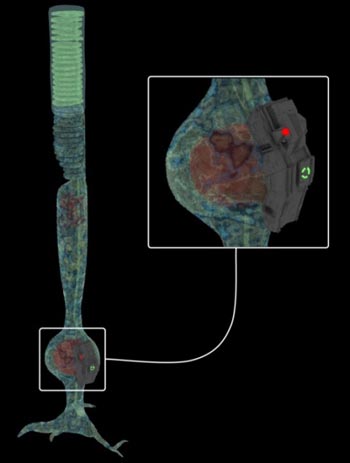 |
| Neurochip on the rod cell |
Abstract:
Nanobotmodels creates artwork for nanoscale technologies
Enhanced photoreception with nanochip
Ukraine | Posted on February 18th, 2010Rod cells, or rods, are photoreceptor cells in the retina of the eye that can function in less intense light than can the other type of photoreceptor, cone cells. Named for their cylindrical shape, rods are concentrated at the outer edges of the retina and are used in peripheral vision. There are about 90 million rod cells in the human retina. More sensitive than cone cells, rod cells are almost entirely responsible for night vision.
But we can improve rod's photodetection work using molecular nanotechnology. For instance, nanochip, which store, process and transmit information about rod biochemical state, will be very useful.
Moreover, it can add some useful information into our eyesight field working as a augmented reality tool.
It also can transmit data directly to hub, which connect thousand of individual neurochip. This hub can store and process data about any light signature, formed in our retina.
Humanity can use this nano-tools as implanted video recorders, which will save "videodata" from entire human life, starting from it beginning. Crime prevention will be turned on new, efficient and radical stage.
Model designed by Svidinenko Yuriy.
####
About Nanobotmodels
Our company Nanobotmodels (www.nanobotmodels.com) was founded in 2007 and it goal is develop modern art-science-technology intersections. Nanotechnology boost medicine, engeneering, biotechnology, electronics soon, so artwork and vision of the nanofuture will be very useful.
Our team consist of modern artists, modellers and nanotechnology scientists.
For more information, please click here
Contacts:
common questions:
sales and image permissions:
Svidinenko Yuriy
Nanobotmodels Company CEO
Phone: +38 (096) 470 41 66
Copyright © Nanobotmodels
If you have a comment, please Contact us.Issuers of news releases, not 7th Wave, Inc. or Nanotechnology Now, are solely responsible for the accuracy of the content.
Bookmark:


| Related News Press |
News and information
 Simulating magnetization in a Heisenberg quantum spin chain April 5th, 2024
NRL charters Navy’s quantum inertial navigation path to reduce drift April 5th, 2024
Discovery points path to flash-like memory for storing qubits: Rice find could hasten development of nonvolatile quantum memory April 5th, 2024
Nanomedicine
New micromaterial releases nanoparticles that selectively destroy cancer cells April 5th, 2024
Good as gold - improving infectious disease testing with gold nanoparticles April 5th, 2024
Researchers develop artificial building blocks of life March 8th, 2024
Announcements
NRL charters Navy’s quantum inertial navigation path to reduce drift April 5th, 2024
Discovery points path to flash-like memory for storing qubits: Rice find could hasten development of nonvolatile quantum memory April 5th, 2024
 |
||
 |
||
| The latest news from around the world, FREE | ||
 |
||
|
|
||
| Premium Products | ||
 |
||
|
Only the news you want to read!
Learn More |
||
 |
||
|
Full-service, expert consulting
Learn More |
||
|
|
||